

Overview
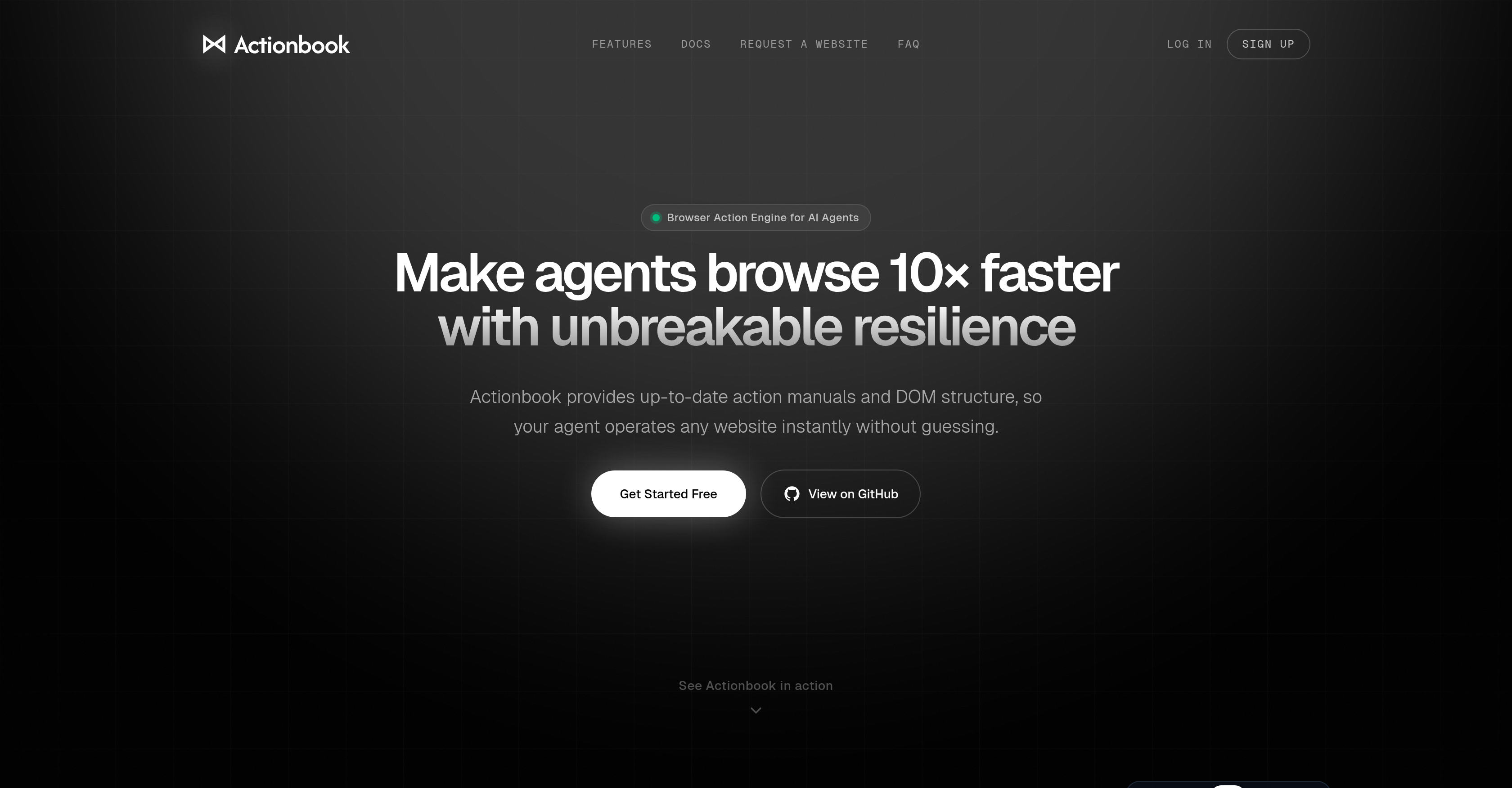
- Eliminate guesswork and failed interactions on complex websites with precise action manuals and verified DOM selectors that ensure your agent clicks and types correctly every time.
- Handle modern web apps like React, Vue, and Next.js without breaking, thanks to resilient design that manages virtual DOM updates, streaming content, and dynamic SPAs.
- Drastically reduce token consumption and latency by providing agents with only the necessary, actionable DOM structure instead of forcing them to analyze entire page layouts.
- Integrate seamlessly into your existing stack, as it's model-agnostic and works with any LLM, agent framework, or browser automation tool you already use.
- Replace brittle HTML scraping with executable actions, focusing on reliable interaction with dynamic page elements rather than just returning raw text.
Pros & Cons
Pros
- Operates websites efficiently
- Updated DOM structure
- Action manuals provided
- Reduces guesswork in navigation
- Direct information and element interaction
- Resilient design
- Handles dynamic pages
- Compatible with complex DOM trees
- Accommodates streaming content
- Works with React, Vue, Next.js
- Precise DOM targeting
- Universal compatibility
- Integration with any LLM
- Compatible with any agent framework
- Compatible with browser automation tools
- Focuses on executable actions
- Handles dynamic page layouts
- Integrations with pre-existing tools
- Not model or framework specific
- Handling of virtual DOM updates
- Accommodates Single Page Applications
- Significant token savings
- Verified selectors for accuracy
- Faster browsing process
- Robust resilience
- Avoids need to analyze page structures
- Works where traditional scraping fails
- One integration, endless possibilities
- Eliminates traditional approach for dynamic pages
- Accurate DOM structure targeting
- Suitable for dynamic pages disruption
- Adapts to complex DOM trees
- Operates websites without guessing selectors
- Focuses on action over scraping
- Offers contemporary action manuals
- Seamless and instant website operation
- Resilient to layout changes
- Handle streaming interfaces
- Model agnostic
- Framework agnostic
Cons
- Limited to browser action
- Potential DOM parsing issues
- Dependent on page updates
- No built-in scraping features
- Requires integration with LLM
- Sophisticated setup
- Not suitable for non-dynamic pages
- Performance impacts on complex pages
- Resource inefficient for static pages
- No direct raw data access
Reviews
Rate this tool
Loading reviews...
❓ Frequently Asked Questions
Actionbook is a browser action engine designed specifically for AI agents to handle websites more efficiently and effectively. Its purpose is to provide the agents an updated DOM (Document Object Model) structure and action manuals, thereby reducing guesswork often associated with navigating website structures.
Actionbook manages dynamic website elements through a resilient design that enables it to effectively handle dynamic pages, complex DOM trees, and streaming content. This allows it to stay compatible with modern web applications and ensure accurate website element targeting, even in dynamically changing environments.
The primary point of difference between Actionbook and traditional HTML scraping tools lies in their focus areas. While most HTML scraping tools concentrate on returning raw page text, Actionbook focuses more on executable actions. It is designed to perform actions like clicking and typing and understands how web page elements are connected, offering more practical and interactive website engagement.
Yes, Actionbook can seamlessly integrate with any Language Model (LLM). It has been designed with universal compatibility, offering wide-ranging and flexible integration possibilities.
Yes, Actionbook supports modern web applications such as React, Vue, and Next.js. Its design and functionalities have been finely tuned to handle dynamic pages, including those where layouts, Virtual DOM updates, and streaming interfaces may disrupt regular automation.
Actionbook is incredibly efficient in terms of resource usage. By providing precise action manuals and updated DOM structure, it eliminates the need for AI agents to spend unnecessary resources in analyzing complete page structures, leading to considerable savings.
Actionbook's DOM targeting is exceptional, ensuring that AI agents hit the right website element every time. By providing the relevant DOM structure and verified selectors, Actionbook removes any guesswork involved in targeting the correct elements on a webpage.
Yes, Actionbook is designed to handle streaming content. One of its defining characteristics is its resilience, which enables it to manage dynamic pages, complex DOM trees, and streaming content, making it especially beneficial for modern, constantly-updating websites.
No, Actionbook is not dependent on any particular model or framework. This is one of Actionbook’s strengths as it supports integrations with a multitude of pre-existing tools, making it adaptable to various settings and requirements.
Actionbook enhances efficiency in website operations by reducing the guesswork often tied to navigating website structures. It provides AI agents with up-to-date action manuals and DOM structures, removing the need for agents to spend excessive resources analyzing entire webpage structures.
Actionbook's approach to browser automation involves providing AI agents with an updated DOM structure and action manuals. This methodology speeds up operations and ensures accurate element targeting, allowing agents to interact and complete tasks efficiently on a website.
Yes, Actionbook is designed to handle complex DOM trees efficiently. This ability is built-in by design, allowing it to manage dynamically changing pages and components without breaking, thus presenting a level of unmatched resilience in handling web content.
Actionbook reduces guesswork in website navigation by providing AI agents with updated action manuals and DOM structures. This gives the agent clear instruction on what actions to perform and which elements to interact with, eliminating the need to guess website functions, selectors or page flows.
Yes, you can integrate Actionbook with your pre-existing tools. Actionbook is not tied to one particular model or framework and thus supports integrations with various tools, providing a highly adaptable solution to varying needs and requirements.
The updated DOM structure provided by Actionbook benefits AI agents by offering a precise and up-to-date understanding of the website. This enables them to interact directly with the necessary information and elements without wasting resources on analysing the entire page structure.
Actionbook’s resilience is designed to keep agents functional and efficient, even in challenging digital landscapes. Its resilience is highlighted through its ability to handle dynamic pages, complex DOM trees, and streaming content that can often disrupt traditional approaches to website interaction.
The main features of Actionbook include unbreakable resilience, precise DOM targeting, universal compatibility, highly efficient resource utilization, support for modern web applications, and management of dynamic web structures.
Actionbook ensures compatibility with various agent frameworks or browser automation tools through its design philosophy of universal compatibility. It is not tied to any single model or framework and thus integrates freely with any tool, providing ample flexibility in different settings and requirements.
Yes, Actionbook supports Virtual DOM updates. Its design is intended to manage dynamic pages where layouts, Virtual DOM updates, and streaming interfaces can often disrupt brittle automation.
Yes, Actionbook is designed to adapt to various settings and requirements. It is not restricted to a single model or framework, allowing it to integrate with pre-existing tools and adjust based on changing needs and demands.
Actionbook is specifically designed for AI agents to operate websites more efficiently and with greater resilience. It provides updated DOM structure and action manuals, eliminating the guesswork usually associated with navigating website structures.
Actionbook differs from HTML scraping tools in its focus on executable actions rather than just returning raw page text. It is especially designed for handling dynamic pages, even those where layouts, Virtual DOM updates, and streaming interfaces may disrupt brittle automation.
DOM structure refers to the Document Object Model (DOM), which is the data representation of the objects that comprise the structure and content of a web document. Actionbook provides AI agents with an updated DOM structure, enabling them to interact with the necessary information and elements directly.
Actionbook deals with dynamic pages by reducing the guesswork tied to navigating website structures. It's resilient by design, which allows it to handle dynamic pages, complex DOM trees, and streaming content. This compatibility extends to modern web applications like React, Vue, and Next.js.
Yes, Actionbook can handle modern web applications. Its resilience by design allows it to deal with dynamic pages, complex DOM trees, and streaming content, making it compatible with modern web applications like React, Vue, and Next.js.
DOM targeting, in the context of Actionbook, refers to precise aiming at the correct website element every time. It ensures that AI agents interact with the necessary information and elements directly without having to understand entire page structures.
Yes, Actionbook can be integrated with any Language Model (LLM). It offers universal compatibility, meaning it can work alongside any agent framework or browser automation tool.
'Universal compatibility', in the context of Actionbook, refers to the tool's ability to be integrated with any Language Model (LLM), any agent framework, or any browser automation tool. This gives it a vast range of integration possibilities.
Actionbook can save token values by eliminating the need for AI agents to spend resources analyzing entire page structures. By providing an updated DOM structure and action manuals, agents can get straight to action, resulting in significant token savings.
Actionbook can handle a wide variety of pages, including those that are dynamic in nature. Its design allows it to comfortably manage complex DOM trees, streaming content, and even modern web applications like React, Vue, and Next.js.
Actionbook is both model agnostic and framework agnostic. This means it can be paired with any preferred Low-Level Machine (LLM), agent framework, and browser automation tooling.
Actionbook's approach in handling Virtual DOM involves the capability to keep up with dynamic changes like Virtual DOM updates that often disrupt brittle automation. It can handle virtual DOM, streaming components, and even Single Page Applications (SPAs), where traditional scraping fails.
Actionbook increases the efficiency of web scraping by providing executable actions instead of just returning raw page text. This eliminates the need for AI agents to spend resources decoding the full page structure, allowing them to interact with necessary information directly and more economically.
Yes, Actionbook can be integrated into any browser automation tool. It has universal compatibility, giving it diverse integration possibilities.
Actionbook ensures resilience by design through its ability to handle dynamic pages, complex DOM trees, and streaming content. By offering updated action manuals and DOM structure, it helps AI agents to operate any website instantly, making it significantly more resistant to disruption.
Actionbook handles streaming content by being resilient by design. It's capable of dealing with dynamic pages, complex Document Object Model trees, and streaming content that might cause issues in traditional automation tools.
'Precise DOM Targeting' in Actionbook refers to its ability to provide relevant DOM structure and verified selectors. This ensures that AI agents hit the correct website element every time, eliminating any guesswork.
Actionbook is framework-agnostic, meaning there isn't a specific agent framework that works best with it. Its universal compatibility allows it to be integrated with any agent framework, giving users a wide range of possible configurations to suit their specific needs and requirements.
Actionbook supports multiple integrations through its universal compatibility. It works with any Low-Level Machine (LLM), any agent framework, and any browser automation tool, providing virtually limitless integration possibilities.
Yes, Actionbook can handle Single Page Applications (SPAs). It can operate efficiently even with modern web applications due to its capability of managing virtual DOM, streaming components, and SPAs where traditional scraping methods fail.
Pricing
Pricing model
Pricing
Paid options from
N/A