
AppDeploy
Overview
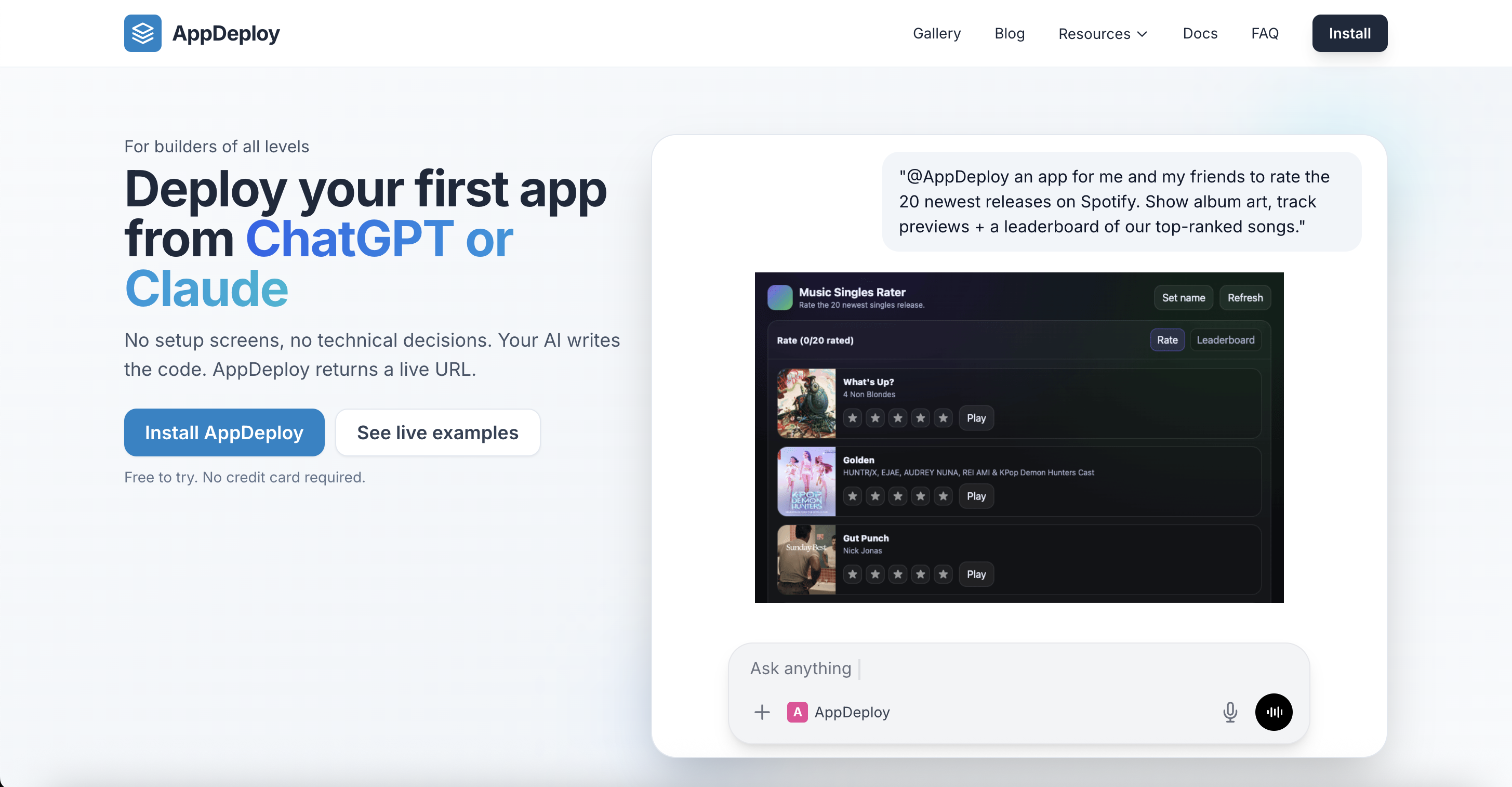
- Launch a live, functional app from an AI chat description in under a minute, with no setup screens or technical decisions required.
- Get a production-ready app with managed cloud hosting, database, user authentication, and file storage automatically configured and scaled.
- Instantly roll back to a previous stable version if a deployment fails, protecting your live application from errors.
- Receive visual bug reports directly in your chat interface, enabling quick identification and resolution of issues without digging through logs.
- Track real-time deployment status and debug logs for complete visibility and control over your app's launch and updates.
- Iterate on your live app instantly by describing changes in chat and redeploying, allowing for rapid refinement based on feedback.
Pros & Cons
Pros
- Deploys directly from ChatGPT and Claude
- Hosted on scalable cloud infrastructure
- Database and storage setup
- Automatic setup of app components
- Visual bug reports
- Instant version rollbacks
- Live deployment status tracking
- No technical decisions from user
- Live URL provision
- Supports creating diverse apps
- Managed cloud hosting
- Secure secrets management
- User login and authentication
- Real-time user sync
- Background tasks and notifications setup
- Supports real deployments
- Accessible to non-coders
- Supports MCP-compatible platforms
- Free to try
- No credit card required
- No hosting provider choice needed
- No setup screens
- User-friendly design
- Speedy and efficient deployment
- Handles user login & authentication
- Simplifies app development process
- Handling of error and complexities
- Generates live URL
- Compatibility with Codex and Cursor
- Cloud hosting feature
- Supports non-coders
- Real-time synchronization
- Platformer Quest
- Simple installation process
- No need for hosting knowledge
- Can deploy apps from ChatGPT
- Can deploy apps from Claude
- Can deploy apps from Codex
- Interactive chat interface
- Automatic secret management
- Can deploy apps from Cursor
- UI-less deployment
- Automatic backend essentials setup
- Supports app variety and flexibility
- Deploys real applications
- Adjustable scaling
- Streamlines app deployment
- Codes automatically generated
- Allows live balance updates
- Offers autonomous E2E QA
Cons
- User chat interface required
- Limited to app development
- Possible coding knowledge requirement
- No user control over hosting
- No integration with own databases
- Limited storage setup options
- No technical decision making
- Cloud hosting only
Reviews
Rate this tool
Loading reviews...
❓ Frequently Asked Questions
AppDeploy is a tool that simplifies the application deployment process by leveraging AI. It allows users to instruct an AI, such as ChatGPT or Claude, to write the necessary code for the application that they want to build. Once the code is prepared, the tool deploys the application and provides a live URL. Contrary to traditional methods, it requires no setup screens or technical decisions from the user.
AppDeploy works by facilitating AI-based coding. When the user describes the application they want to build via chat, AI tools like ChatGPT or Claude interpret these descriptions and write the subroutine. When the script is ready, AppDeploy deploys the application and renders a live URL.
No, AppDeploy does not require any setup screens or technical decisions from the user. The tool is designed to simplify the application deployment process, therefore, it removes the requirement for any setup or technical decision-making by the user.
There is a wide range of applications that can be created with AppDeploy. For example, users have built apps ranging from a music rating application for Spotify releases to a bakery pre-order app or an expense splitter for trips.
AppDeploy manages all the necessary application components during deployment, including managed cloud hosting, database and file storage, secure secrets management, user login and authentication, background tasks, notifications, and real-time user synchronization.
AppDeploy offers several unique features. Some of these include visual bug reports, instant version rollbacks, and real-time deployment status tracking. These features aim to make the app development and deployment process more convenient and effective.
Yes, AppDeploy supports real deployments that users can iterate on. It's not just for demos; it's designed for developing and deploying functional, live applications.
AppDeploy can be used directly with AI tools like ChatGPT and Claude. These AI tools write the necessary code based on the instructions given by the user.
Yes, after the application is deployed, AppDeploy provides a live URL for instant access to the newly created application.
Yes, AppDeploy offers instant version rollbacks. This feature allows users to safely navigate back to a previous version of an application, enhancing the flexibility and control over its development.
AppDeploy handles managed cloud hosting as a part of deployment. It serves content where the users are, hence eliminating the need for users to manage or set up hosting providers.
AI plays a substantial role in AppDeploy by writing the necessary code for the application based on the instructions given by the user. This drastically simplifies the application development process and reduces the reliance on technical expertise from the user's end.
Yes, AppDeploy can handle user login and authentication as part of the automatic setup of app components during deployment. This feature allows users to focus on their product, rather than the details of secure user access.
AppDeploy handles both database and file storage. The tool automatically sets up these backend essentials as part of the application deployment process.
The process of deploying an app from ChatGPT or Claude with AppDeploy is straightforward. Users only need to instruct their preferred AI tool to write the necessary code for their application in a chat. AppDeploy deploys the application and returns a live URL once the code is ready.
AppDeploy manages notifications and background tasks automatically as part of the deployment process. This facilitates efficient app operation and communication between the app and the user.
Yes, AppDeploy is free to try. However, details about the detailed pricing structure beyond the trial period may vary.
No, you do not need to be a coder to use AppDeploy. If the user can accurately describe the app they want, AppDeploy, along with AI tools like ChatGPT and Claude, can build and deploy the app for them.
Yes, AppDeploy can be used to build an app for Spotify integration. It has been used to create music rating apps for Spotify releases as an example.
Yes, one of the features AppDeploy offers to users is visual bug reports. These reports are sent directly through chat, helping users identify and address any issues with their applications quickly and efficiently.
The deployment process on AppDeploy is streamlined and user-friendly. The user first adds AppDeploy to their preferred AI tool like ChatGPT or Claude once. The user then describes to the AI tool what kind of application they want to build, which writes the code. Once the code is ready, the AI calls AppDeploy to deploy it. AppDeploy then returns a live URL within a minute. Notably, AppDeploy handles all necessary deployment aspects, such as managed cloud hosting, database and file setups, user login and authentication, and real-time user sync, without the need for advanced user intervention.
AppDeploy is compatible with several AI platforms. It is explicitly designed to integrate with AI platforms like ChatGPT and Claude. In addition to these, AppDeploy also supports other MCP-compatible platforms, including Codex and Cursor.
With AppDeploy, users can create a wide variety of applications. Examples showcased on their website include a music rating application for Spotify releases, a bakery pre-order application, and an expense splitter for trips. The type of app that can be created depends on the user's instructions given to the AI platforms.
AppDeploy is designed to be user-friendly and is suitable for builders of all levels, including beginners. Although coding knowledge can enhance the speed and efficiency of app deployment, it is not essential to use the tool. AppDeploy removes a lot of the usual complexity associated with app deployment, making it accessible to non-coders.
Examples of apps created with AppDeploy include a bakery pre-order app, a platformer game, and an expense splitter app for trips. The bakery pre-order app showcases baked goods and provides services like order tracking and sales tools. The platformer game includes different features like enemy patrols, coin collection, and sound effects. The expense splitter offers progress tracking until everyone is even, live balance updates, and other useful features.
AppDeploy handles hosting automatically as part of its deployment process. It employs managed cloud hosting, removing the need for users to choose a hosting provider. This approach also ensures that the content is served where the users are.
User login and authentication on AppDeploy are set up automatically during the deployment of an application. This feature facilitates a secure environment for user data and access management, simplifying another layer of app development for users.
Yes, AppDeploy provides assistance with bug reports. It integrates an autonomous end-to-end quality assurance system that sends visual bug reports to the chat. This allows users to quickly identify potential issues and remedies.
Yes, AppDeploy has a built-in feature for instant version rollbacks. In case of an error or failed deployment, users can roll back to an earlier saved version of their application, ensuring that work is never lost and the version available to the end-users is stable.
Yes, AppDeploy provides real-time tracking of deployment status. Users can track live deployment status and debug logs, ensuring they have full visibility and control over the deployment process, which contributes to a more efficient and smooth experience.
Yes, AppDeploy allows for iteration on deployments. Users can make changes and redeploy instantly, greatly facilitating the process of improving and refining the application in response to user feedback or changing requirements.
AppDeploy incorporates robust features for handling database setup and file storage. It sets them up automatically as part of deployment. Users don't need to worry about setup or management, freeing them to focus on other aspects of their product.
Installing AppDeploy on popular AI platforms like ChatGPT and Claude is a hassle-free process. Each platform has a setup guide provided that directs the user through the installation process, which typically only takes a couple of minutes to complete.
Yes, AppDeploy provides live URLs for the apps it deploys. A live URL is generated as part of the deployment process, meaning your application is ready to go live as soon as it has been deployed.
To use AppDeploy, users don't need a high level of technical knowledge. While having some coding knowledge can enhance the speed and efficiency of deployment, it is not a prerequisite. The tool is designed in a user-friendly manner that allows non-coders to develop and deploy applications.
Yes, the cloud infrastructure used by AppDeploy is scalable. It uses a scalable cloud hosting service as part of the deployment process, ensuring that the app's hosting resources can handle user demand, whether it's high or low.
AppDeploy has a 'free to try' pricing model. The users don't need a credit card to deploy their first app. Details about subsequent usage aren't specified, but it's suggested that AppDeploy's use might require some form of payment after the initial free usage.
Pricing
Pricing model
Free
Paid options from
Free