

Figma Make
Overview
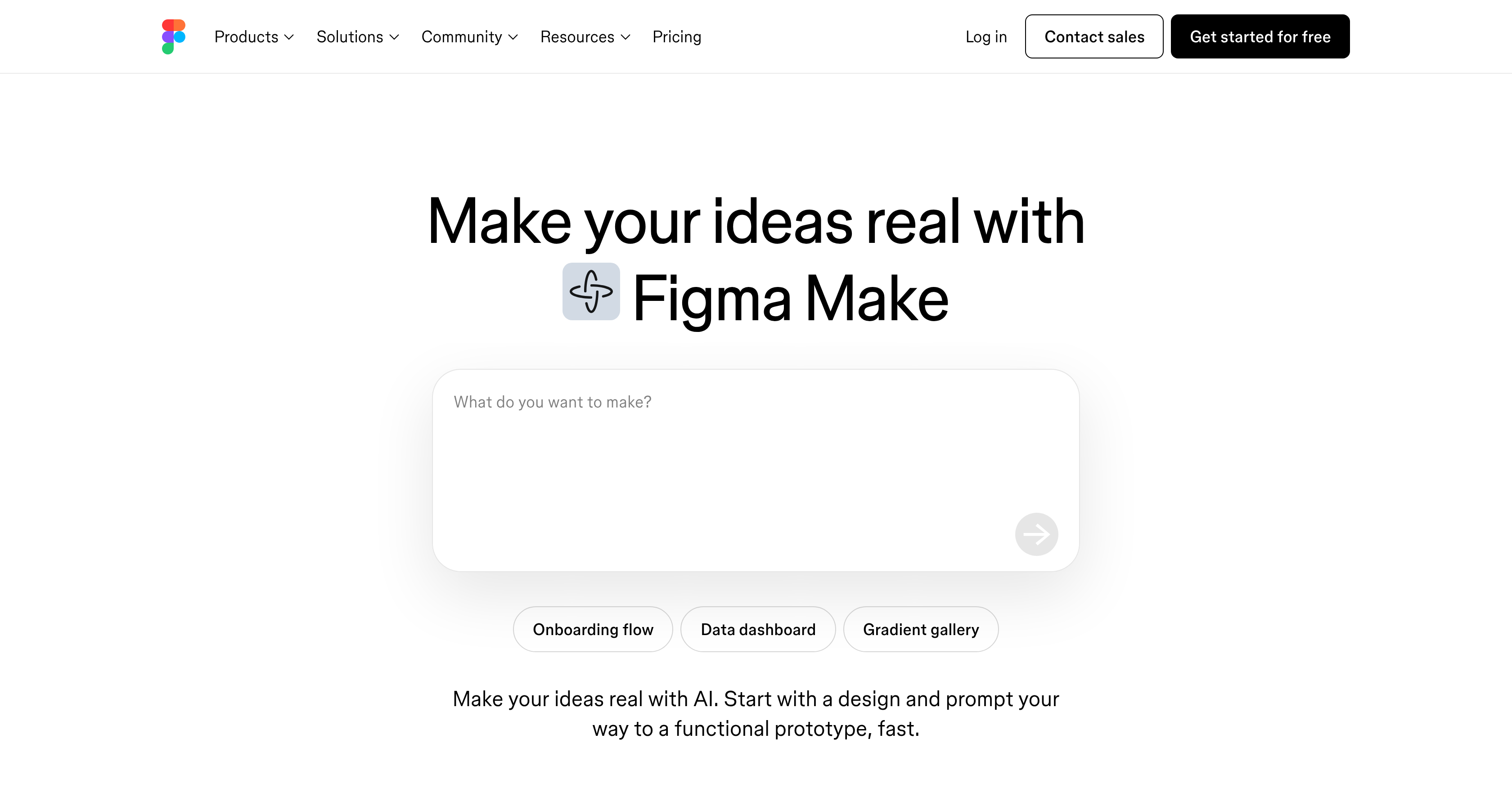
- Transform design concepts into live web applications without writing code by connecting directly to tools like Supabase for authentication and data storage.
- Rapidly generate and refine high-fidelity prototypes from initial drafts using AI suggestions, even without design or coding experience.
- Maintain visual consistency across projects by applying styling context from your existing Figma library directly within the AI-assisted workflow.
- Directly edit every AI output—rewrite copy, swap images, and adjust spacing—to ensure the final design matches your exact vision.
- Seamlessly test and publish interactive designs by integrating with Figma Sites to customize, preview, and launch your work.
Pros & Cons
Pros
- Create and prototype feature
- Iterative design facilitation
- High-fidelity prototypes development
- Customization of designs
- No coding knowledge required
- Supabase integration for app development
- Seamless other Figma products integration
- Geared towards diverse design types
- Interactive design capability
- Design to code feature
- Supports design testing and publishing
- Facilitates drafting of ideas
- Collaborative design experience
- Easy transformation of design to apps
- UX design facilitation
- Web design and wireframing geared
- Prototyping design tool
- Design system focussed
- Integrated with Figma community
- Suitable for beginners and professionals
- Empowers non-technical design refinement
- Prompt to code functionality
Cons
- Limited to Figma ecosystem
- Dependent on Supabase integration
- Limited customization options
- High learning curve
- No offline mode
- No direct coding capability
- Potentially narrow design diversity
- Lack interoperability with other software
- Strictly web-based
Reviews
Rate this tool
Loading reviews...
❓ Frequently Asked Questions
Figma Make is an AI-powered design tool that allows its users to transform their ideas into reality. It offers a unified creative space where users can draft, iterate, generate, and build their designs efficiently and quickly. It is primarily intended for tasks such as design systems, prototyping, UX design, web design, and wireframing. Figma Make also has a prompt to code feature that facilitates the creation of anything you can imagine.
AI powers Figma Make by offering intelligent suggestions and automating certain parts of the design process. The AI in Figma Make allows users, even those without specific design or coding experience, to refine a design based on its suggestions. It also assists in modifying its outputs to fit the user's needs, such as adjusting the text, swapping images, or fine-tuning the spacing.
Figma Make offers a multitude of features that facilitate the entire design process. It helps users draft out their ideas, and then rapidly iterate and build those ideas within a single creative space. It has a feature that refines designs based on AI suggestions, even if the user lacks specific design or coding skills. The platform also allows the users to collaborate with the AI and modify its outputs directly like adjusting text, substituting images, or fine-tuning the space. Figma Make can connect to external tools like Supabase to convert design concepts into functional web apps.
Figma Make offers extensive customization capabilities. Users can guide the AI as it brings their unique designs to life. They have the option to edit the AI's outputs directly, such as adjusting copy, replacing images, or changing padding and margins. It also allows users to keep everything visually consistent with their design system by adding styling context from their Figma library.
Figma Make has a feature that refines designs based on AI suggestions. It allows users, even if they don't hold specific design or coding knowledge, to fine-tune their designs by selecting parts of the design they want to refine and prompting the AI to change the appearance.
Yes, you can edit the outputs of Figma Make. It allows users to collaborate with the AI and directly modify its outputs, such as rewriting copy, replacing images, or adjusting padding and margins.
Figma Make facilitates AI collaboration by allowing users to directly modify the AI's outputs to better meet their needs. This includes the flexibility to rewrite text, replace images or adjust spacing. Even without specific design or coding skills, users can refine their designs with AI suggestions. It offers an intuitive interface for users to interact and collaborate with the AI-generated designs.
The Supabase integration in Figma Make allows users to connect their design concepts to Supabase, a realtime and RESTful API and Postgres database. This enables the transformation of design concepts into working web applications.
The benefits of Supabase integration in Figma Make include the capability to turn design concepts into functional web applications without requiring coding skills. Supabase provides additional functionalities like user authentication, data storage, connecting to private APIs, and more. In essence, the Supabase integration simplifies the process of building web applications from design concepts.
Figma Make integrates with other Figma products to provide a seamless design experience. You can incorporate the power of Figma Make into Figma Sites to easily customize your website, test interactions, and publish. Selected frames in Figma Sites can be brought to life with Figma Make.
Yes, Figma Make is ideally suited for UX design and prototyping. The platform is designed to support and streamline these pivotal aspects of the design process. It allows users to rapidly generate, iterate, and build their design ideas, all within one unified creative space.
With Figma Make, you can create a wide variety of designs. This includes, but is not limited to, design systems, prototypes, UX designs, web designs, and wireframes. Figma Make is equipped with features that enable the creation and iteration of any design idea you can imagine.
No, Figma Make does not require programming skills. One of its greatest advantages is its user-friendly and intuitive design interface that allows anyone to create and refine designs based on AI suggestions. Its capability to transform a design concept into a functional web app with tools like Supabase also doesn't require coding knowledge.
Figma Make turns design concepts into functional web apps by connecting to tools like Supabase. With this integration, users can transform their ideas into web apps ready to go live, without requiring any coding skills. This process includes options to add user authentication, store user data, and even connect private APIs.
You can publish designs of all types with Figma Make. Owing to its extensive feature set and seamless integration with other Figma products, Figma Make allows you to enhance, test, and publish designs, whether it is for design systems, UX designs, web designs, or wireframes.
Yes, Figma Make can assist you in drafting ideas. It provides an all-in-one creative space that facilitates the initial conceptualization and drafting phase of your design process. Through AI suggestions, even those without specific design or coding experience can refine their initial concepts.
Figma Make supports iterative design by allowing users to rapidly generate, refine, and reconstruct their designs directly on the platform. It has a feature that refines designs based on AI suggestions, thus helping in the iterative process. Also, its capability to directly edit AI outputs aids in fast and efficient iterations.
Yes, Figma Make can generate high-fidelity prototypes. It offers design tools—powered by AI—that facilitate the development of high-fidelity prototypes. With Figma Make, users can explore every big, wild, wacky, and tiny idea and create high-fidelity prototypes to help everyone see their vision.
Figma Make offers the ability to interactively design in a virtual space. Users can collaborate with the AI, directly edit its outputs, and further iterate on designs within Figma Design. This enhances both the design and prototyping experience, making it more interactive and user-friendly.
Figma Make can assist you with wireframing tasks by facilitating the rapid generation of detailed wireframes. The AI-powered design tools allow users to create and refine wireframes based on AI suggestions. You can visually map out the design structure and interface of your projects, making wireframes easier and more efficient to create.
Pricing
Pricing model
Freemium
Paid options from
$3/month
Billing frequency
Monthly
Related Videos
Figma Make
Design Champs•12.2K views•Jan 20, 2026