

General Compute
Overview
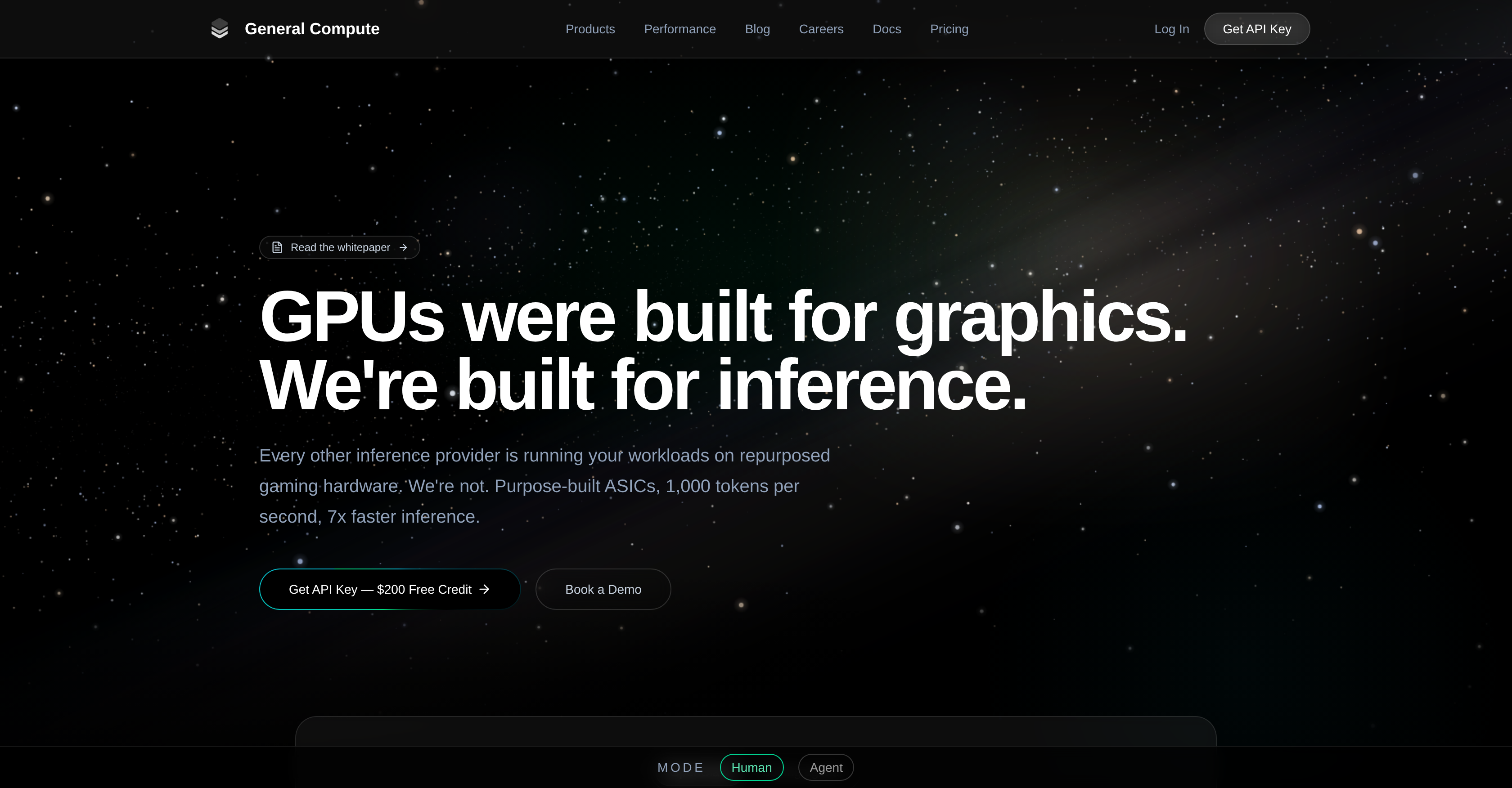
- Deliver real-time AI responses with sub-millisecond time to first token (TTFT) using purpose-built ASICs designed specifically for inference tasks.
- Cut operational costs by up to 85% through energy-efficient hardware that uses only 17 kW per rack versus 120 kW for equivalent GPU systems.
- Deploy any model instantly without code rewrites using the OpenAI-compatible REST API – just swap the base URL and API key.
- Scale AI workloads with guaranteed capacity and custom scaling through dedicated infrastructure backed by Service Level Agreements (SLAs).
- Achieve high throughput for production-grade applications by leveraging hardware architected exclusively for AI inference, not repurposed gaming GPUs.
- Maintain full control over model deployment on optimized infrastructure that eliminates legacy GPU architecture inefficiencies.
Pros & Cons
Pros
- Sub-millisecond TTFT
- High Inference Throughput
- Purpose-built ASICs utilization
- Enables custom deployments
- Ease of Integration
- Eliminates GPU dependence
- Energy and Cost Efficiency
- Creates optimized infrastructure
- API key integration with OpenCompute
- Guaranteed capacity for workloads
- Ability to deploy any model
- Alternate to GPU cloud systems
- Seamless code transitions
- $200 Free Credit
- Air cooling technology
- Low energy cost ($0.035/kWh)
- High throughput: 950 tokens/sec
- Significantly lower rack energy usage
- Custom scaling options
- Offers service level agreements
- Model comparison with NVIDIA
- Maintains existing code structure
- Provides user's own model at same speed
Cons
- ASIC hardware requirement
- Dependent on infrastructure uptime
- SLAs for custom deployments
- Need of API key change
- No GPU support
- Unknown inference sustainability
- Complexity in cost calculation
- Unclear model compatibility
- Absence of liquid cooling
Reviews
Rate this tool
Loading reviews...
❓ Frequently Asked Questions
General Compute is an AI tool fundamentally designed for fast AI inference. The tool provides sub-millisecond Time To First Token (TTFT) delivery and high throughput. The REST API that General Compute provides is compatible with OpenAI which allows for model deployment on its optimized infrastructure. It also emphasizes user convenience with its ease of code integration and offers dedicated infrastructure with Service Level Agreements (SLAs), custom scaling, and guaranteed capacity for different workloads.
General Compute distinguishes itself from other AI inference tools by utilizing purpose-built ASICs to handle AI tasks as opposed to the standard gaming hardware that other inference providers use. Unlike GPUs which were created for rendering pixels and adapted for training and inference, General Compute is built expressly for inference. General Compute also excels in real-time delivery, boasting a sub-millisecond TTFT which enables high throughput and delivers faster inference capabilities.
General Compute employs ASICs instead of GPUs due to their superior efficiency in handling AI workloads. ASICs are dedicated for specific tasks and thus can execute them more efficiently than GPUs which were originally designed for rendering pixels and repurposed for AI inference. Furthermore, General Compute is geared towards providing high-performance computations without relying on Graphical Processing Units.
Time To First Token (TTFT) refers to the time that it takes for the first token of inference to be delivered. In the context of General Compute, TTFT is critical because it enables real-time delivery of output, thus contributing to high throughput and faster inference capabilities.
General Compute provides a REST API which is compatible with OpenAI. This allows users to deploy any model on the infrastructure of General Compute. This compatibility with OpenAI enhances the flexibility of General Compute, enabling it to accommodate a variety of AI tasks.
To deploy your model on General Compute's optimized infrastructure, simply use the provided REST API which is compatible with OpenAI. This allows you to run your model on the dedicated infrastructure provided by General Compute. The ease of transition is underscored by changing the base URL and swapping the API key in your original code.
Custom deployments on General Compute come with various benefits. These include dedicated infrastructure with Service Level Agreements (SLAs), custom scaling, and guaranteed capacity for different workloads. These features grant you the flexibility to execute your AI tasks according to your specific needs.
General Compute guarantees a tailored infrastructure that is dedicate to your specific needs. It offers Service Level Agreements (SLAs) to ensure the quality of service; custom scaling to accommodate different needs; and guaranteed capacity to ensure that your AI tasks can be carried out without hindrance.
Transitioning to General Compute's infrastructure can be done swiftly by just changing the base URL and swapping the API key in your original code. The emphasis on ease of code integration results in a hassle-free transition that maximizes user convenience.
General Compute emphasizes ease of code integration to enhance user convenience. The tool is designed in such a way that users can quickly and easily transition to using General Compute's infrastructure. This ease of integration ensures a smooth transition which enables you to start taking advantage of the tool's high-performance AI computations immediately.
By forgoing the legacy architecture of GPUs, General Compute is able to deliver more efficient AI computations. GPUs are originally designed to render pixels and are not optimized for AI tasks. On the other hand, General Compute's usage of purpose-built ASICs allows for a more efficient and effective computational performance.
Legacy architecture dispensability in the context of General Compute refers to the tool's poignant design decision to avoid utilizing GPUs. GPUs carry a legacy architecture that is tailored towards rendering pixels, making them less efficient when used for AI tasks. By dispensing with this legacy architecture, General Compute is able to provide a more optimal solution for tasks related to AI.
To use the API key of General Compute in your original code, you simply change the base URL in your existing code to the General Compute's URL and swap your existing API key with the General Compute's API key. This procedure allows for a swift transition to General Compute's dedicated infrastructure.
By utilizing General Compute's high-performance AI computation capabilities, you can enjoy faster AI inference time and high throughput. In addition, General Compute enables real-time delivery with its sub-millisecond TTFT. This means that you are able to benefit from a more efficient execution of your AI tasks, all without relying on a graphical processing unit (GPU).
The non-GPU computation strategy that General Compute employs does not impede the tool's performance. Instead, it greatly enhances it. GPUs, while versatile, carry a legacy architecture that is less efficient for AI tasks. General Compute uses ASICs, which are specifically built to handle AI workloads, thus ensuring high-performance computations.
General Compute aims to facilitate real-time delivery with a sub-millisecond Time To First Token (TTFT). With this short TTFT, General Compute is able to achieve high throughput and faster inference capabilities, hence ensuring real-time delivery of AI inference.
Yes, you can utilize General Compute to run an OpenAI model. Thanks to the compatibility of its REST API with OpenAI, you're able to deploy any model on General Compute's optimized infrastructure.
General Compute ensures high throughput by leveraging its purpose-built ASICs for efficient handling of AI workloads and emphasizing real-time delivery with a sub-millisecond Time To First Token (TTFT). These elements combined enable high-speed AI inference.
General Compute places customer convenience as a priority by ensuring that its transition process is simple and straightforward. By simply swapping the base URL and the API key in the original code, users can effortlessly transition to General Compute's infrastructure. In addition, General Compute offers custom deployments with SLAs, custom scaling, and guaranteed capacity – features designed to adjust to varying customer needs.
To integrate your current codebase with General Compute, simply replace the base URL in your original code with General Compute's URL. Then, swap your existing API key with General Compute's API key. These steps allow you to transition swiftly and effortlessly to General Compute, harnessing its high-performance inference capabilities for your AI tasks.
General Compute uses application-specific integrated circuits (ASICs) purpose-built for AI workloads. Their use of ASICs provides better performance and energy efficiency compared to regular gaming hardware used by many AI inference providers.
General Compute integrates with OpenAI through a REST API that is compatible with OpenAI. Users can deploy any model on General Compute's optimized infrastructure. The API key from General Compute can be used for integration with OpenCompute for faster inferences.
The sub-millisecond Time To First Token (TTFT) of General Compute allows users to get results extremely quickly, thus facilitating high throughput and faster delivery of inferences. This is particularly useful in real-time applications where speed is paramount.
Unlike many inference providers that use regular gaming hardware, General Compute uses purpose-built ASICs, which are more efficient at handling AI workloads. This means General Compute can deliver faster and more efficient inference capabilities. Furthermore, General Compute does not carry the legacy architectural baggage of GPUs, which were designed for rendering pixels and only later adapted for AI tasks.
The integration process with General Compute is designed to be user-friendly. Clients can swiftly move to this infrastructure by just changing the base URL and swapping the API key in their original code. The existing code does not require any changes, making the transition smooth and effortless.
General Compute provides an alternative to Graphics Processing Units (GPU) by focusing on hardware specifically designed for AI and inference tasks. It utilizes ASICs, which are more efficient and faster at inference tasks. Additionally, unlike GPUs, it doesn't carry unnecessary architectural baggage, ensuring that users' resources are optimally utilized.
Users should consider General Compute for high-performance AI computations because of its optimized infrastructure and purpose-built hardware, which make AI computations faster and more efficient. It offers dedicated infrastructure, custom scaling and guaranteed capacity for different workloads. Its quick TTFT and high throughput also make it an advantageous choice.
Custom Deployments in General Compute refer to its capability to offer dedicated infrastructure with Service Level Agreements (SLAs), allowing for customized scaling and assurance of capacity for varied workloads.
General Compute's REST API offers users access to the fastest models with a single API key. It is compatible with OpenAI, enabling integration and ease of deployment of any model on General Compute's optimized infrastructure. It allows users to have swift and efficient interaction with General Compute's advanced inference capabilities.
General Compute ensures efficient computing by utilizing purpose-built ASICs specifically designed for inference tasks. This hardware outperforms the regular gaming hardware used by other inference providers in terms of speed and efficiency. It also ensures energy efficiency, reducing operational costs.
General Compute guarantees custom scaling through its feature of Custom Deployments, which provides dedicated infrastructure with Service Level Agreements (SLAs). This offers flexibility and assurance for handling high-load workloads, ensuring efficient handling of computational operations.
General Compute facilitates efficient and faster inferences by using purpose-built ASICs which are designed to handle AI workloads. Its optimized infrastructure, coupled with a short Time To First Token (TTFT) and high throughput, add to faster delivery of inferences.
Efficient energy usage is one of the key features of General Compute. It uses only 17 kW per rack compared to 120 kW for equivalent GPU infrastructures. This represents huge energy and cost savings, making it a highly cost-effective solution for AI computations.
The advantages of switching to General Compute for AI inference include Quick TTFT, high throughput, and use of purpose-built ASICs. These elements allow for faster inferences and efficient energy usage. Also, it offers API access with OpenAI compatibility, easy integration, Custom Deployments with guaranteed capacity, and the ability to deploy any model on their optimized infrastructure.
Yes, General Compute allows users to deploy any model on its optimized infrastructure. This provides flexibility for users to choose the most suitable model for their specific use case and workload.
The General Compute API key can be easily obtained through their website. Users need to sign up to receive $200 of free credit and the API key. Once obtained, the API key can be used in the user's original code by changing the base URL, facilitating a swift transition to using General Compute's infrastructure.
Models can be deployed in the optimized infrastructure of General Compute using its REST API which is compatible with OpenAI. Users can access the fastest models with a single API key, thereby ensuring streamlined and efficient deployment of models on General Compute's hardware.
General Compute guarantees workload capacity through its Custom Deployment feature. This provides users with dedicated infrastructure with Service Level Agreements (SLAs), ensuring custom scaling and guaranteed capacity for their workloads, providing reliability and assurance.
Pricing
Pricing model
Free Trial
Paid options from
$0.01/unit
Billing frequency
Pay-as-you-go