
Overview
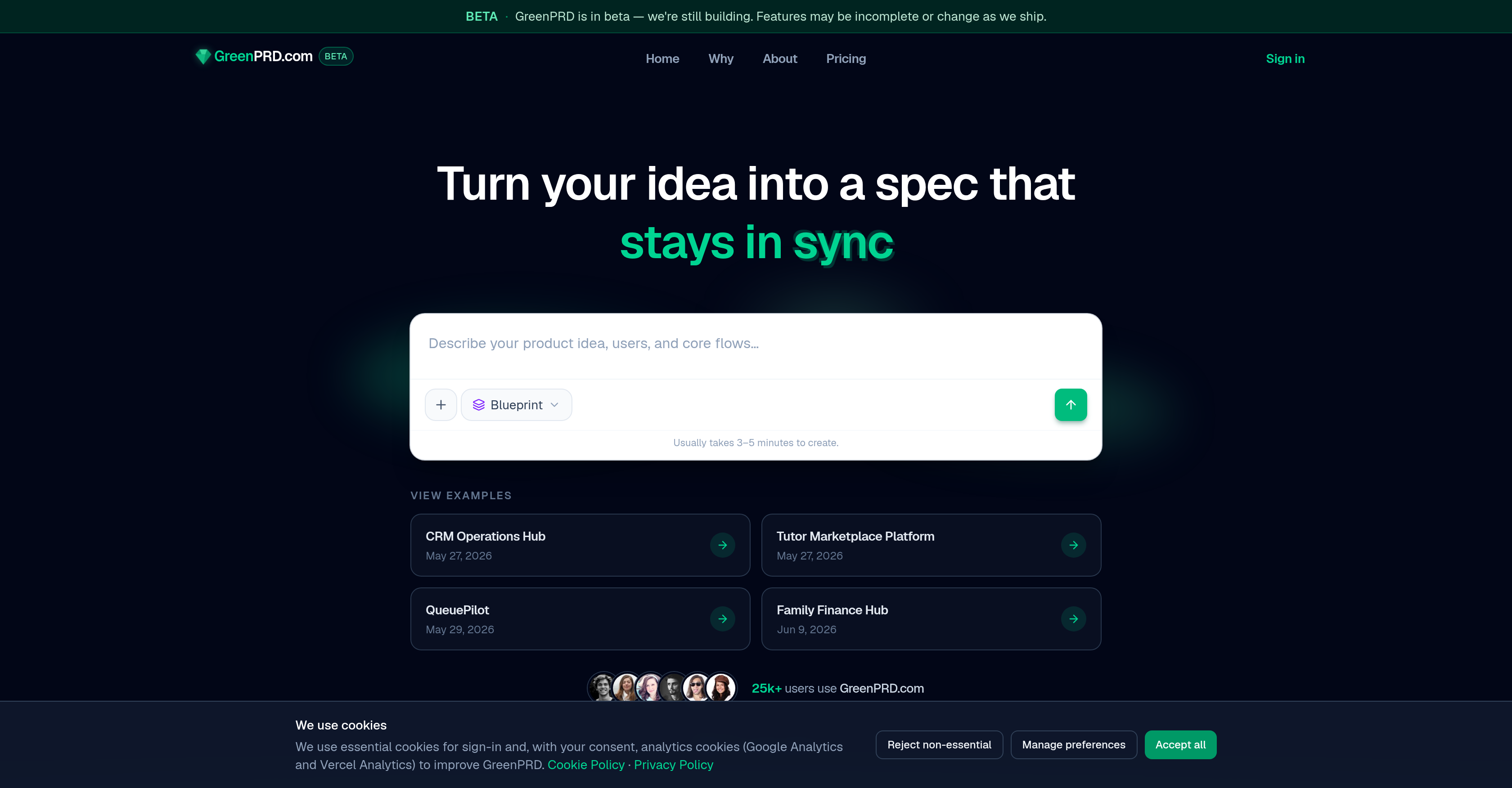
- Turn raw ideas into specific, cohesive product requirements that stay synchronized as your product evolves, using a virtual canvas that models triggers, branches, and actions.
- Eliminate drifting diagrams with a behavioral layer that chains conditions and side effects, keeping every workflow module tightly coupled to your evolving specification.
- Align designers and engineers before a single line of code is written by mapping screens, routes, and UI flows directly on the canvas for shared product architecture understanding.
- Maintain clear ownership of every API, webhook, and third-party service interaction through a centralized hub-and-spoke graph that updates as your specification changes.
- Import your entire repository into the specification graph with one-time IDE integration, then keep code and requirements in lockstep with live two-way GitHub sync.
- Ensure every workflow, documentation, and MCP element stays consistently in sync, delivering well-scoped products without manual reconciliation.
Pros & Cons
Pros
- Detailed synchronized specifications
- Complex workflow handling
- Virtual canvas modeling
- Allows condition chaining
- Designs pages, navigation elements
- Pre-coding UI flow structuring
- API, webhook, third-party documentation
- Hub-and-spoke graph feature
- Responsibility clarity
- Integration capabilities
- Two-way GitHub synchronization
- Repository import functionalities
- Specification graph integration
- Facilitates collaborative work
- Beta phase improvements
- Product Mapping
- Workflow Automation
- Product development support
- Product architecture understanding
- Code Mapping
- Consistent documentation
- IDE integration
- Evolution synced diagram
- Designers, engineers shared understanding
- Centralized Documentation Hub
- One-time repo import
- Live GitHub sync upgrade
- Workflow module synchronization
- Technical & architecture views
- Screen nodes and routes
- Canvas connected to product spec
- Comprehensive API Documentation
- Inbound and outbound API calls
- Central app node with services
- Maintains spec consistency.
Cons
- Limited IDE integration
- Requires Pro upgrade for full features
- Beta version instability
- Limited repository import options
- Consistent updates may cause confusion
- Complex for beginner users
- Unclear documentation for third-party services
- No real-time collaboration noted
- Uncertain long-term support
- Changes may affect existing workflows
Reviews
Rate this tool
Loading reviews...
❓ Frequently Asked Questions
GreenPRD.com is an artificial intelligence tool designed to translate ideas into detailed, synchronized product specifications. It's capable of modeling complex workflows while maintaining constant updates, and comes equipped with an array of features to streamline the process of product requirement mapping.
GreenPRD.com offers features like modeling triggers, branches, and actions on a virtual canvas connected to the specification, chaining conditions, and side effects within a behavioral layer, designing pages and navigation elements before any coding. It documents APIs, webhooks, and interactions with third-party services through a hub-and-spoke graph for clarity of communicative elements ownership. Users also have the option to import their repositories into the specification graph with live two-way GitHub synchronization.
GreenPRD.com facilitates specification design and workflow management through an intuitive modeling approach. Users can model triggers, branches, and actions on a virtual canvas that remains connected to the specification. It also allows for the chaining of conditions and side effects within one behavioral layer, creating a comprehensive and accurate workflow.
The 'virtual canvas' mentioned in GreenPRD.com's features refers to a digital workspace where users can model triggers, branches, and actions related to their product. This canvas stays connected to the specification, providing a real-time, visual representation of the product's workflow.
Yes, GreenPRD.com assists in designing user interface and navigation elements. It allows structuring of screens, routes, and UI flows before any coding takes place, promoting shared understanding between designers and engineers.
GreenPRD.com plays a critical role in API and webhooks documentation by providing a unique means to document them, along with interactions with third-party services. Through a hub-and-spoke graph that GreenPRD.com implements, ownership of various communicative elements is clarified.
Yes, GreenPRD.com does offer GitHub integration. Users can import their repositories into the specification graph and also have options for live two-way synchronization with GitHub.
The 'hub-and-spoke' graph feature of GreenPRD.com provides a clear visual representation of the relationship between APIs, webhooks, and third-party services. This aids in maintaining clear ownership of what talks to what, while ensuring consistency as the specification evolves.
Yes, GreenPRD.com allows users to import their repositories into the specification graph. This promotes a seamless integration of their existing workflows and resources into the specification design process.
GreenPRD.com facilitates collaborative work by providing a platform where screens, routes, and UI flows can be structured before coding. This creates a shared understanding between designers and engineers. Also, its capability for live two-way GitHub synchronization allows team members to work on the same project and keep all updates in synchronization.
Yes, GreenPRD.com is suitable for various software engineering tasks as it provides features like modeling of triggers, branches, actions, conditions and side-effects, designing UI and navigation elements, documenting APIs and webhooks, and integrating with GitHub.
Behavioral chaining in the context of GreenPRD.com refers to the ability to sequence conditions and side-effects within a single layer of the product's behavior. This allows users to closely map out and control the nuances of their product's functionality.
GreenPRD.com interacts with third-party services by documenting the interactions through its hub-and-spoke graph. This helps in maintaining clear ownership of what talks to what, while ensuring consistency when the specification evolves.
In the context of GreenPRD.com, 'beta phase' indicates that the tool is in a development stage where new features may still be added and existing features refined, based on user feedback and testing.
Due to its ongoing beta phase, GreenPRD.com is expected to introduce future changes and improvements to the platform. While the specifics of these updates are not explicitly mentioned on their website, they typically involve improvements in usability, feature enhancements, bug fixes, and potentially, new functionalities based on user feedback.
GreenPRD.com handles complex workflows by enabling users to model triggers, branches, and actions on a virtual canvas. It also allows conditions and side effects in the workflow to be chained within a single behavioral layer, providing a digital blueprint that syncs with the product requirements.
GreenPRD.com assists with product development by allowing users to translate ideas into detailed and synchronized product specifications, before any coding begins. It facilitates collaborative work between designers and engineers, ensuring the final product is as per the shared understanding. Additionally, GreenPRD.com offers the ability to document APIs, webhooks, and third-party service interactions, adding clarity to the development process.
The product requirements mapping process in GreenPRD.com begins with translating your idea into a specification. You can model triggers, branches, and actions on a virtual canvas that stays connected to your specification. Conditions and side-effects are chained within a single behavioural layer, and pages and navigation elements are designed. It can document APIs, webhooks, and interactions with third-party services. Additionally, users can import their repositories for easy integration.
GreenPRD.com keeps specifications consistently updated by maintaining a live link between the digital representation on the virtual canvas and the actual product specifications. It also provides the feature of two-way synchronization with GitHub, ensuring the specifications stay synced with any changes made on the codebase.
GreenPRD.com is designed to transform ideas into specific, cohesive product requirements. It allows users to easily generate detailed specifications that keep pace with the evolution of the product, ensuring constant synchronization. This AI tool also facilitates the creation of complex workflows, the design of pages and navigation elements, and the documentation of APIs and webhooks, among other features.
Yes, translating ideas into detailed, synchronized specifications is one of the principal functions of GreenPRD.com. This feature ensures that your outlined plans stay relevant and updated, even as changes occur during the product development stage.
GreenPRD.com offers a gamut of features for mapping product requirements. This includes infrastructure for designing complicated workflows, tools for designing pages and navigation (structuring screens, routes, and UI flows even before coding), and features for documenting APIs, webhooks, and interactions with third-party services in a centralized hub-and-spoke graph.
The virtual canvas provided by GreenPRD.com serves as a platform on which product specifications are formed and managed. It allows users to model triggers, branches, and actions consistently with their product specification, helping to avoid drifting diagrams that aren't in sync with the evolving product.
Yes, GreenPRD.com allows users to design pages and navigation elements. It offers the necessary tools to structure screens, routes, and UI flows prior to any coding, promoting shared understanding between designers and engineers of the product's architecture.
Yes, GreenPRD.com allows the ability to chain conditions and side effects within a single behavioral layer. This feature provides an organised way to manage complex workflow designs.
The hub-and-spoke graph in GreenPRD.com serves as a centralised documentation system. It is used for documenting APIs, webhooks, and third-party service interactions, providing clear ownership and understanding of inter-component communications.
GreenPRD.com facilitates the documentation of APIs and webhooks through a unique centralized hub-and-spoke graph feature. This feature ensures ownership clarity of various communicative elements, making certain all information remains accessible and understandable.
Live two-way GitHub synchronization in GreenPRD.com is a feature that allows real-time updates between your GitHub repository and your product on GreenPRD.com. This enables seamless integration and ensures your product specifications stay in sync with your actual code base.
Yes, GreenPRD.com is specifically designed to facilitate collaborative work. It provides a streamlined process for specification creation, workflow design, page and navigation construction, and documentation. All these operations stay synced, encouraging effective teamwork.
The beta phase of GreenPRD.com refers to its current developmental stage, where features may still be incomplete or subject to changes and improvements as the tool evolves.
Yes, GreenPRD.com can assist with UI Flow Modelling. The tool includes features for structuring screens, routes, and UI flows, allowing designers and engineers to conceptualize the product’s architecture even before coding begins.
Yes, GreenPRD.com provides several features tailored towards supporting effective product development. These include meticulous product specification and workflow design, page and navigation construction, and robust documentation capabilities.
Yes, GreenPRD.com can assist in code mapping. It allows users to import their repositories into its specification graph. This feature makes it easier to visualize and understand the relationship between different elements of your codebase.
GreenPRD.com can greatly assist in understanding product architecture. It allows users to map out screens, routes, and UI flows before coding begins, thereby fostering a shared understanding of the product’s architecture between designers and engineers.
Yes, GreenPRD.com is designed to seamlessly integrate with your IDE. It offers a one-time repo import to map code to its canvas and has compatibility with popular Integrated Development Environments.
An upgrade to Pro in GreenPRD.com provides full MCP (Cursor ↔ spec) and a live two-way GitHub sync. This facilitates real-time synchronization between your repository and the GreenPRD.com specification graph.
Yes, GreenPRD.com is designed to maintain consistent synchronization between every workflow module, documentation, and the MCP. This feature ensures that all elements stay updated and in sync, supporting the development of well-scoped and effectively managed products.
Pricing
Pricing model
Freemium
Paid options from
$7.67/month
Billing frequency
Monthly