
Overview
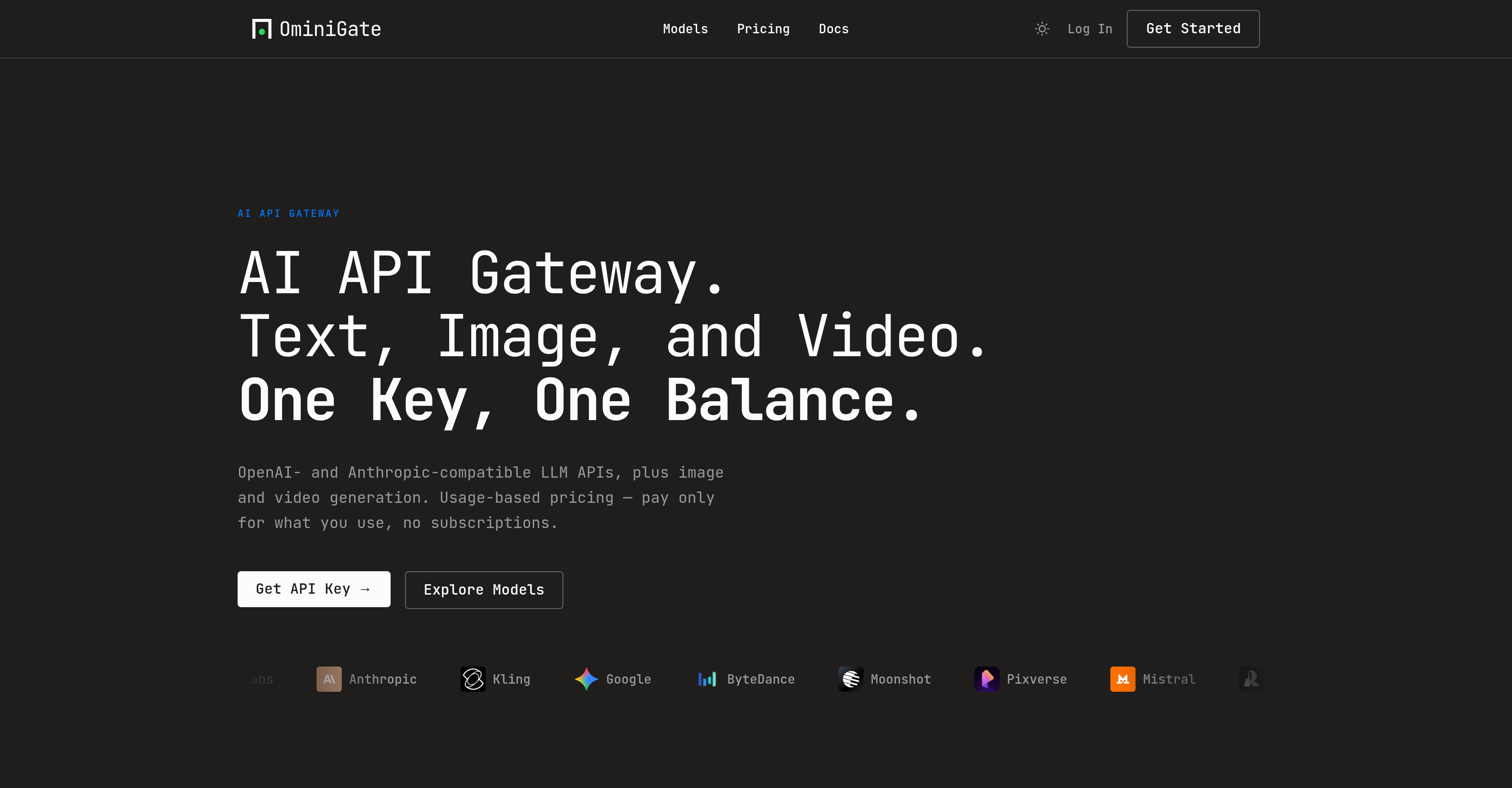
- Eliminate multi-provider complexity by accessing GPT-5.4, Claude Opus 4.6, and 50+ models from Google, NVIDIA, and ByteDance through a single API endpoint and one API key
- Reduce AI spend automatically with real-time price comparison across providers and usage-based pricing—no subscription fees, only per-token or per-image billing
- Maintain consistent service availability with multi-provider automatic failover that instantly switches to a redundant path when any provider experiences downtime
- Optimize response times for production applications using smart load balancing that distributes requests across redundant infrastructure in multiple regions
- Protect sensitive data with end-to-end TLS 1.3 encryption, strict access controls, and a zero data retention policy that never stores prompts or completions
- Switch between text, image, or video models for any task—from text reasoning to marketing visual generation—by changing just one line of code in your existing OpenAI-compatible workflows
- Scale enterprise AI pipelines with volume discounts, custom SLA guarantees, dedicated account management, and priority support for high-throughput applications
Pros & Cons
Pros
- Compatible with Anthropic
- Single API key access
- Multiple providers support
- No multiple API management
- Integrated multi-provider failover
- Maintains consistent service availability
- Smart load balancing
- Optimized performance
- Streamlined resource allocation
- Usage-based pricing model
- Real-time price comparison
- Automatic cost optimization
- Streaming function support
- Supports function calling
- Supports JSON mode
- Supports vision inputs
- TLS 1.3 encryption
- End-to-end data protection
- Strict access control
- Zero data retention policy
- Strong data auditing systems
- Flexible use cases
- Supports text models
- Supports image models
- Supports video models
- Variety of mainstream models
- Compatible with large language models
- Integrated cheapest-route optimization
- Effortless model switching
- Supports unified API access
- Built-in use cases
- High availability through redundancy
- Stripe payment support
- Enterprise plans availability
- Volume discounts on plan
- Dedicated account management
- Custom SLA guarantees
- Priority support
- Supports structured JSON outputs
- Guaranteed high availability
- Transparent & fair pricing
- Supports multiple regions
- Enterprise-grade security
- Optimized for startups
- Unified billing system
- Supports major credit cards
Cons
- No free tier available
- Requires stripe for payments
- Dependent on provider availability
- Data passes through OminiGate
- No data storage options
- Limited payment options
- Requires coding knowledge
- Pricing per usage can escalate
Reviews
Rate this tool
Loading reviews...
❓ Frequently Asked Questions
OminiGate is an AI API Gateway that is designed for text, image, and video models. It offers compatibility with both OpenAI and Anthropic methodologies, functioning as a unified platform. Through OminiGate, users can gain access to a variety of mainstream models from major providers using a single API key and endpoint, eliminating the need for multiple API keys, SDKs, and billing accounts. Its distinctive features include multi-provider automatic failover, smart load balancing, and a usage-based pricing model without subscription fees.
OminiGate provides compatibility with both OpenAI and Anthropic methodologies by functioning as a unified platform. It leverages its advanced capabilities to bridge the gap between different AI providers, offering high accessibility through a single API key and endpoint. This eliminates the necessity of having to manage multiple API keys and billing accounts while providing the versatility and compatibility of both the OpenAI and Anthropic methodologies.
OminiGate provides access to a multitude of mainstream models from major providers. It has specifically mentioned providers including OpenAI, Anthropic, Google, ByteDance, Z.AI, NVIDIA, Black Forest Labs, Pixverse, and Moonshot among others. However, the exact list of models available would be subject to change and users are advised to refer to the site for the most recent updates.
The single API key feature of OminiGate works by giving users access to a wide range of AI models from different providers through a single API key and endpoint. This means that the users do not have to manage multiple API keys, SDKs, and billing accounts for different models. Instead, they can seamlessly access numerous models via the unified OminiGate platform.
The multi-provider automatic failover in OminiGate refers to its capability of automatically switching to another provider when one fails. This ensures a consistent service availability, even in the event of a provider experiencing downtime.
OminiGate optimizes performance and resource allocation by utilizing smart load balancing. This method provides redundant paths for every model which optimises the allocation of computational resources and bandwidth, ensuring consistent performance and reduce the amount of time taken to process requests.
OminiGate operates on a usage-based pricing model without any subscription fees. Users are billed transparently on a per-token basis for text models, per-image basis for image models, and on resolution and duration basis for video models. It offers real-time price comparison across providers which results in automatic cost optimization.
Yes, OminiGate supports features like streaming, function calling, and JSON mode. These functionalities are enabled to ensure a comprehensive coverage of possible workflows, matching the features available in the OpenAI API.
OminiGate uses end-to-end TLS 1.3 encryption for its security. This provides a secure environment by encrypting the data both at rest and in transit. It prevents unauthorized access and maintains the integrity and confidentiality of the information.
Access controls in OminiGate are described as strict. This typically implies that the platform implements robust measures to ensure only authorized individuals can access certain data or features. The exact mechanisms and systems used are not specified on their website.
OminiGate operates under a zero data retention policy. That means, it doesn't store any of your prompts or completions. Such a policy aims to protect user data by ensuring no user information is retained following the execution of an action or request.
OminiGate operates robust auditing systems to uphold the integrity of its operations and ensure service quality. Auditing could involve tracking and recording access to the system, maintaining a history of user transactions and interactions, and regularly evaluating security protocols. The specifics of these systems are not detailed on their website.
OminiGate's flexibility allows it to be used in various contexts, including constructing AI products for text, images, and videos. For instance, it can be used to route reasoning to different AI models, generate marketing and product visuals, and create AI video pipelines.
Yes, OminiGate does support vision inputs. This capability further enhances its applicability in diverse AI use cases, especially those involving image and video processing.
The advantages of using OminiGate as an API Gateway for AI models include access to mainstream models from varied providers through a single API key, compatibility with OpenAI and Anthropic methodologies, smart load balancing and redundant paths for every model, enterprise-grade security measures, multi-provider automatic failover for consistent service availability, and a transparent, usage-based pricing model.
The real-time price comparison feature in OminiGate works by constantly comparing the prices across different service providers. This allows users to make cost-effective decisions based on the most current price information. It also automatically optimizes costs by choosing the most affordable route.
'Smart Load Balancing' in OminiGate refers to its method of distributing workloads across multiple resources in a way that optimizes efficiency and performance. By offering redundant paths for every model, OminiGate ensures that no single resource is overwhelmed while others remain underutilized.
No, there is no subscription fee for OminiGate. It operates on a usage-based pricing model, where users pay only for the resources they use, instead of a fixed, periodic subscription fee.
OminiGate displays high flexibility for various use cases by being a unified platform for text, image, and video models. It enables access to a wide range of providers' models via a single API key and endpoint. Additionally, it supports features like streaming, function calling, and JSON mode, making it adoptable for varied AI requirements.
The term 'Enterprise Grade Security' in OminiGate implies the implementation of advanced security measures in line with industry standards. These include end-to-end TLS 1.3 encryption, strict access controls, zero data retention policy, and robust auditing systems to safeguard user data and provide a secure environment for operations.
OminiGate supports a wide range of models from major solution providers like Black Forest Labs, Google, ByteDance, and NVIDIA among others. It is also capable of supporting large language models (LLMs) and specific models like GPT-5.4 Pro by OpenAI and Claude Opus 4.6 by Anthropic.
OminiGate operates on a usage-based pricing model. There are no subscription fees involved. It provides a real-time price comparison across providers and offers automatic cost optimization. This means users pay only for what they use, thus making the pricing transparent and fair.
OminiGate provides full compatibility with both OpenAI and Anthropic methodologies. This flexibility allows developers to integrate various models into their applications seamlessly by using a single API endpoint. Which not only reduces the complexity but also increases functionality.
OminiGate ensures service availability through multi-provider automatic failover and smart load balancing. This implies that in case a service from a provider is available, it could automatically switch to another provider, thus ensuring consistent service availability. It also runs redundant infrastructure across multiple regions that furthers its capacity to ensure high availability.
Smart load balancing in OminiGate works by providing redundant paths for every model. This strategy is integral for maintaining high service availability and optimized performance. It efficiently distributes workloads across multiple computing resources, which helps in preventing overloading of a single resource while optimizing resource usage.
OminiGate has implemented several security measures to protect data. It has an end-to-end TLS 1.3 encryption which ensures that data in transit is secure. Strict access controls are in place, allowing only authorized access. Additionally, it operates on a zero data retention policy, meaning it does not store any data. It also conducts regular security auditing for further assurance.
OminiGate handles API management by offering Unified API access to numerous AI models. It allows developers to switch between models easily simply by changing a single line of code. Additionally, it facilitates intelligent routing and ensures high availability of services. The gateway maintains a single API key and endpoint simplifying the complexities usually associated with multi-provider model management.
The functionality of OminiGate has a wide range of applications. Developers can use it to construct AI products for text, image, and video modalities. It can also be beneficial for startups and various enterprise-grade applications. Among the notable use-cases are text reasoning and visual generation for marketing and product imagery.
GPT-5.4 Pro model from OpenAI can be utilized through OminiGate for AI applications involving text. It's built to handle long context, native vision, and tool calling tasks making it perfectly suited for constructing nuanced and context-aware AI products.
OminiGate allows developers to utilize mainstream image and video models from major providers through a unified API gateway. This means you can easily switch between different models for image and video applications just by changing a single line of code, thus making it a one-stop solution for all multimedia AI applications.
OminiGate's enterprise plans feature volume discounts, dedicated account management, custom SLA guarantees, and priority support. This ensures enterprises get a smooth and cost-effective experience along with the assurance of quality assistance when required.
OminiGate stands out from typical AI API gateways through its unified nature, compatibility with multiple models and providers, smart load balancing, and automatic failover. It also provides cost-effective and transparent usage-based pricing along with enterprise-grade security measures, making it a comprehensive solution for AI model integration.
OminiGate's unified API key and endpoint simplify the process of accessing and managing various AI models. This cohesive approach eliminates the need to manage multiple API keys, SDKs, and billing accounts, thus saving developers time and hassle while reducing the complexity associated with multi-provider model management.
Automatic cost optimization in OminiGate involves a mechanism that ensures users pay the least cost for the usage. It operates by offering a real-time price comparison across providers. This transparency in pricing allows users to choose the most cost-effective options.
Redundant paths in OminiGate are used for optimizing performance and ensuring high service availability. They function as alternative routes that facilitate load balancing. If one route faces an issue, the workload automatically switches to another route, ensuring optimal performance and service continuity.
OminiGate is compatible with major AI solution providers including Black Forest Labs, Google, ByteDance, and NVIDIA. This makes it a comprehensive gateway for accessing a variety of mainstream models. It's also compatible with OpenAI and Anthropic, which opens the doors to some of the most powerful and nuanced AI capabilities.
High availability in OminiGate is achieved through redundant infrastructure across multiple regions and smart load balancing. Additionally, it utilizes multi-provider automatic failover, thereby minimizing the risk of service interruptions by quickly switching the service from one provider to another if one goes down.
Built-in use cases of OminiGate include text reasoning, visual generation for marketing and product imagery. It provides a simplified way for developers to choose the right models for these tasks and integrates them into AI products for a wide range of applications.
OminiGate's usage-based pricing model provides several benefits. First, it eliminates the burden of subscription fees, meaning users only pay for what they use. Next, it offers real-time price comparison across providers, providing transparency and aiding cost optimization. Lastly, this model accommodates varying workload sizes and resource needs, making it a cost-effective solution for both startups and large enterprises.
Pricing
Pricing model
Paid
Paid options from
$5/unit
Billing frequency
Pay-as-you-go
Refund policy
No Refunds