
Overview
- Slash production changeover costs and engineering hours by eliminating manual robot reprogramming for new tasks, enabled by adaptive AI motion and vision.
- Boost first-pass yield and reduce scrap with AI-driven quality inspection that performs precise, real-time visual checks.
- Handle variable product sizes and weights in material handling without costly reconfiguration, using adaptive motion planning.
- Deploy automation applications faster with rapid development of vision, perception, and motion planning on the NVIDIA-powered AI Accelerator toolkit.
- Achieve long-term savings on total cost of ownership through higher utilization, fewer manual interventions, and optimized operational efficiency.
- Scale smarter automation with seamless AI integration via the PolyScope X control platform and a global collaborative innovation network.
Pros & Cons
Pros
- Real-time vision
- Adaptive motion
- Collaborative automation platform
- Accessibility for businesses
- Technology alliances (NVIDIA, Google, Microsoft, Siemens)
- Cost-efficient operation
- Minimises need for manual reprogramming
- Minimises changeover costs
- Improves first-pass yield
- Faster deployment
- Fewer manual interventions
- Higher tool utilization
- Long-term savings on ownership
- Advanced development tools
- Intuitive interface of PolyScope X
- Modular architecture of PolyScope X
- Real-time data handling
- Advanced torque control
- Faster innovation at scale
- NVIDIA Jetson-powered
- Enables development of vision applications
- Enables development of perception applications
- Enables development of motion planning
- Strategic technology alliances
- Global network of developers
- Global network of integrators
- Global network of research partners
- High-mix assembly without manual reprogramming
- Adaptive palletizing and material handling
- Variable size and weight handling
- Dynamic path planning in logistics
- Force-sensitive tasks with torque control
- Reduced defect-related costs
- Maximises throughput
- Reduced downtime
- Reduced integration costs
Cons
- Requires technical expertise
- Changeover costs exist
- Dependent on partner alliances
- Limited to specific industries
- Lack of transparency in costs
- Manual interventions still needed
- Facade of universality
- Real-time vision might lag
- Hardware-software integration complexity
Reviews
Rate this tool
Loading reviews...
❓ Frequently Asked Questions
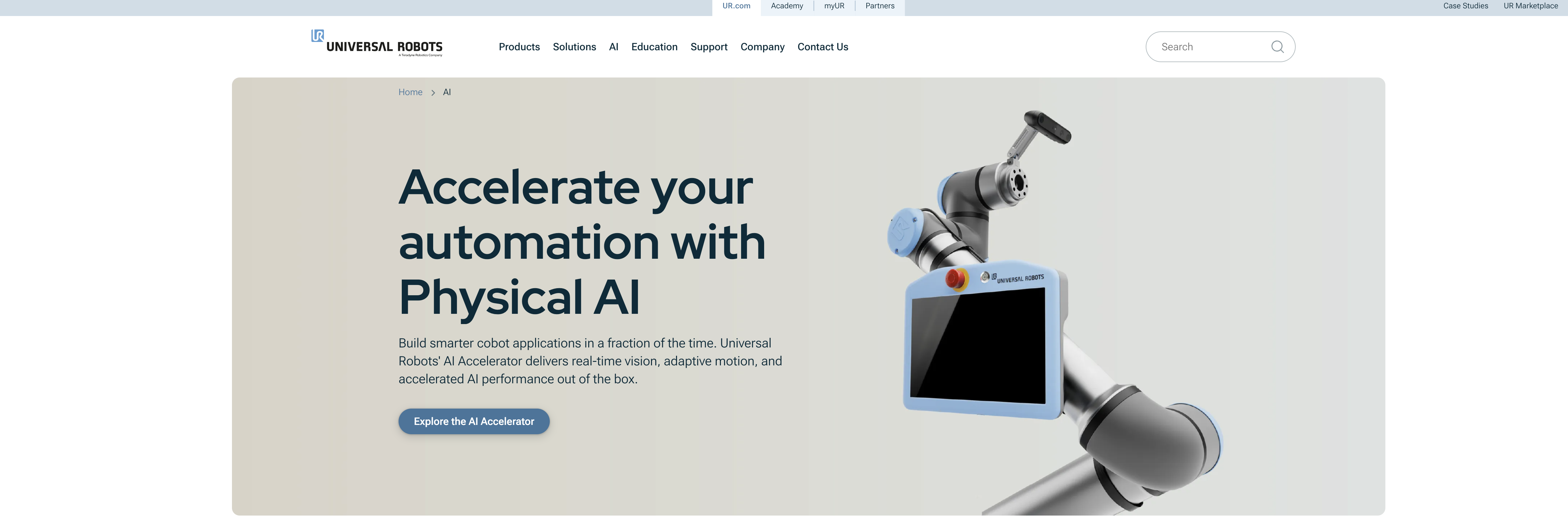
The Physical AI from Universal Robots functions as a tool that brings together the power of AI with robotics to facilitate smarter, adaptive automation. It expedites the automation process by delivering real-time vision, adaptive motion, and improved AI performance.
Physical AI facilitates smarter, adaptive automation by providing real-time vision and adaptive motion, improving AI performance. It lowers the need for manual reprogramming, thereby reducing changeover costs and optimizing operations. The NVIDIA-powered AI Accelerator enables rapid development of vision, perception, and motion planning applications.
The AI Accelerator brings real-time vision, adaptive motion, and accelerated AI performance to automation. Powered by NVIDIA, it enables rapid development of vision, perception, and motion planning applications. This supercharges robotics with AI, thus enhancing innovation, precision, and adaptability at scale.
Physical AI aligns with collaborative automation by enabling people to work effectively with robots. Universal Robots emphasizes innovation through collaboration, enabling advanced technology accessibility for businesses across industry verticals. This approach facilitates smarter, adaptive automation that enhances the way people work alongside robots.
Universal Robots caters to a broad range of industry verticals, making advanced technology accessible for businesses in diverse sectors. However, specific industry verticals were not specified on their website.
Universal Robots is aligned with technology leaders such as NVIDIA, Google Deep Mind, Microsoft, and Siemens to deliver solutions that combine proven trust with intelligence and adaptability for modern industry complexity.
The NVIDIA-powered AI Accelerator plays a critical role in the Physical AI platform by supercharging robotics with AI. This enables rapid development of vision, perception, and motion planning applications, resulting in faster innovation, precision and adaptability at scale.
The high-performance AI toolkit offered by Physical AI includes 'AI Accelerator' and 'PolyScope X'. The AI Accelerator, powered by NVIDIA Jetson™ and PolyScope X, enables quick development of vision, perception, and motion planning applications, combining advanced hardware with seamless software integration for smarter automation. PolyScope X allows developers to integrate AI seamlessly using an intuitive interface, modular architecture, and real-time data handling.
Physical AI can provide savings and operational efficiencies by minimizing the need for manual reprogramming, reducing changeover costs and improving first-pass yield. This results in faster deployment, fewer manual interventions, and higher utilization, contributing to long-term savings on the overall cost of ownership.
Physical AI optimizes operations by reducing the need for manual reprogramming, thereby lowering changeover costs. Additionally, it improves the first-pass yield, effectively enhancing the operational efficiency of an industry.
Physical AI Robotics accelerates automation by providing real-time vision and adaptive motion for rapid application development. Backed by the high-performance AI Accelerator, it enables the fast and efficient development of vision, perception, and motion planning applications, thus significantly expediting the automation process.
PolyScope X, the AI-ready control platform, provides a foundation for advanced robotics in the AI era. It allows developers to integrate AI seamlessly with an intuitive interface, modular architecture, and real-time data handling. It also offers high-level APIs and advanced torque control, delivering precision, adaptability, and faster innovation at scale.
The high-performance AI toolkit 'AI Accelerator' functions as a plug-and-play toolkit that supercharges robotics with AI. Powered by NVIDIA Jetson™ and PolyScope X, it enables the rapid development of vision, perception, and motion planning applications, combining advanced hardware with seamless software integration for smarter automation.
The collaborative innovation network in Physical AI includes UR+ certified solutions and strategic alliances with technology leaders including NVIDIA. Additionally, the network includes a global network of developers, integrators, and research partners working together to make AI practical, enabling faster deployment, easier adaptation, and smarter scaling.
Physical AI helps minimize changeover costs and improve first-pass yield by reducing the need for manual reprogramming, which results in less downtime and reduced engineering hours. This also helps in handling variable sizes and weights, thereby optimizing industrial operations.
Physical AI contributes to long-term savings on the overall cost of ownership by enabling faster deployment, reduced manual interventions, and increased utilization. This in effect lowers the total operation costs and provides measurable impact and cost savings.
In high-mix assembly, Physical AI reduces downtime and engineering hours by eliminating the need for manual reprogramming. This results in reduced integration costs and improved operational efficiency.
In quality inspection, Physical AI improves the first-pass yield and reduces scrap. This AI-driven inspection boosts Return on Investment by improving productivity and optimizing operations.
Physical AI assists in material handling and palletising by handling variable sizes and weights, thereby reducing changeover costs. It can adapt to different material handling requirements, thus improving efficiency and reducing costs.
Dynamic path planning in logistics, facilitated by Physical AI, helps to avoid bottlenecks and maximize throughput for enhanced productivity. By leveraging AI technology, it enables efficient navigation and route planning, thereby enhancing operational efficiency.
Pricing
Pricing model
Pricing
Paid options from
N/A