Pydantic Logfire
Overview
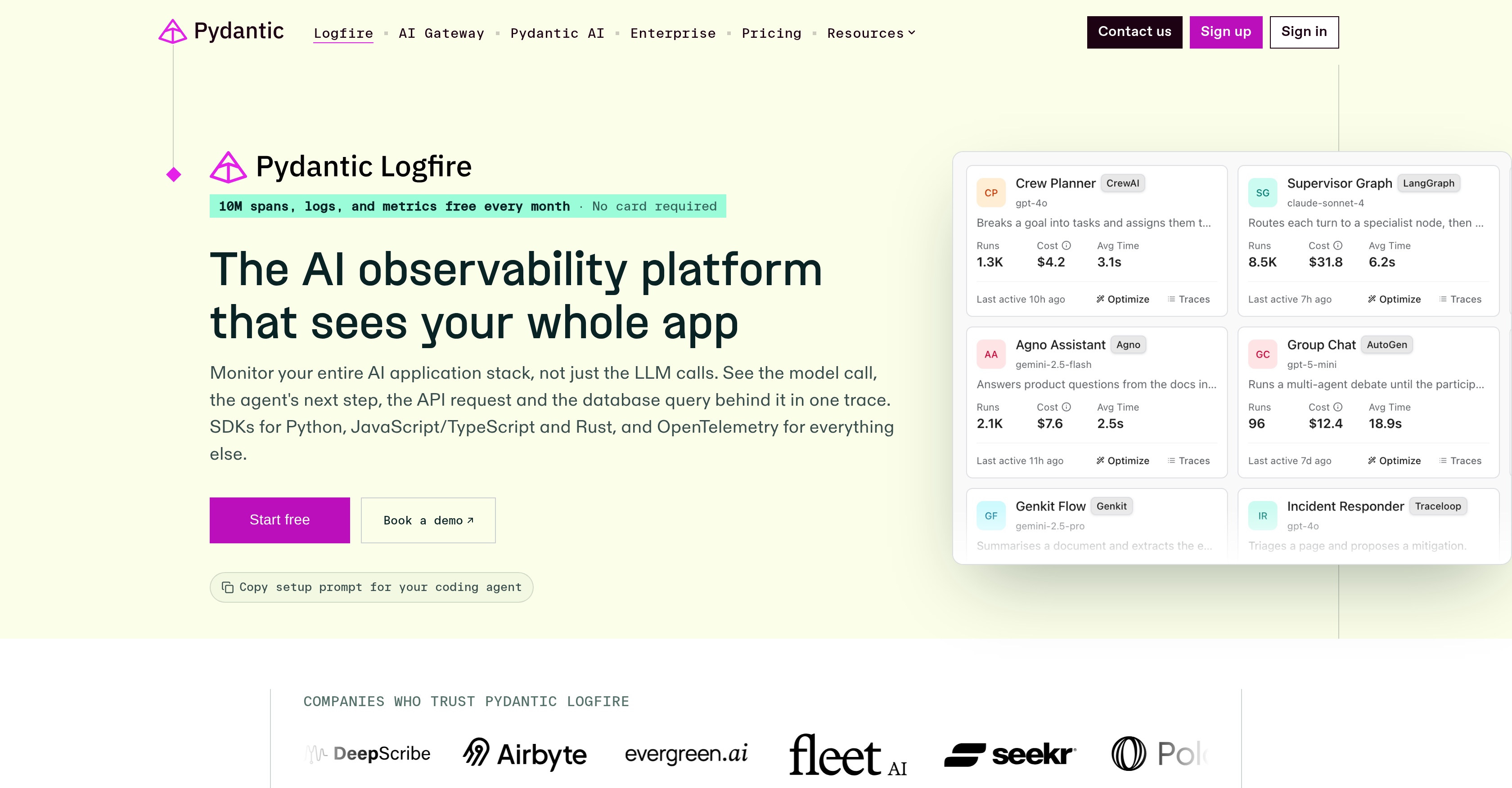
- Gain complete visibility into every layer of your AI application stack, from model calls to database queries, with OpenTelemetry-based distributed tracing that captures each agent step and API request.
- Pinpoint bottlenecks and failures across complex distributed AI systems by tracing the full execution path of every request through all services and infrastructure layers.
- Reduce operational costs by identifying resource-intensive API requests, database queries, and model calls through detailed usage tracking and cost tracking features.
- Debug AI applications faster using a SQL query interface that runs Postgres-flavored queries over every span, letting you explore metrics and telemetry data with precision.
- Continuously improve LLM performance with built-in evaluation methods including living evals inside traces, programmatic checks, LLM judges, and human review workflows.
- Handle deeply nested trace and attribute data efficiently with FusionFire, a columnar engine built on Apache DataFusion designed for wide, complex AI system telemetry.
- Monitor APIs and LLM calls across Python, JavaScript/TypeScript, Rust, Go, and Java using native SDKs and OpenTelemetry compatibility for unified observability.
- Track and log every interaction within your AI application stack, from model execution times to API response metrics, enabling data-driven optimization decisions.
Reviews
Rate this tool
Loading reviews...
❓ Frequently Asked Questions
Pydantic Logfire is an AI observability platform designed for production-grade AI applications. It enables general observability based on OpenTelemetry and operates across multiple programming languages. Pydantic Logfire is specifically designed for monitoring AI Language Models (LLMs), APIs and Apps, providing capabilities such as distributed tracing, evaluations, and cost tracking. It allows the observation of the complete AI application stack, not limited to just model calls, but also including the next agent's step, the API request and the database query.
Pydantic Logfire leverages AI to aid in debugging AI applications by offering features like SQL query interfaces for exploring AI system metrics and telemetry. It also includes evaluation methods for continuous performance improvement, thus enabling AI developers to more accurately identify and rectify issues within their applications.
Supported programming languages by Pydantic Logfire include Python, JavaScript/TypeScript, Rust, Go, and Java. For languages other than Python, JavaScript, and Rust, it uses OpenTelemetry.
Pydantic Logfire is an observability platform due its ability to monitor entire AI application stacks instead of just model calls. This includes areas like the next agent's step, API requests, and the database queries. This allows developers to maintain complete oversight over their AI applications, from model execution times and API call responses to database query performance. Moreover, its ability to provide functionalities like distributed tracing, evaluations, and cost tracking further expands its footprint in providing a comprehensive observability platform.
'General observability based on OpenTelemetry' refers to the ability of Pydantic Logfire to observe operations across differing programming languages in a unified manner. It uses OpenTelemetry, a set of APIs, libraries, and tools to facilitate visibility for agents, APIs, SDKs, and other services. This means that regardless of the programming language or infrastructure a system might be using, Pydantic Logfire can still bring about effective monitoring and tracing of its operations.
Pydantic Logfire contributes to reducing operational costs by providing in-depth insights into the functioning of AI applications. By offering features like distributed tracing, evaluations, cost tracking, and SQL query interfaces for exploring AI system metrics and telemetry, it helps identify inefficiencies and underperforming aspects of an AI application. Once these are identified, they can be rectified or optimized, leading to better performance, lesser resource usage, and, subsequently, reduced costs.
Pydantic Logfire monitors AI Language Models (LLMs) by tracing the entire chain of operations right from the model call, to the next agent's step, the API request, and the database query. It integrates with the LLM, tracks its functioning, traces steps, logs information, measures performance, and provides telemetry data. The data derived from this monitoring can help understand the model's behaviour and performance more thoroughly and make data-driven improvements.
The SQL query interface feature in Pydantic Logfire acts as a platform to explore AI system metrics and telemetry. It lets users query anything in the AI system using Postgres-flavored SQL over every span. This allows users to delve into their AI system's data, extract meaningful information, find patterns, and derive insights, thus giving them greater control over their AI systems.
Pydantic Logfire offers evaluation methods that aim to provide continuous performance improvement. These include living evals inside the trace, programming checks (for failures that can be identified exactly by code), LLM judges (for qualities code cannot check), and human review. Together, these evaluation methods make identifying regressions and other issues more straightforward and allow for the implementation of necessary improvements.
FusionFire is a columnar engine integrated within Pydantic Logfire designed to handle deeply nested traces and attributes. It is built on Apache DataFusion and allows for effective handling and querying of wide, deeply nested trace and attribute data. This comes in handy when dealing with intricate AI systems and applications where data can often be nested many layers deep.
Pydantic Logfire provides deep observability by enabling users to monitor their entire AI application stack, not just the LLM calls. It offers features like distributed tracing, evaluations, and cost tracking and uses OpenTelemetry for enabling widespread observability. Moreover, it also provides a feature to execute Postgres-based SQL over every span, granting even more depth of observability.
Through its SQL query interface, Pydantic Logfire helps in handling AI system metrics and telemetry. It allows users to learn more about their AI systems by querying system metrics and diving into telemetry (the process of recording and transmitting data) data. This includes detailed information about an AI's functionality, its interactions, its performance, and more, providing a fuller picture of the AI's operations.
Pydantic Logfire provides application stack monitoring through its OpenTelemetry-based observability. This allows it to track and log every action and interaction happening within an AI application, from model calls to database queries, enabling deeper insights into the operation and performance of the application.
API monitoring in Pydantic Logfire happens through the tracking of API requests within a traced operation chain. Whether an API is used by the main AI application or by an auxiliary service, such as an agent or a separate model, Logfire can observe the request and record its metrics. This provides valuable, actionable insights about the efficiency and response times of the APIs used within the AI application.
Pydantic Logfire facilitates distributed tracing of AI applications by comprehensively monitoring the AI application stack. It traces the execution path of a request or a task through all layers of the application and across multiple services. This way, it can record specific details about every action and interaction, pinpoint bottlenecks or failures and provide clear visibility into the operations of complex, distributed AI applications.
Cost tracking in Pydantic Logfire is enabled by its detailed recording and monitoring capabilities. It tracks usage data such as API requests, database queries, and tool-required operations, among others. This information can be used to understand which parts of an AI application are resource-intensive and subsequently, cost-intensive. By identifying these areas, developers can optimize them for cost efficiency.
Pydantic Logfire is integrated with Python, JavaScript, and Rust by providing SDKs for these languages. The SDKs allow developers to install and configure Pydantic Logfire within their applications built using these languages. This enables real-time monitoring and tracing of application performance, enabling them to gather deep insights.
Pydantic Logfire uses AI to better understand the operations of AI applications that it is monitoring. It uses this understanding to provide detailed insights for debugging, performance improvement, cost tracking, and more. This helps minimize operational issues and strains, ultimately improving the overall performance and effectiveness of the application.
Postgres-based SQL execution in Pydantic Logfire is a feature where every span (the basic unit of work in tracing) can be queried using SQL. This enhances data retrieval, allowing users to extract more specific and meaningful data from their AI systems, thus providing a greater depth of observability.
Pydantic Logfire is compatible with a wide range of systems or platforms due to its OpenTelemetry base. It can be used in conjunction with any programming language or infrastructure that supports OpenTelemetry, including but not limited to Python, JavaScript/TypeScript, Rust, Go, Java, Ruby, and .NET.
Pricing
Pricing model
Freemium
Paid options from
$49/month
Billing frequency
Monthly
Refund policy
No Refunds