
Saviynt
Overview
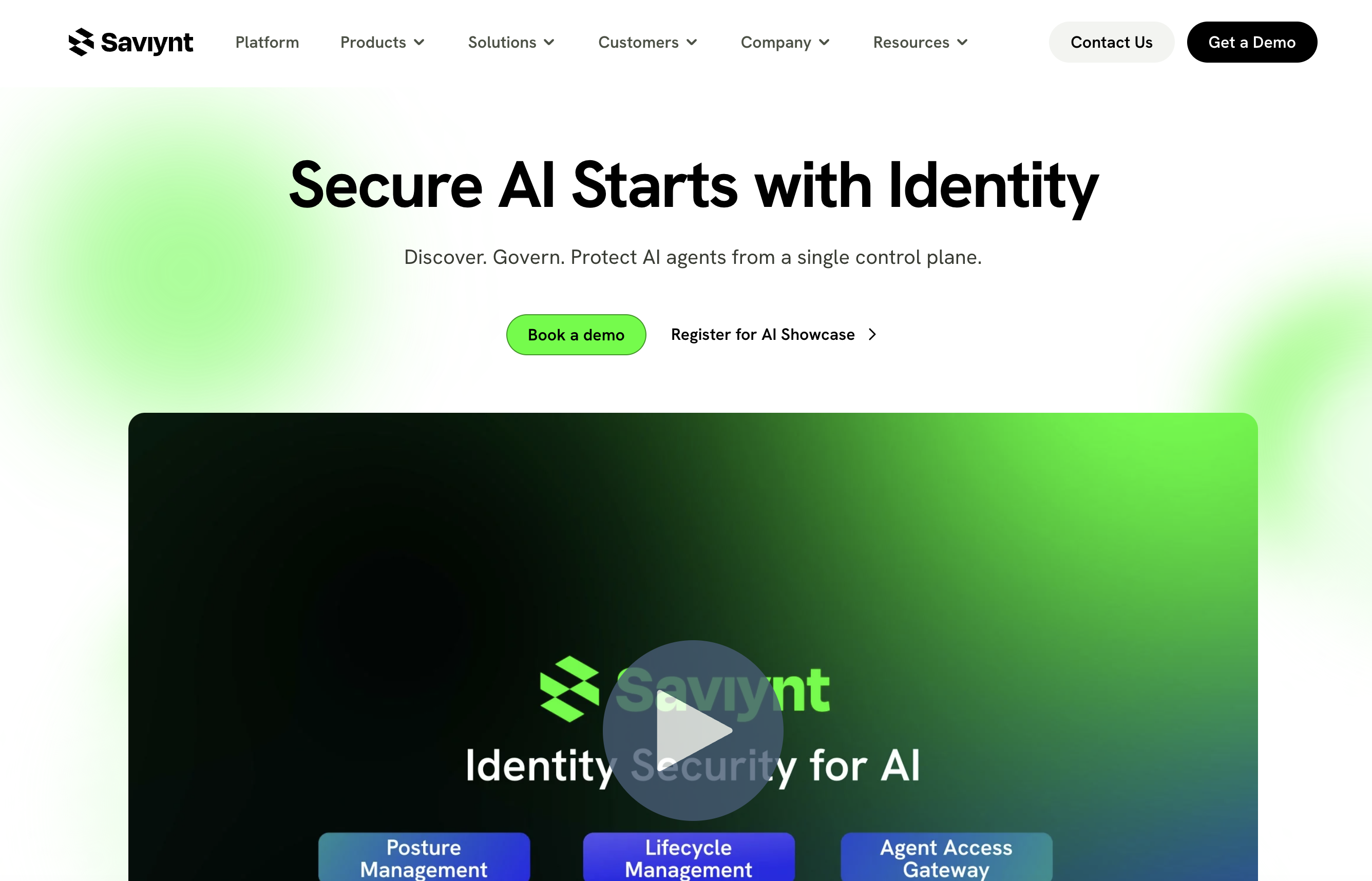
- Eliminate blind spots in your AI environment by identifying every agent and mapping its access with continuous Posture Management.
- Establish clear human accountability for every AI agent by automatically detecting orphaned agents and assigning policy-driven ownership through Lifecycle Management.
- Prevent unauthorized access in real-time by verifying every agent request and enforcing zero-trust principles with the runtime Agent Access Gateway.
- Maintain a provable audit trail for compliance by tracking every AI agent change in a detailed timeline from integration to retirement.
- Limit lateral movement and credential exposure by granting agents only time-bound, task-specific access with upcoming Privileged Access Management.
Pros & Cons
Pros
- Continuous visibility
- Lifecycle governance
- Clear ownership accountability
- Reduces attack surfaces
- Posture Management
- Eliminates access blind spots
- Actionable risk insights
- Lifecycle Management
- Detects newly added agents
- Surfaces orphan agents
- Policy-driven ownership assignment
- Agent Access Gateway
- Verifies agent access requests
- Continuous authentication and authorization
- Enforces zero-trust access
- Runtime authorization
- Detects independent agent actions
- Planned Privileged Access Management
- Enforces least privilege for agents
- Time-bound, task-specific agent access
- Securely stores and rotates credentials
- Prevents agent misuse
- Compliance maintenance
- Behaviour baseline learning
- Agent access map visualization
- Change timeline view
Cons
- No mobile app
- Output verbosity
- No free trial
- Complex interface
- Possibly high learning curve
- Privileged Access Management pending
- Overwhelming amount of features
- Limited language support
- Incomplete isolation between agents
- Limited on-premise support
Reviews
Rate this tool
Loading reviews...
❓ Frequently Asked Questions
Saviynt Identity Security for AI is a comprehensive system designed to discover, govern, and protect AI agent identities across various environments. It provides a control plane for AI, delivering continuous visibility and lifecycle governance with clearly defined ownership. The system aids organizations in reducing emerging attack surfaces while maintaining accountability and compliance with AI adoption scaling up.
Posture Management in Saviynt is a feature that helps users identify AI agents, understand what resources these agents can access, and identify access risks to eliminate blind spots. It also delivers actionable risk insights and tracks every AI agent change in a timeline, providing a clear summary of each change.
The Lifecycle Management feature in Saviynt allows users to register, govern, and track AI agents throughout their entire lifecycle. This feature aids in maintaining clear accountability through policy-driven ownership assignment and supports the easy detection of newly added agents, thereby establishing a continuous governance model for AI agents.
Yes, Saviynt can detect and register newly added AI agents effortlessly. This forms a part of the Lifecycle Management capability, making it easy for users to maintain an up-to-date inventory of their AI agents.
The Agent Access Gateway in Saviynt is a feature that continuously authenticates and authorizes AI agent access requests. It enforces a zero-trust access policy at all times, ensuring only authenticated and approved agents can access resources. It also verifies whether an agent acts independently or on behalf of a human or another agent.
Yes, Saviynt provides a detailed history of changes made by AI agents. Each change is tracked in a timeline view, giving users visibility into their AI environment and a clear understanding of agent actions and changes over time.
Yes, Saviynt assists in establishing clear accountability for AI agents. Its Lifecycle Management feature surfaces orphan agents and establishes accountability through policy-driven ownership assignment, ensuring every AI agent has a designated human owner.
The Privileged Access Management feature in Saviynt is aimed at enforcing a principle of least privilege for AI agents. It intends to limit the lateral movement of agents by granting them only time-bound, task-specific access. It also plans to securely store and rotate credentials, thereby preventing exposure and potential agent misuse.
Saviynt Identity Security for AI enhances organizational trust by providing a system that governs every AI agent, ensuring they operate securely. By providing comprehensive visibility, lifecycle governance with clear ownership, and real-time guardrails, it ensures that every AI identity operates securely across an organization's environment, thereby enhancing trust.
Saviynt provides actionable risk insights through the Posture Management feature. It offers the ability to identify AI agents, map their access capabilities, surface access risks, and eliminate blind spots, allowing for proactive risk management in the AI environment.
The Runtime Authorization in the Agent Access Gateway feature verifies each agent's access to resources at the moment of execution. This real-time validation prevents misuse, limits unintended behavior, and enforces least-privileged access as conditions change.
Yes, Saviynt offers capabilities for tracking AI agents throughout their lifecycle. The Lifecycle Management feature aids in registering, governing, and tracking AI agents from their integration to their retirement, ensuring a consistent visibility and governance model.
Yes, Saviynt can help monitor whether an AI agent acts independently or on behalf of a human. This feature, which is part of the Agent Access Gateway, is essential in effectively administering the access control and authorization of AI agents.
Yes, Saviynt's Privileged Access Management feature aims to prevent agent misuse. By limiting lateral movement and granting agents only time-bound, task-specific access, it ensures agents do not have undue access. Furthermore, it plans to securely store and rotate agents' credentials to prevent exposure and misuse.
Saviynt aids organizations in maintaining compliance as AI adoption scales by implementing a systematic Lifecycle Management process for AI agents. It ensures every agent is registered, owned, and decommissioned in a way that is auditable. Additionally, it provides a comprehensive audit trail, which is necessary for meeting evolving regulatory requirements.
Saviynt helps in identifying and governing AI agent identities through its Posture Management feature. It allows users to identify AI agents, understand what these agents can access, and discern access risks. It also tracks every change made by AI agents, providing continuous visibility and governance.
Yes, Saviynt can help in detecting orphan AI agents. The Lifecycle Management feature allows for the discovery of orphan agents and ensures clear accountability through policy-driven ownership assignment.
Policy-driven ownership assignment in Saviynt's Lifecycle Management feature provides clear accountability for every AI agent in a user's inventory. It ensures every agent has a designated human owner through policy-driven controls which enhances the governance and auditability of AI agents.
Saviynt provides behavioral insights for AI agents through its Posture Management feature. This feature allows learning what normal looks like for AI agents by continuously monitoring behavior and access patterns, enabling users to identify anomalous or risky behaviors.
Zero-trust access in Saviynt is a security model that enforces rigorous identity verification for every person and device trying to access resources on a private network, regardless of whether they are sitting within or outside of an organization's network. It is important as it ensures only authenticated and approved AI agents can access resources, thereby enhancing the overall security posture of an organization.
Pricing
Pricing model
No Pricing
Related Videos
What Is Saviynt
Saviynt•1.8K views•Dec 3, 2025