
Overview
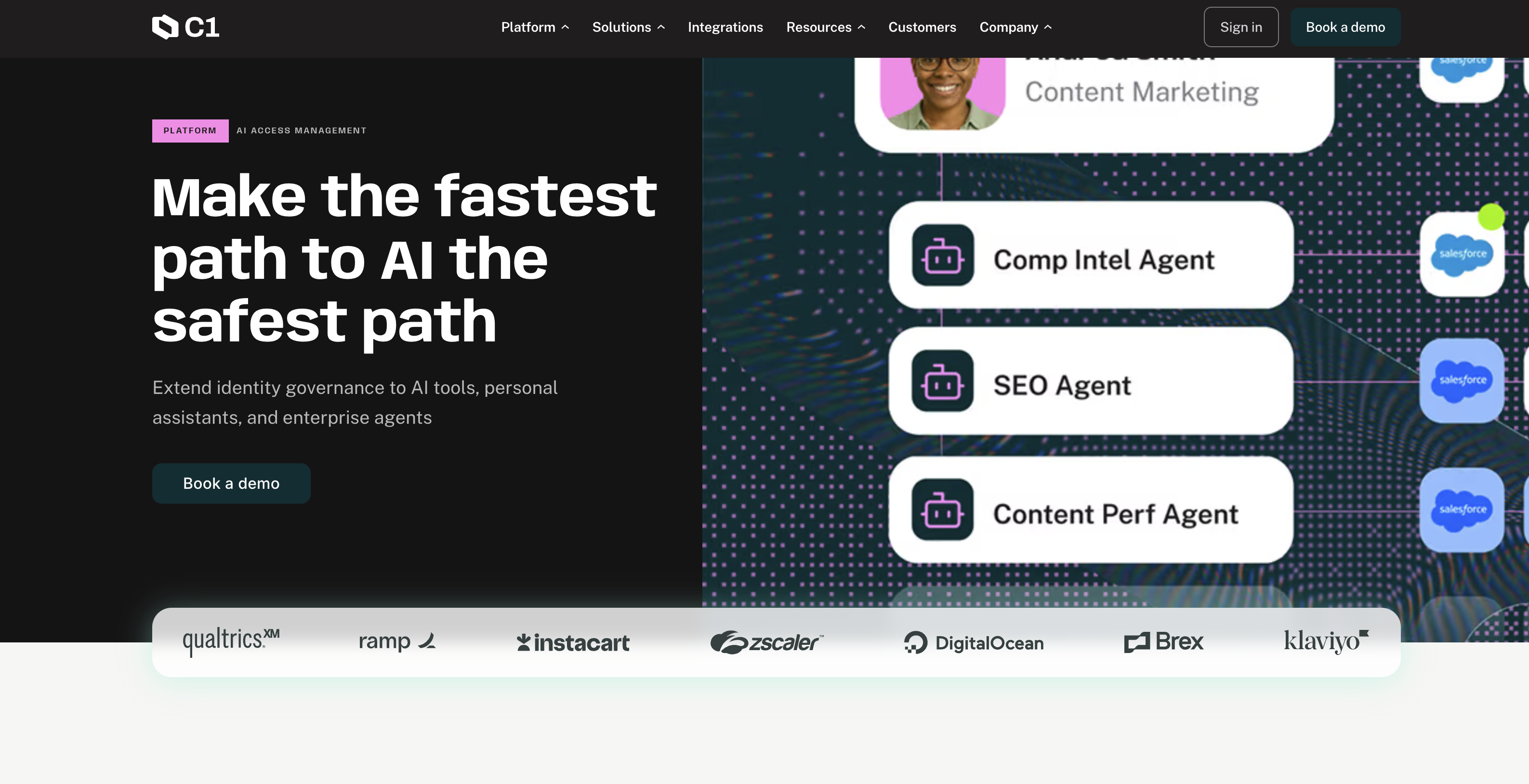
- Eliminate ticket-based delays for AI tool access with self-service provisioning and policy-based auto-approval, enabling rapid deployment without IT bottlenecks.
- Prevent credential sprawl and unauthorized access by managing AI agents as first-class identities with centralized credentials and lifecycle states.
- Filter sensitive data and control outputs at the tool-call level using an identity-aware MCP gateway that enforces fine-grained permissions and redaction rules.
- Achieve full audit compliance by logging every AI tool interaction with complete identity context for real-time monitoring and review.
- Adapt access policies dynamically based on user role, department, and operational context to maintain precise, intelligent governance.
Pros & Cons
Pros
- Policy-driven control
- Rapid provisioning of access
- Identity-aware MCP gateway
- Agent identity management
- Fine-grained policy enforcement
- Real-time audit and compliance
- Adapts policies to role
- Data protection at tool-call level
- Central credential management
- Limits credential sprawl
- Defines allowable agent operations
- Output redaction rules
- Approval for privileged operations
- Contextual policies
- Role-based policies
- Department-based policies
- Integrates with enterprise agents
- Sensitive input/output filter
- Provisioning without tickets or waits
- Automated access decisions
- Enforces least privilege
- Covers all tool calls
- Policies adapt to context
- Personal assistants as identities
- Managed secret credentials
- Instant credential revocation
- Automated evidence generation
- Contextual, policy-driven provisioning
- Reduced standing privileges
- Custom identity workflow automations
- Identity at scale management
- Single platform for identity use-cases
- Evidence for GDPR, HIPAA compliance
- Shared agents governance
- Automatic credential rotation
Cons
- No local deployment option
- Potential latency in provisioning
- Limited fine-grained policy options
- No direct user management
- Restricted to MCP environment
- Rigid context-based policies
- Lack of integrated single sign-on
- Limited to enterprise-level usage
- Requires prior identity governance
Reviews
Rate this tool
Loading reviews...
❓ Frequently Asked Questions
The C1 AI Access Management tool is a system that extends enterprise identity governance to AI tools, personal assistants, and enterprise agents. It allows for policy-driven control over who and what can access MCP-connected tools, data, and actions. It features self-service provisioning, policy-based auto-approval, an identity-aware MCP gateway, agent identity management, comprehensive policy enforcement, and real-time audit and compliance.
C1 extends enterprise identity governance to AI tools, personal assistants, and enterprise agents by providing policy-driven control over access. This control governs access to MCP-connected tools, data, and actions. The tool allows end users to request access to AI tools and have this access provisioned quickly, with policy-based auto-approval or human approval eliminating traditional bottlenecks.
In the C1 tool, policy-driven control is implemented through functions like policy-based auto-approval and an identity-aware MCP gateway. The MCP gateway acts as a policy-aware proxy, checking permissions and filtering sensitive inputs and outputs. This offers protection at the tool-call level. Policy-based auto-approval allows for swift provisioning of AI tools to end users.
Self-service AI tool provisioning in C1 allows end users to request access to AI tools and become provisioned quickly. This mechanism aims at reducing wait times and workarounds usually associated with traditional ticket-based systems.
Policy-based auto-approval or routed human approval in C1 eliminates the need for tickets, wait times, or workarounds by providing a fast and efficient process. Once a user requests access to an AI tool, their request is either automatically approved based on the predefined policy or sent to the relevant human operator for authorization. This cuts out the traditional, time-consuming approval processes.
The identity-aware MCP gateway in C1 acts as a policy-aware proxy, managing every AI tool call. It's responsible for authenticating agents, checking permissions, filtering sensitive inputs and outputs, emitting full audit events, and ensuring data protection.
C1 treats AI agents as stand-alone identities by giving them their own credentials, lifecycle states, and ownership. This elevates AI agents, treating them with the same rigorous governance as human users.
In C1, credentials are managed centrally, preventing potential credential sprawl across devices and AI clients. This central management of credentials offers improved control to organizations.
Fine-grained policy enforcement in C1 serves to regulate AI tool usage. It allows defining which tools an agent can call, what parameters are allowed, output redaction rules, and approval requirements for privileged operations.
C1 ensures real-time audit and compliance by logging every AI tool call with full identity context. This allows all tool usage to be monitored and reviewed, making audit and compliance procedures more effective and enforceable.
C1 adapts policies to role, department, and context, allowing for a tailored approach to identity management. This intelligent adaptation aligns with various identity use cases, providing relevant and effective governance.
C1 protects identity by employing several measures, including a policy-driven MCP gateway that authenticates agents and checks permissions, a central credential management system, and comprehensive real-time auditing that logs every AI tool call.
C1 provides AI-powered access management with intelligent policy-driven controls by using a policy-aware MCP gateway for permissions and sensitive data filtering. It uses policy-based auto-approval, and its agent identity management handles AI agent permissions and credentials. Fine-grained policy enforcement and real-time auditing ensure compliance.
C1's agent identity management feature creates an identity for every AI agent, granting them credentials, lifecycle states, and ownership. This allows AI clients and systems to experience seamless access and usage while maintaining strict control over governance.
C1 handles AI permissions by employing a policy-aware MCP gateway, which checks permissions for every AI tool call. Fine-grained policy enforcement further refines this by defining which tools an agent can call, what parameters are allowed, and so forth.
In C1, AI agent lifecycles are managed by granting each AI agent their own lifecycle states, centralizing their credentials management and governing them with the same rigor as their human counterparts.
C1 tracks AI audit trails by logging every tool call made with full context of the identity. This ensures full transparency and accountability in AI behaviors and usage patterns.
Role-based and department-based policies in C1 are adaptive policy elements that adjust AI tool access and usage permissions based on a user's role or department. Such adaptations allow for nuanced, context-related variations in how policies are applied.
C1 integrates with enterprise agents by treating these agents as first-class identities with their own credentials, lifecycle states, and ownership. This integration approach ensures governance aligns across human, AI tool, and enterprise agent activities.
Sensitive filter and output redaction in C1 work via the identity-aware MCP gateway, which acts as a policy-aware proxy. This gateway filters sensitive inputs and outputs, checking permissions and emitting audit events. Output redaction rules are managed within the fine-grained policy enforcement features of C1, offering specific control over output data to enhance security.
Pricing
Pricing model
No Pricing