

Overview
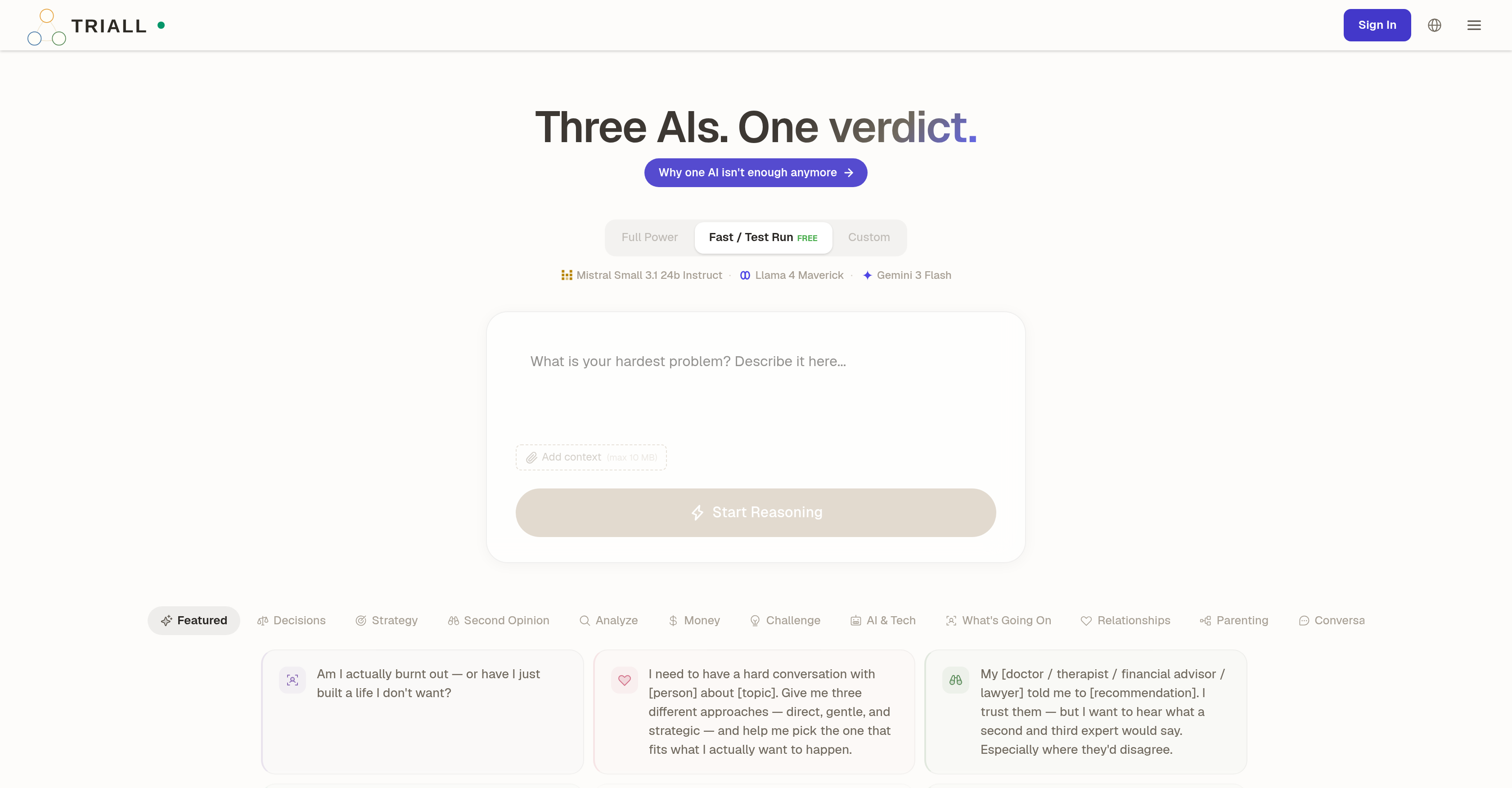
- Receive a stress-tested, refined answer instead of a first draft, using a systematic pipeline where AI models generate, critique, and fine-tune responses.
- Watch the full reasoning process unfold in real-time, observing how different AI models debate and converge on a final verdict.
- Challenge your final answer to uncover hidden weaknesses, using the built-in Devil's Advocate feature that probes for potential loopholes.
- Provide rich context for more accurate analysis by uploading PDFs and files directly into the AI reasoning pipeline.
- Access live, cited information during the analysis with integrated web search that pulls from current sources.
- Apply structured critical thinking to any domain, from investment research to academic writing, using a library of 178+ curated prompts.
- Preserve and learn from every analysis by exporting complete session histories to PDF, Markdown, or JSON formats.
Pros & Cons
Pros
- Live streaming of process
- Devil's advocate stage
- Web search integration
- File/PDF upload for context
- Exportable session history
- Prompt library with 178 questions
- No sign-up required
- Multi-stage algorithm
- Adaptable across various domains
- Finetuned responses
- Learning from user Interactions
- Real-time disagreements and convergence
- Critical thinking emphasis
- Increased reliability of solutions
- Open access availability
- Improves over time
- No initial commitment needed
- Data analysis capabilities
- Promotes problem-solving
- Pipeline reasoning
Cons
- One free session only
- No sign-up may limit customization
- Real-time streaming could be slow
- Reliance on shared learning
- Limited to text-based queries
- No mention of language support
- Time consuming due to multiple evaluations
- No mobile application mentioned
- No details on data privacy
Reviews
Rate this tool
Loading reviews...
❓ Frequently Asked Questions
Triall is an AI-powered tool that integrates three AI models into a reasoning pipeline for generating, critiquing, and refining answers. The tool promotes critical thinking and is designed to provide verified and enhanced solutions through its interactive AI models, rather than just presenting an initial answer. It does not require sign up and provides open access for all users.
Triall operates through a staged process involving three AI models. The first model generates an initial solution, which is then evaluated and critiqued by the second model. The third model takes the critique into account and finetunes the output to provide a more comprehensive response. This process is further subjected to a 'devil's advocate' stage where potential weaknesses in the final answer are probed for an even more refined verdict.
The three AI models in Triall are represented as Claude, Gemini, and Grok. These models have differing roles - the initial one, Claude, is responsible for generating a probable solution. The second model, Gemini, reviews and critiques Claude's output. The third model, Grok, considers Gemini's critique and finetunes the response, thereby optimizing the final output.
Yes, the operational process of Triall can be observed in real-time. Users can watch how the three AI models work, argue, and converge on the final output, all streamed live.
The devil's advocate stage in Triall is a part of the process following the synthesis of the final answer by the three AI models. This stage serves to challenge the finalized answer by probing for potential loopholes or weaknesses, thereby ensuring a more robust and refined output.
The web search feature in Triall assists in gathering additional live sources to provide more context or supplement the reasoning process. This feature enables the AI models to consider updated information during their analysis and verdict generation.
Yes, users can upload files or PDFs in Triall. This added context assists the AI models in analysing the question or problem more accurately by considering the context supplied in the uploaded documents.
The session history feature in Triall allows users to review previous sessions. The history is fully exportable and may assist users in understanding how previous questions were processed and solutions generated. This could provide insights for better query formulation in future sessions.
No, sign up is not a requirement for using Triall. The tool’s purpose is to provide open access and allow anyone to witness and participate in the AI-driven reasoning process. Only a hard question is required from the user's side.
Triall refines the initial responses generated by the first AI model via a multi-step process. The initial solution is critiqued by the second AI model and the third one finetunes the solution based on this critique. The fine-tuned solution is further subjected to a 'devil's advocate' stage which aims to identify potential weaknesses, further refining the response.
Triall has adaptability across domains. It's not confined to any specific domain and can hence be employed for decision-making and problem-solving contexts across various fields.
Triall deals with complex or hard questions by leveraging the reasoning pipeline involving its three AI models. The question is broken down, reviewed, and critiqued in a collaborative fashion. The output is then fine-tuned and probed in a 'devil's advocate' stage to ensure a robust solution.
The 'Three AIs. One Verdict' concept in Triall refers to the operational mechanism of the tool, wherein three AI models work in coordination to respectively generate, critique, and finetune answers. A single, refined verdict is produced through this collective reasoning process.
Yes, the accuracy and quality output of Triall can improve over time. As an AI tool, Triall uses data from various interactions to learn and enhance its reasoning and output generation capabilities. The more data it processes, the better it becomes at providing reliable solutions.
Triall can be highly beneficial for making investment decisions or career strategies. Its systematic reasoning pipeline can aid in scrutinizing various parameters and risks associated with investments or career paths, ultimately providing a consolidated and refined verdict.
Yes, Triall can also provide relationship advice. Its structured reasoning and critiquing approach may prove useful in understanding and navigating complex relationship scenarios.
Research conducted using Triall can be multi-faceted. Given the open-domain adaptability of the tool, it can be used to explore questions and generate comprehensive insights across various academic or professional research themes.
By 'interactive AI', Triall refers to the live, real-time engagement between its three AI models in generating, critiquing, and refining solutions. The AI models do not work in isolation but rather interact collaboratively.
Triall uses data analysis extensively throughout its process. It initially analyses a user-posed question to generate a probable solution. Data analysis is again applied when the initial solution is critiqued and finetuned. Web-searched data and uploaded documents are also analysed for incorporation into the verdict.
Triall offers a free session with no signup required. It does not provide information about premium features, if there are any, on its website. For further details, users may approach the developers or service providers directly.
Pricing
Pricing model
Free Trial
Paid options from
$11/month
Billing frequency
Monthly
Refund policy
No Refunds