
Overview
- Stop malicious AI agent behavior before execution by detecting prompt injections, tool misuse, and policy drift in real-time, powered by dual analysis of activity logs and reasoning traces.
- Prevent data breaches and unauthorized actions with block mode that automatically intervenes and halts suspicious agent activities during runtime.
- Maintain full data sovereignty by self-hosting the entire monitoring stack on your own infrastructure using Docker commands, with no external data transmission.
- Enforce AI policy compliance continuously as agents operate by defining acceptable behaviors vs. known risks, then catching deviations the moment they occur.
- Reduce integration overhead to near zero with a Python SDK that wraps LangChain agents in just two lines of code for immediate security coverage.
- Get instant visibility into agent operations through customizable alerting channels that notify you the second a security event is classified, without waiting for logs.
Pros & Cons
Pros
- Real time security monitoring
- Direct control over agents
- Analyzes agent activity logs
- Analyzes reasoning traces
- Can intervene during events
- Python SDK integration
- Two operation modes: audit/block
- Alerting channels feature
- Defines acceptable behaviours
- Highlights known risks
- Self-hosting compatibility
- Open-source tool
- Detects policy drift
- Prevents threat attempts
- Behavior analysis of agents
- In-flight behaviour intervention
- Customizable alert system
- Audit mode for monitoring
- Block mode for intervention
- Generates security audit
- Hosted on GitHub
- Real-time threat response
- Agent activity log monitoring
- Accessible and easy use
- Python SDK: simple integration
- Low risk of unwanted behaviours
- Designed for range of behaviours
- Flexible alert customization
- Dashboard for real-time updates
- Can install with two lines
- Monitors tool calls/outputs/actions
- Real-time classified events
- Offline, data sovereign deployments
- Entire stack runs on single host
- Reasoning analysis boosts detection accuracy
- Free, open-source tool
- Can run on user's infrastructure
Cons
- Python SDK restricted
- Only two operation modes
- Customization complexities
- Limited alert channels
- Dependent on LangChain agents
- Self-hosting pains
- Requires frequent interventions
- Offline deployments demanding
- Single host limitations
Reviews
Rate this tool
Loading reviews...
❓ Frequently Asked Questions
Adrian is a runtime security monitoring and control engine designed for AI agents. It is capable of identifying and handling security matters such as the misuse of tools, prompt injections, and policy drifts in real time, before the AI agent conducts the action. It does this by scrutinizing both agent activity logs, encompassing tool calls, actions, and outputs, as well as reasoning traces to spot any potential harmful or misaligned behavior.
Adrian employs a detailed analysis of both agent activity logs and reasoning traces to detect harmful or misaligned behavior. The agent activity logs include tool calls, actions, and outputs carried out by the AI. On the other hand, reasoning traces allow Adrian to understand the logic or reasons behind these actions. By combing the two, it can identify any behaviour that may pose a security risk.
Adrian offers a suite of features geared towards ensuring AI agent security. These include real-time analysis of agent activities and reasoning traces, malicious tool use detection, real-time understanding and intervention of policy drift, prompt injection, and more. It also provides alerting channels, the ability to delineate acceptable behaviours and known risks, and compatibility for self-hosting on users' own infrastructure. Furthermore, it facilitates easy integration into LangChain agents with its Python SDK.
Yes, Adrian is designed not only to monitor AI activities but also to intervene them when necessary. This is mainly done in its block mode operation. When a potential harmful activity is identified, Adrian can interrupt the suspect activity as part of its control measures.
Integration of Adrian into LangChain agents is made seamless with its Python Software Development Kit (SDK). You first need to install the SDK using pip, the Python package installer. Then a LangChain provider for the agent's model needs to be installed. Finally, an 'adrian.init' and 'adrian.shutdown' bracket is wrapped around the standard LangChain.
In Adrian, the audit mode is responsible for identifying and classifying security events. It observes AI agent operations and raises an alert when it spots activities that may pose a risk based on set guideline. On the other hand, block mode goes a step further. When suspicious activities are identified, block mode interrupts these actions rather than just generating an alert.
Yes, Adrian can be hosted on a user's own infrastructure. This ensures data privacy and sovereignty. Adrian supports entirely offline, data sovereign deployments using just a handful of Docker commands. The Go backend, the Next.js dashboard, the Python SDK, and a Llama.cpp container that serves a local Gemma model can all be run on a single host.
Absolutely, Adrian offers real-time analysis and security event classification. By continuously monitoring agent activity logs and reasoning traces, it can immediately detect any aberrations or behaviors that violate set guidelines. Once identified, these security events are promptly classified depending on their nature and severity for appropriate handling.
Adrian provides its users the ability to establish acceptable behaviours for their AI agents. This is done during configuration, where one sets the remit of the agent, distinguishes between the behaviors that are permissible versus the known risks. With these boundaries in place, Adrian can then detect any deviations and take corrective actions when an AI agent engages in unacceptable behaviours.
Yes, Adrian is designed to detect policy drift in real time. Its continuous monitoring and control system is adept at catching changes that indicate a drift from pre-established policies. This allows it to intervene and correct course as soon as it identifies the deviation.
Adrian supports alerting channels, making sure notifications about identified security events reach you. The specific types of alerting channels are not explicitly stated on their website presently. However, they could potentially include email alerts, SMS notifications, system messages, etc.
Adrian is geared towards preventing misuse of AI tools. It does this by continuously monitoring and analyzing two main things: agent activity logs and reasoning traces. If it detects suspicious activities, like malicious tool use, prompt injection, or policy drift, it can intervene in real time and block these activities before they're executed.
Block mode is an operational mode in Adrian that not only identifies the malicious activities of an AI agent but also interrupts them. When Adrian operates in block mode, it stops the identified suspect activities, providing an extra layer of security by taking proactive actions against potential risks.
Yes, Adrian is capable of analyzing both agent activity logs and reasoning traces. While activity logs provide a record of the actions, output, and tool calls made by an AI agent, reasoning traces help in understanding the context, logic, or rationale behind these actions. This dual analysis enhances its ability to detect irrational behavior.
Adrian contributes to malware prevention by spotting and acting on malicious or misaligned behaviours before they're executed. This preemptive approach identifies harmful actions, like misuse of tools, in real time and interrupts the agent's activities if they pose threat; thus, mitigating the risk of malware-related issues.
Adrian plays a proactive role in risk management. It delineates acceptable behaviours and known risks, helping the user to clearly define what the AI agent is and isn't permitted to do. If the agent attempts to deviate from established guidelines or falls into known risk patterns, Adrian detects this and can intervene thereby preventing the risk from escalating.
Integrating Adrian into your own infrastructure is a straightforward process facilitated by its compatibility for self-hosting. Users need to use Docker commands to run the Go backend, the Next.js dashboard, the Python SDK, and a Llama.cpp container that serves a local Gemma model on a single host machine. This way, Adrian can be made to operate on your own infrastructure, ensuring data sovereignty and privacy.
Adrian provides a flexible solution for numerous use cases that require real-time AI security monitoring and control. These could range from use cases where there need to be monitoring and control of AI agents in e-commerce platforms, customer service chatbots, automated data analysis systems, healthcare AI applications, AI-driven utility management systems, and many more.
Yes, Adrian offers real-time security monitoring for AI agents. It is consistently vigilant about the operations and behaviours of AI agents, promptly catching and dealing with events such as misuse of tools, prompt injections, and policy drifts. This allows Adrian to tackle any potentially harmful or misaligned behaviour before the AI agent goes ahead with the action.
Adrian has two fundamental operational modes: the audit mode and block mode which operate differently for enhanced AI agent security. The Audit mode specializes in identifying and classifying security events. It essentially monitors the operations and raises red flags when it spots suspicious activities. The Block mode, on the other hand, actively disrupts these detected dubious activities, providing active security control measures on top of monitoring.
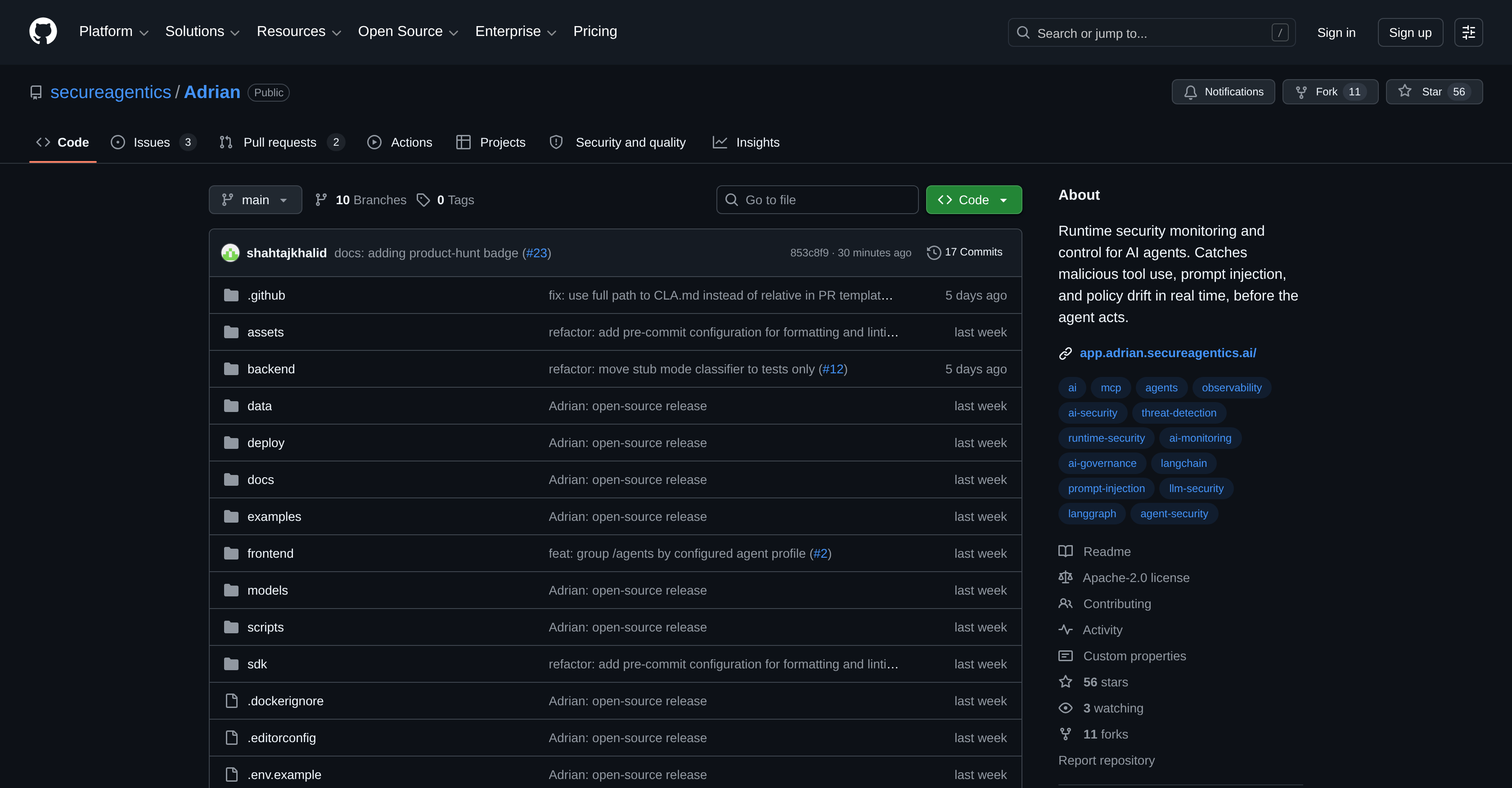
Adrian is an open-source runtime security monitoring and control tool designed specifically for Artificial Intelligence (AI) agents.
Adrian provides security for AI agents by continually monitoring their activities, such as tool calls, actions, and outputs. Apart from monitoring agent activity logs, it also examines reasoning traces to identify and counteract any harmful or misaligned behaviors. This real-time analysis allows Adrian to catch and handle events such as malicious tool use, prompt injection, and policy drift before the AI agent acts.
Adrian is capable of detecting and handling events like malicious tool use, prompt injection, and policy drift in real-time, before the AI agent acts.
Yes, Adrian has the capability to intervene and halt an AI agent's suspect activities. This is especially true in its block mode of operation, where it interrupts the agent's actions if they are deemed suspicious.
Adrian can be integrated into LangChain agents through a Python Software Development Kit (SDK). With just two lines of code, developers and AI practitioners can install and integrate Adrian with LangChain agents.
Adrian operates in two primary modes: audit mode and block mode.
In audit mode, Adrian identifies and classifies security events for further analysis. However, in block mode, Adrian takes an additional step and interrupts any identified suspect activities.
The key features of Adrian include its ability to alert via multiple channels, the capacity to delineate acceptable behaviours from known risks, compatibility for self-hosting on a user's own infrastructure, the ability to analyse agent activity logs and reasoning traces, real-time detection and response to harmful behaviours, and in-flight intervention capabilities.
Yes, Adrian has the capability to be self-hosted on a user's own infrastructure. This makes it a highly flexible solution suitable for a variety of use cases that require real-time AI security monitoring and control.
Yes, Adrian is built to offer real-time AI security monitoring and control.
Yes, Adrian is an open-source tool.
Adrian can be found in the secureagentics repository on GitHub.
Adrian analyses AI behaviour by inspecting agent activity logs, including tool calls, outputs, actions, and the agent's reasoning traces. This allows it to detect any deviant behaviours and react in real-time, before the agent acts.
Adrian offers developers and AI practitioners a straightforward and accessible way to ensure their AI tools and models operate within their specified limits. It helps reduce the risk of unexpected or unwanted behaviors by providing real-time monitoring and control capabilities.
Yes, Adrian allows for in-flight intervention on behaviours that deviate from expected or acceptable patterns, adding an extra layer of security during the runtime operation of AI agents.
Yes, there is a Python Software Development Kit (SDK) for Adrian, which can be easily installed and integrated.
Yes, Adrian provides an alert system. Users can set up specific alerting channels as part of the tool's customizable features.
Absolutely, Adrian can be customized to define acceptable behaviours and known risks. This allows users to have precise control over the operation of their AI agents.
Adrian helps ensure AI policy compliance by continuously monitoring the behaviour of AI agents in real-time. Any anomalies, such as policy drift or deviant behaviour, are detected before the AI agent executes its actions. This also extends to in-flight intervention for behaviours that deviate from the accepted norm.
Adrian plays a crucial role in threat detection and prevention. By scrutinising an agent's activity logs and reasoning traces, it identifies deviant behaviours and reacts in real time, negating the potential risks before the agent acts. This includes handling events like malicious tool use and prompt injection, thereby adding another layer of security to the AI system.
Pricing
Pricing model
Free
Paid options from
Free