

Overview
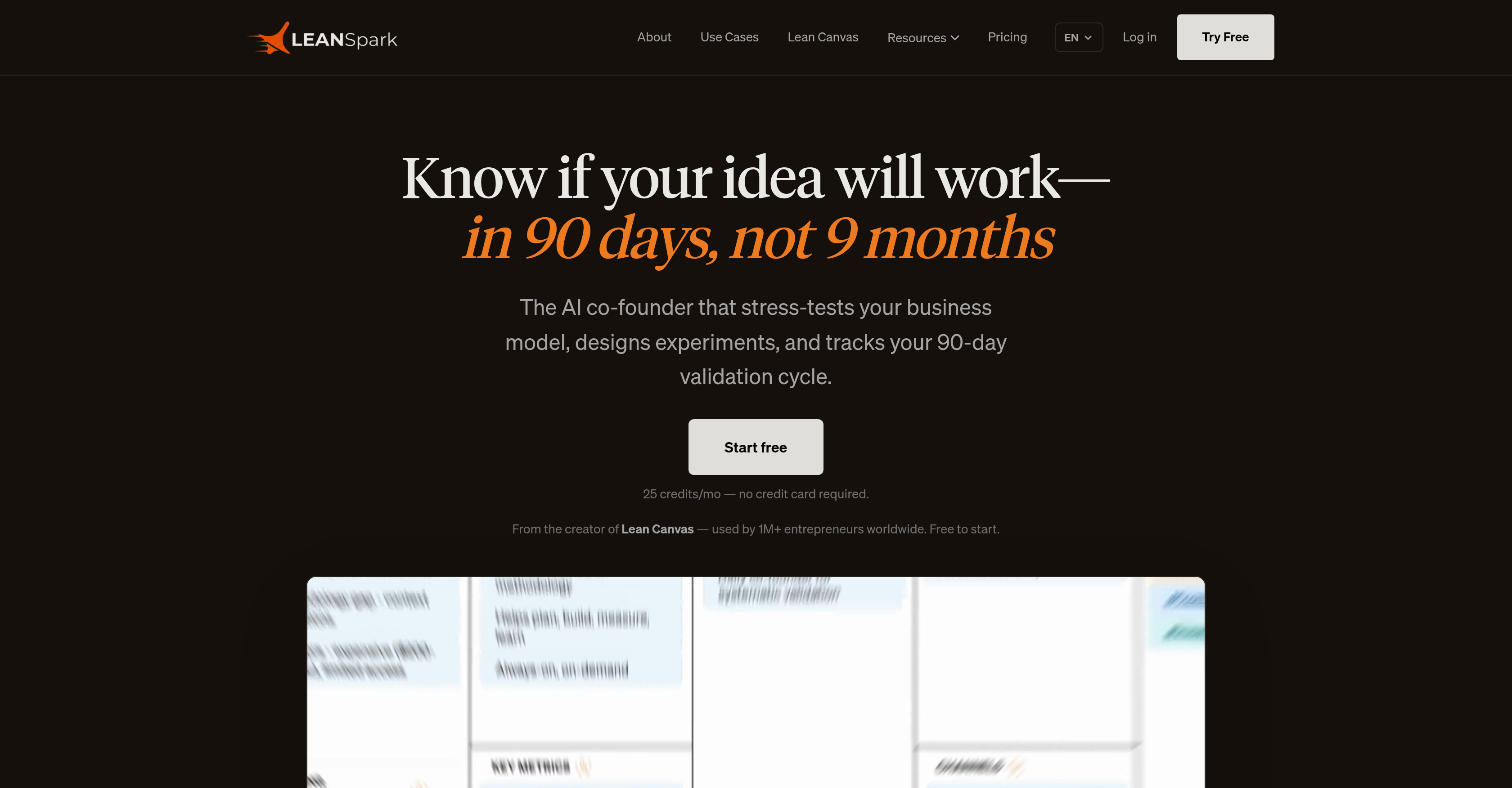
- Stop building the wrong thing by identifying fatal flaws in your business model early, using a systematic assessment across Clarity, Desirability, Viability, Feasibility, Defensibility, Timing, and Mission.
- Make data-driven pivot or persevere decisions every 2 weeks, through structured 90-day validation cycles that turn assumptions into evidence from real experiments.
- Extract actionable insights from customer interviews instantly by pasting transcripts, with AI identifying key patterns and suggesting your next strategic steps.
- Design effective problem interviews and experiments with guided coaching, ensuring you ask the right questions to validate your riskiest assumptions.
- Maintain perfect project continuity as every canvas update, metric, experiment, and past pivot is remembered, creating a context-aware AI co-founder that learns with you.
- Get specific fixes for your unique business model, with AI guidance drawn from the complete Continuous Innovation Playbooks, not generic advice.
Pros & Cons
Pros
- Ash Maurya's proven methodologies
- Business model stress-testing
- Systematic validation cycles
- Detailed 7-dimensional assessment
- Risk identification before resource commitment
- Offers context-aware responses
- Maintains session continuity
- Efficient project memory
- Repeatable structured processes
- Supports decision making
- Enables effective customer interviews
- Lean Canvas import feature
- Problem identification and solutions
- Insight-driven metrics
- Strategic planning support
- Startup idea validation acceleration
- 90-day idea validation cycle
- 2-week sprints for data-driven decision
- Efficient in resource optimization
- Streamlined business validation process
- Business model design framework
- Encourages data-driven decision making
- Continuous Innovation Playbook access
- Provides methodical, structured approach
- Canvas, metric, experiments and pivot tracking
Cons
- No offline functionality
- No multi-language support
- Requires continuous context maintenance
- Uses only Ash Maurya's methodologies
- Lacks API for integrations
- No reference to customer support
- No collaborative features mentioned
- High complexity for beginners
- Lack of user customization
Reviews
Rate this tool
Loading reviews...
❓ Frequently Asked Questions
The main purpose of LEANSpark is to enable startup founders to validate their business ideas. It is designed as an AI co-founder, providing a platform to stress-test business models, design experiments and follow through a 90-day validation cycle.
LEANSpark validates business ideas by using Ash Maurya's methodologies. It stress-tests the business model, helps design experiments and tracks the 90-day validation cycle. It uses a business model assessment tool to scrutinize the business model across seven critical dimensions and identifies any potential flaws before resources are committed.
LEANSpark stress-tests business models using a business model design (BMD) framework. The framework assesses the business canvas across seven critical dimensions to identify potential issues. This assessment helps in catching problems early, saving founders from investing time and resources in building the wrong thing.
The 90-day validation cycle in LEANSpark comprises of systematic 90-day cycles with 2-week sprints. Each sprint involves identifying the riskiest assumption, designing an experiment, running the experiment, gathering evidence, analyzing results against success criteria, and finally deciding whether to persevere, pivot, or pause. This cycle is designed to sharpen the business model or give a clear signal to change the course.
LEANSpark provides specific, context-aware responses for queries related to the continuous innovation framework. It has access to all Continuous Innovation Playbooks and can provide answers that are specific to a user's business model and their current challenges.
LEANSpark's business model assessment tool works by assessing your business model across seven critical dimensions. It provides a systematic approach to identify any flaws before one commits resources to it.
The seven critical dimensions that LEANSpark assesses in a business model are Clarity, Desirability, Viability, Feasibility, Defensibility, Timing, and Mission.
LEANSpark supports decisions with data through its structured approach to validation cycles and sprints. These systematic 90-day validation cycles feature 2-week sprints backed by data-driven decisions, ensuring all actions taken are informed and measured.
LEANSpark offers features to help analyze customer interviews effectively. You can paste your interview transcripts and LEANSpark will extract key insights, patterns, and suggest next steps, ensuring that nothing gets lost between conversations.
LEANSpark maintains context across sessions by storing all interactions and processes. Every conversation, metric, experiment and past pivot adds to the project's memory, providing a more comprehensive and context-aware experience for the user.
LEANSpark offers added benefits over other AI tools by providing structured and repeatable processes, a context-aware experience, a comprehensive knowledge package beyond isolated activities, and specific guidance for individual business models.
Each session with LEANSpark contributes to your project's memory by recording all activities carried out. This includes updates to your canvas, changes to metrics, past pivots, and more.
Yes, you can ask LEANSpark anything about the continuous innovation framework. It has complete access to all Continuous Innovation Playbooks and can provide quick answers, framework recommendations, and guidance specific to your canvas.
LEANSpark can help design more effective experiments by identifying the riskiest assumption in your model and helping you design an experiment around it. The results of these experiments are then analyzed against success criteria to decide the next course of action.
The 2-week sprints are integrated into LEANSpark's 90-day validation cycle to achieve more precise and swift results. These sprints involve planning, executing, checking, and acting upon an experiment, allowing for six complete cycles within the 90-day period.
In the context of LEANSpark, a structured and repeatable process means a series of systematic activities that are performed in each session to validate a business model. These may include stages such as identifying the riskiest assumption, designing and running an experiment, analyzing results, and deciding the next step.
LEANSpark equips founders to analyze customer interviews by providing a feature to paste interview transcripts. The AI will then extract key insights, identify patterns, and suggest next steps, thereby effectively translating conversations into actionable insights.
Yes, LEANSpark provides guidance for conducting customer interviews effectively. It assists in designing interview questions, ensuring the right information is gleaned without leading the respondent or making questions too broad.
Yes, LEANSpark can help identify flaws in your business model before you commit resources to it. The AI scrutinizes the business model across seven critical dimensions including Clarity, Desirability, Viability, Feasibility, Defensibility, Timing, and Mission, highlighting potential problems and recommending fixes.
The project memory that LEANSpark contributes to comprises canvas updates, changes to metrics, past pivots, and all interactions with the tool. This continuous updating of project memory allows for a more contextual and comprehensive use of the tool.
Pricing
Pricing model
Freemium
Paid options from
$40/month
Billing frequency
Monthly
Related Videos
Capture Your Startup's Story, Automatically
LEANSpark•6 views•Mar 9, 2026