
OpenSourceAIHub
Overview
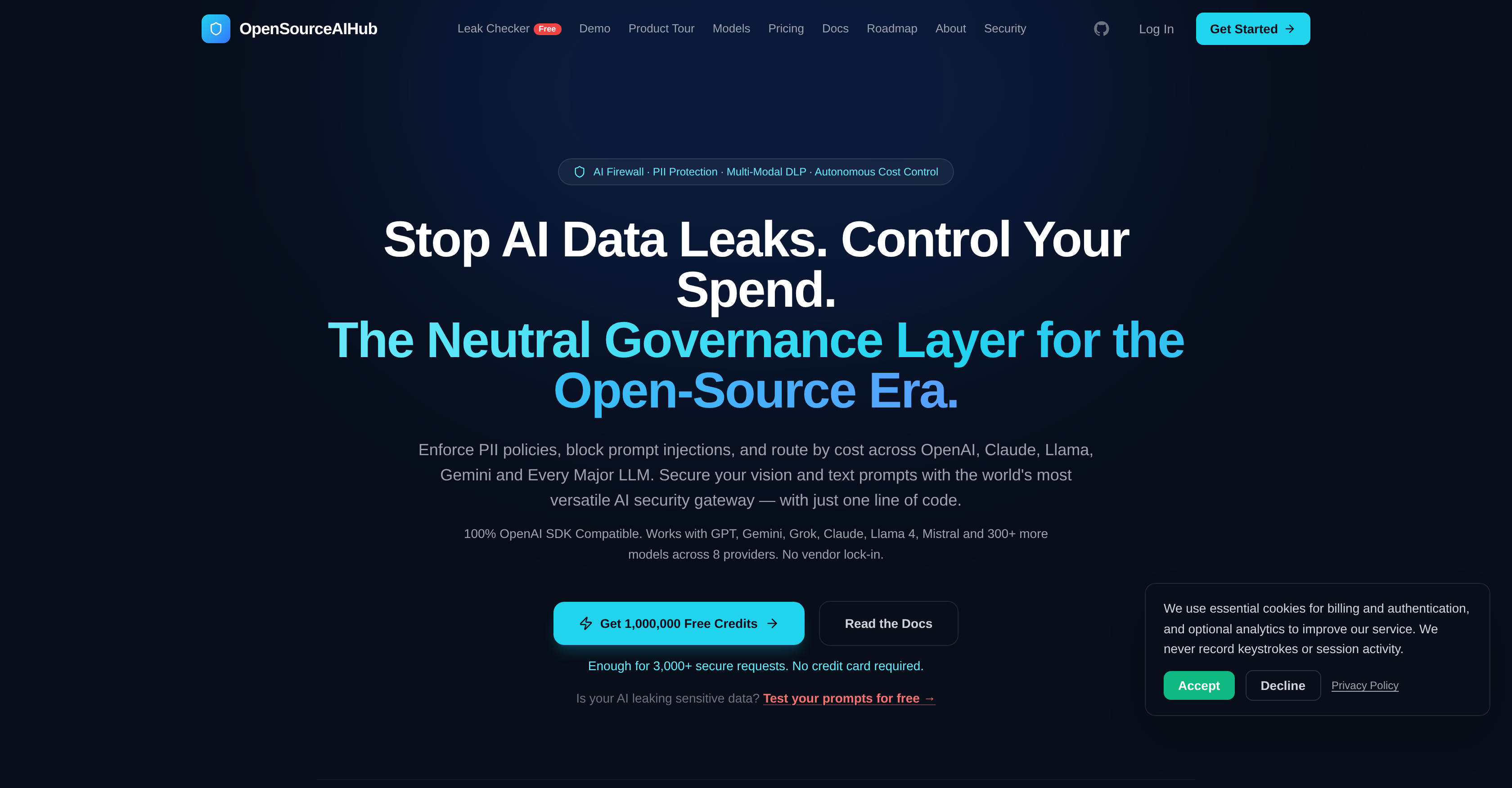
- Eliminate AI data leaks before they happen with real-time redaction of 28+ PII types from text and images, powered by an AI Firewall that scans every request.
- Slash LLM costs by up to 90% compared to GPT-4o using autonomous smart routing that selects the most cost-efficient provider from 300+ models for each request.
- Maintain full data sovereignty and compliance (GDPR/HIPAA/PCI) with a stateless architecture that never stores prompts or responses, only using volatile memory.
- Integrate security and cost control in minutes with a 2-line code change using the OpenAI SDK-compatible proxy, requiring no major codebase overhaul.
- Enforce strict project budgets and prevent billing surprises with hard credit limits and token quotas configurable per API key.
- Avoid vendor lock-in and use your preferred models with a neutral governance layer supporting OpenAI, Claude, Gemini, Llama, and others with BYOK at 0% markup.
Pros & Cons
Pros
- Professional security gateway
- Hardened, stateless firewall
- Supports 300+ models
- Total data sovereignty enforcement
- Real-time redaction of 28+ PII entities
- Image OCR for PII detection
- Autonomous cost-optimized routing
- Saves up to 90% vs GPT-4o
- Per-project budget governance
- Token quotas enforcement
- Audit-ready security logs
- Integration in 2 lines of code
- 1,000,000 Free Hub Credits offer
- Privacy-first governance layer
- Never persist prompt content
- Smart routing of provider efficiency
- Hard budget enforcement
- Full audit trails
- GDPR, HIPAA, PCI-DSS compliant
- Prevention of vendor lock-in
- Dashboard-configured spending limits
- Security and compliance awareness
- Model versatility
- Automated PII protection
- Multi-Modal Data Loss Prevention
- Autonomous cost control
- Cost-optimized provider routing
- Neutral governance layer
- Security auditing
- API Key Generation
- No data persistence
- Free initial hub credits
- Pay-as-you-go Wallet mode
- Pro Plan for BYOK
- Zero-Percent Markup option
- Sensitive Data Auto-redaction
- Starts with 1 Million free credits
- Budget-Centric Approach
- Budget enforcement per API key
- Disposable API request logs
- Platform Neutral Implementation
- Active Firewall Functionality
- Built-in DLP Policy Engine
- Prompt Injection Blocking
- Scan and Clean Data Functionality
- Optimize cost and enforce limits
- PII is removed inside Hub
- Custom Regex IP Guard
- Multiple Provider Failover Functionality
Cons
- Limited to 100+ models
- Provider optimization not customizable
- No personalized scanning rules
- Data persistence only in RAM
- Only 28+ PII entities detected
- No data storage options
- Setup requires codebase modification
- No OCR scanning customizations
- Pro plan required for BYOK
Reviews
Rate this tool
Loading reviews...
❓ Frequently Asked Questions
OpenSourceAIHub is an open-source AI firewall and proxy designed to enhance data security and cost optimization when using Language Learning Models (LLMs). It provides a layer of security that sanitizes application prompts for sensitive data types before they reach AI models in third-party servers, thus helping prevent personal identifiable information (PII) leaks. The tool also enables effective control over request routing to the most cost-efficient provider, all while requiring minimal code alterations for integration into existing systems.
OpenSourceAIHub mitigates data leaks by efficiently sanitizing application prompts for sensitive data types before they reach AI models in third-party servers. Its AI firewall inspects every message before it leaves and removes any sensitive details. This process helps prevent leaks of personal identifiable information (PII) such as names, emails, credit cards, or passwords.
Yes, OpenSourceAIHub supports cost optimization by ensuring requests are routed to the most cost-efficient provider available. This helps manage expenditure on AI processes effectively. Its security dashboard even allows users to track potential cost savings in real-time.
The OpenSourceAIHub firewall works by scanning each request for sensitive data and removing any such data before it is sent to third-party AI servers. This ensures that the AI models on the other side never receive any sensitive data like Personal Identifiable Information (PII), thus protecting users from potential data leaks.
To set up OpenSourceAIHub, three steps are required: first, the user must create an account. Second, they must point their API to OpenSourceAIHub. Finally, they must send their requests safely. This straightforward process allows ease of integration into existing systems.
OpenSourceAIHub is compatible with numerous applications and services. It supports several top Language Learning Models (LLMs), offering versatility and no vendor lock-in. Its compatibility extends to other services, like Google and GitHub, further enhancing its utility and versatility.
Yes, OpenSourceAIHub ensures GDPR and PCI compliance. The tool includes capabilities for GDPR and PCI template inclusion, making it a safe choice for users that are concerned about compliance with data protection regulations.
Yes, OpenSourceAIHub can be used with multiple Language Learning Models (LLMs). It offers the versatility of supporting several top LLMs, eliminating potential vendor lock-in and enhancing its overall utility and versatility.
OpenSourceAIHub enhances data security by adding a vital layer of protection that sanitizes application prompts for sensitive data types before they reach AI models on third-party servers. This process screens out potentially sensitive details like names, emails, credit cards, or passwords. Additionally, the tool logs every request for user review, but refrains from storing any data within the tool itself, thus providing transparency without compromising data security.
The OpenSourceAIHub security dashboard provides a means of user control over AI requests. It enables real-time tracking of sensitive data protection and policy enforcement. In addition, it allows users to monitor potential cost savings associated with AI process expenditure.
'Transparent logging' in the context of OpenSourceAIHub refers to the tool's feature where every request is logged for user review. However, no data is stored within the tool itself. This manner of transparency can assist users in understanding how the firewall is working and what data it's interacting with, while maintaining data privacy.
The target audience for OpenSourceAIHub includes both startups looking for data leak prevention methods, and backend engineers in search of a drop-in OpenAI SDK replacement with automatic PII removal and cost routing capabilities.
OpenSourceAIHub can protect against inadvertent transmission of various types of sensitive details. These include personal identifiable information (PII) such as names, emails, credit cards, or passwords.
Yes, OpenSourceAIHub is designed to be integrated into existing systems with ease. It requires minimal code alterations, enabling users to incorporate it into their existing workflows with little effort.
OpenSourceAIHub handles personal identifiable information (PII) by preventing it from being unintentionally transmitted to third-party AI models. The tool sanitizes application prompts for various types of PII, such as names, emails, credit cards, or passwords, ensuring these details do not reach the AI models in outbound requests.
Yes, OpenSourceAIHub allows real-time tracking of sensitive data protection. Its security dashboard enables users to view in real time how the tool is managing the protection of sensitive data and enforcing data safety policies.
OpenSourceAIHub avoids vendor lock-in by providing support for multiple Language Learning Models (LLMs). This offering means that requests can be routed to any number of different providers as necessary, depending on the most cost-efficient provider, user needs, or other factors.
OpenSourceAIHub ensures data privacy by putting a robust security layer before AI models in third-party servers. This layer scans and sanitizes any sensitive data found in the application prompts before they reach the AI models. Furthermore, though every request is logged for user transparency, no data is stored within the tool itself.
OpenSourceAIHub handles policy enforcement through its security dashboard that allows users to monitor sensitive data protection and policy enforcement in real-time. In this way, users can consistently ensure that the best and most efficient safety practices are being followed.
Safe request sending process in OpenSourceAIHub involves thorough inspection of each request for sensitive data, then cleaning and routing these requests to the most cost-efficient provider available. Plus, every request is logged and made available for user review on the security dashboard, ensuring full transparency.
OpenSourceAIHub is a security gateway for the Open-Weights era, providing hardened firewall services for AI deployments. It ensures security, prevents AI data leaks, and helps to optimize expenditure by enforcing project budgets and token quotas. It uses real-time redaction to remove 28+ personally identifiable information (PII) entities from texts and images. In keeping with a privacy-first governance layer, it does not store, persist, or train on users' prompts or AI responses. The data only exists transiently during each API request and is immediately destroyed upon completion.
The AI Firewall in OpenSourceAIHub functions as a security layer between an application and large language model (LLM) providers. It scrutinizes every AI request for sensitive information such as social security numbers, credit card numbers, email addresses, and API keys, and redacts them before they reach any provider. This robust mechanism aids in preventing data leaks and in ensuring meeting compliance requirements such as GDPR, HIPAA, and PCI-DSS.
OpenSourceAIHub actively scans every prompt for 28+ types of PII entities present either in text or images (via OCR). Any detected sensitive information, including social security numbers, credit card details, email addresses and API keys, is automatically redacted before being sent to the AI provider. This approach offers an additional line of defense against unintentional data leaks or inadvertent exposure of PII in AI interactions.
OpenSourceAIHub is compatible with over 300+ models like Llama 3, OpenAI, Claude, Gemini and others. This compatibility ensures that teams can deploy a wide range of AI models optimally, while still retaining data sovereignty and benefiting from OpenSourceAIHub's security and cost-effective features.
OpenSourceAIHub's smart cost-routing feature optimizes costs by selecting the most efficient provider for each request across 100+ models. It also provides hard budget enforcement to keep AI spending in check. This feature is autonomous and it can help businesses save up to 90% as compared to GPT-4o, as it operates by navigating the lowest cost option from a pool of multiple AI providers.
Autonomous cost-optimized routing in OpenSourceAIHub works by directing each request to the most cost-effective provider out of 100+ models. This system is autonomous and routes requests on its own, optimizing provider choice based on cost efficiency. By using this system, users can avoid wasteful AI spending and enjoy potential savings of up to 90% compared to GPT-4o.
OpenSourceAIHub meticulously handles sensitive data by scanning each AI request for 28+ types of personally identifiable information (PII), including social security numbers, credit card numbers, email addresses, and API keys. Using Optical Character Recognition (OCR), it also tests images for hidden PII. All detected sensitive data is automatically redacted before it reaches any third-party server. Importantly, no prompt or AI response data is stored or persisted by OpenSourceAIHub, it only temporarily exists in server memory during each API request and is immediately destroyed post completion.
OpenSourceAIHub effectively helps prevent vendor lock-ins by providing a neutral governance layer that is compatible across many models and a range of AI providers such as OpenAI, Claude, Gemini, and Groq among others. This compatibility ensures that organizations are not restricted to a single vendor or model, and it promotes autonomy and choice in AI deployments.
Smart Routing is a handy feature of OpenSourceAIHub that chooses the most efficient AI provider for every request among multiple models. It is an autonomous system that optimizes costs by navigating through a pool of multiple AI providers and selecting the most affordable option for a particular request.
OpenSourceAIHub operates in full adherence to multiple compliance regulations. It meets GDPR, HIPAA, and PCI-DSS compliance, offering reassurance to organizations that require stringent data protection regulations. The OpenSourceAIHub maintains exhaustive, audit-friendly security logs which allow it to verify these compliance credentials at any time required.
Integration with OpenSourceAIHub is simple and can be achieved with just two lines of code. It is fully compatible with the OpenAI SDK. Users only need to generate an API key within their dashboard and adjust their codebase to point towards OpenSourceAIHub.
Stateless in the context of OpenSourceAIHub refers to the practice of not storing, persisting, or training on user prompts or AI responses to ensure data sovereignty. OpenSourceAIHub adheres to a stateless security architecture where users' data exists only in volatile server memory (RAM) for the duration of each API request and is destroyed instantly upon completion, thereby achieving total data sovereignty.
The Pro plan at OpenSourceAIHub, priced at $29 per month, offers several key features such as Bring Your Own Key (BYOK) option with 0% markup, ensuring the user retains complete control over their data. This also guarantees that they can use their preferred AI provider without having to worry about additional costs from OpenSourceAIHub. Additionally, the plan offers the full suite of features including the AI Firewall, Smart Routing, and Statelessness.
OpenSourceAIHub offers an exclusive signup offer. You can get 1,000,000 free Hub credits upon signing up. These credits can be utilized towards using the variety of features and capabilities that OpenSourceAIHub provides, offering a substantial starting advantage for new users.
OpenSourceAIHub offers numerous features to control costs and optimize AI deployment. It allows setting up per-project budgets and token quotas to keep track of spending. A built-in feature called Smart Routing autonomously routes AI requests to the most cost-effective provider, potentially saving up to 90% off the costs compared to using GPT-4o without the Hub.
OpenSourceAIHub ensures that no data leaks occur by implementing several robust data protection measures. It uses its AI Firewall to scan every AI request for sensitive information in real-time and redact such data before it reaches any provider. Furthermore, it does not store or persist any prompt content, ensuring the flow of sensitive data is minimized and it remains in control of the user.
OpenSourceAIHub enforces governance by providing several key features including per-project budgets and token quotas. These features allow teams to have economic control over AI deployments. Audit-ready security logs provide the necessary transparency about every AI request, while the system ensures complete data sovereignty, as it doesn't persist any prompt content.
OpenSourceAIHub is fully compliant with several major international security standards including General Data Protection Regulation (GDPR), Health Insurance Portability and Accountability Act (HIPAA), and Payment Card Industry Data Security Standard (PCI-DSS). These compliance credentials attest to OpenSourceAIHub's commitment to protecting sensitive data and maintaining best security practices.
OpenSourceAIHub can detect and redact a wide range of PII entity types in both text and images via OCR. This includes but is not limited to social security numbers, credit card numbers, email addresses, and API keys. By keeping an active check on these specific PII types, OpenSourceAIHub ensures that sensitive data is not sent to third-party servers, thus contributing to a more robust data protection environment.
Smart cost-routing in OpenSourceAIHub is a feature that optimizes costs by automatically selecting the most efficient AI provider for each request across several models. This routing is done based on a real-time evaluation of service rates across different AI providers, allowing it to choose the most cost-effective option for the desired task on the fly. It aids in keeping the AI-related operations within budget, potentially leading to up to 90% savings compared to GPT-4o.
Pricing
Pricing model
Freemium
Paid options from
$29/month
Billing frequency
Monthly