

Overview
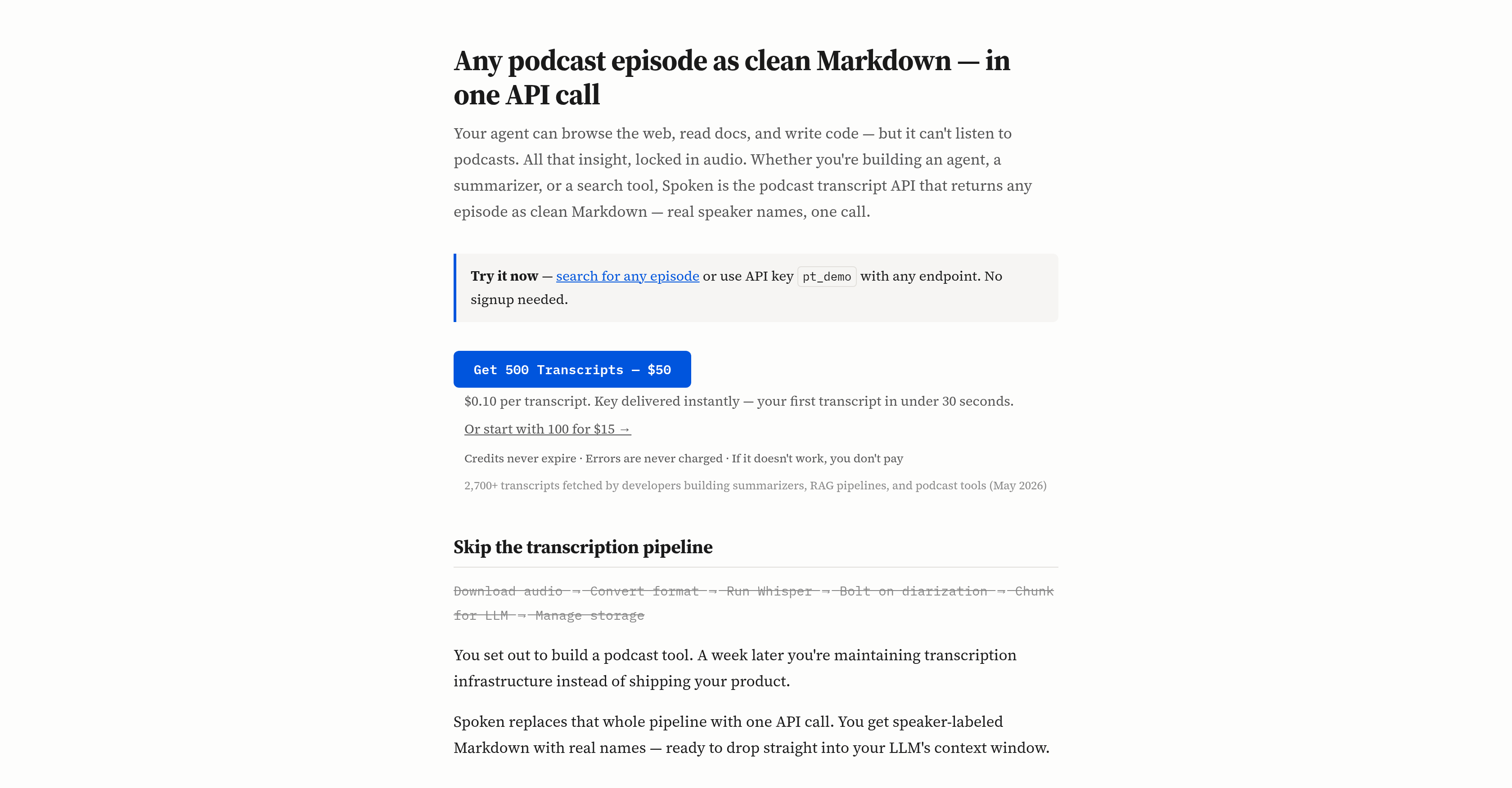
- Eliminate manual audio transcription by replacing your entire pipeline with a single API call that returns clean Markdown transcripts.
- Identify every speaker by real name instead of generic labels, using context analysis that removes the need for manual lookup tables or post-processing.
- Integrate podcast transcripts directly into AI agents, summarizers, and RAG pipelines with a straightforward HTTP API that works with any agent framework.
- Search any podcast episode instantly by text query or URL from Spotify, YouTube, and other platforms, getting results in under 30 seconds.
- Scale from 100 to 2,000 transcripts with volume discounts as low as $0.08 per transcript, without subscriptions or credit expiration.
- Ensure transcript quality with zero financial risk—credits are never charged for errors, and a demo API key lets you evaluate format and accuracy before purchase.
- Feed podcast transcripts into LLM context windows in a single call, thanks to Markdown formatting sized to fit most model limits with bold speaker names and timestamps per turn.
Pros & Cons
Pros
- Single API call
- Markdown formatted transcripts
- Real speaker name recognition
- Speaker names from context
- Easy text or URL search
- Compatible with various podcast platforms
- Straightforward integration process
- Supports any agent framework
- Compatibility with HTTP calls
- Trial experience with demo API
- Quality assurance for errors
- Flexible payment model
- No expiration of credits
- No subscription requirement
- Narration summarization feature
- Text search functionality
- No post-processing requirements
- Direct transcript fetch via URL
- Naming fallbacks for ambiguous speakers
- Transcripts fit into LLM context windows
- Metadata included in response headers
- Agent skill URL for direct installation
- OpenAPI spec for agent integration
- Automatic LLM discovery
- Credits top-up feature
- Error denotation in response
- Transcript preview before purchase
- Volume-based pricing discounts
- Full-service transcript retrieval
- Results returned in text/markdown
- Name mention analysis for speaker detection
- Compatibility across various podcast apps
- Supports plain HTTP calls
- No manual lookup table for speakers
- API response includes top-up link
- No timing artifacts in transcript
- Supports podcast search by text
- Extraction of real speaker names
- Search tool integration
- Ready-to-use transcripts without cleanup
- Allows for text-based episode search
Cons
- No realtime transcription
- No multi-language support
- No offline functionality
- Relies heavily on context
- Doesn't support custom formatting
- Probable speaker misidentification
- No error correction options
- Pricing per transcript
- Limited to podcast data
- No user interface
Reviews
Rate this tool
Loading reviews...
❓ Frequently Asked Questions
Spoken is an API tool designed to provide transcripts for any podcast episode in clean Markdown format. It combines transcript generation with speaker recognition to deliver transcripts that use real speaker names instead of generic labels. Designed for AI agents, it serves various applications such as summarizers, RAG pipelines, podcast tools, and more.
Spoken provides a range of services including audio transcription, markdown formatting, speaker recognition, text search, content analysis, speaker detection and context analysis, API services, and integration with AI systems. It also provides a trial experience for potential users to assess its services, maintaining a quality assurance system that doesn't charge credits for errors.
Spoken works by replacing the conventional manual audio transcribing process with a single API call. Users can search for a podcast episode and get the transcript with real speaker names. Spoken also analyses the context of the dialogues to distinguish between speakers and eliminates the need for manual lookup tables or post-processing.
Spoken distinguishes real speaker names by analyzing the context of the transcript. Instead of generic labels such as 'Speaker 1', 'Speaker 2', it identifies real names, enhancing the readability and comprehension of the transcripts. When actual names cannot be determined, it uses alternate labels like 'Host' or 'Guest'.
To search for podcast episodes with Spoken, users can query by text or paste a URL from various podcast platforms. It provides an easy and efficient search facility accommodating the needs of podcast listeners and analysts.
Spoken is compatible with various podcast platforms, including but not limited to Spotify and YouTube. It also supports any agent framework, making it versatile and universally applicable.
Spoken can be integrated with AI agents in a very straightforward process. It provides an OpenAPI spec that works with any agent framework. Users simply need to install the agent skill and it can then accept simple HTTP calls, making the integration seamless and hassle-free.
Spoken provides transcripts in clean Markdown format with speaker names in bold and timestamps per turn. It aims for convenience, thus eliminating the need for post-processing. The format is designed to be easily readable and is sized to fit in most Language Model Limits (LLM) context windows in a single call.
Yes, Spoken provides a trial experience where potential users can calibrate the transcript's quality and format using a demo API key. This allows users to evaluate the service without any upfront commitment or payment.
Spoken maintains a flexible payment model. It charges on a per transcript basis, without subscriptions or expiration of credits. Though it is a paid service, credits are not charged for erroneous transcripts, ensuring that users only pay for accurate results.
Spoken delivers the first transcript in under 30 seconds. The key is delivered instantly after payment, ensuring a swift turnaround for users.
Yes, Spoken can handle large volumes of transcripts. It offers a range of pricing tiers, from a starter pack of 100 transcripts up to a volume pack of 2,000 transcripts. Larger quantities also come with a discount per transcript.
Spoken ensures the quality of transcripts by identifying and recognising real speaker names through context analysis. It offers a trial experience which allows users to evaluate the transcript's quality before the purchase. Moreover, it employs a quality assurance system where credits are not charged for erroneous transcriptions.
In the event of errors in Spoken's transcripts, the company assures that credits are never deducted for such instances. This means if there are any mistakes, the user is not charged, reinforcing Spoken's commitment to quality and accuracy.
There is no explicit limit to the number of transcripts you can get with Spoken. Its pricing model is designed for flexibility and scalability, offering a range of options from smaller batches of 100 transcripts up to larger volumes of 2,000 transcripts.
Spoken can be extremely beneficial for developers building podcast tools. By eliminating the need to manually transcribe audio and recognising speaker names, developers can focus on their core product delivery. In addition, Spoken's API can replace an entire transcription pipeline, expediting the building process and reducing the maintenance burden.
Yes, Spoken is adept at converting spoken language to text. It uses sophisticated natural language processing capabilities to transcribe any podcast episode into text, replacing the manual audio transcribing processes.
Yes, Spoken can be used as a content analysis tool. It processes and transcribes spoken content from a podcast, converting it into searchable and analyzable text format. This can be instrumental for comprehending, summarizing or referencing spoken content from various podcasts.
Yes, Spoken is suitable for data extraction from audio files. It efficiently transcribes spoken content from podcasts into textual data, making it possible to extract, analyze, and utilize the information present in these audio files for various applications.
The cost per transcript using Spoken can vary. It starts at $0.15 per transcript for a pack of 100 transcripts. The company also offers volume discounts, bringing the cost down to $0.10 per transcript for 500 transcripts, or $0.08 per transcript for 2,000 transcripts.
Pricing
Pricing model
Paid
Paid options from
$15/unit
Billing frequency
Pay-as-you-go