
WebCrawler API
Overview
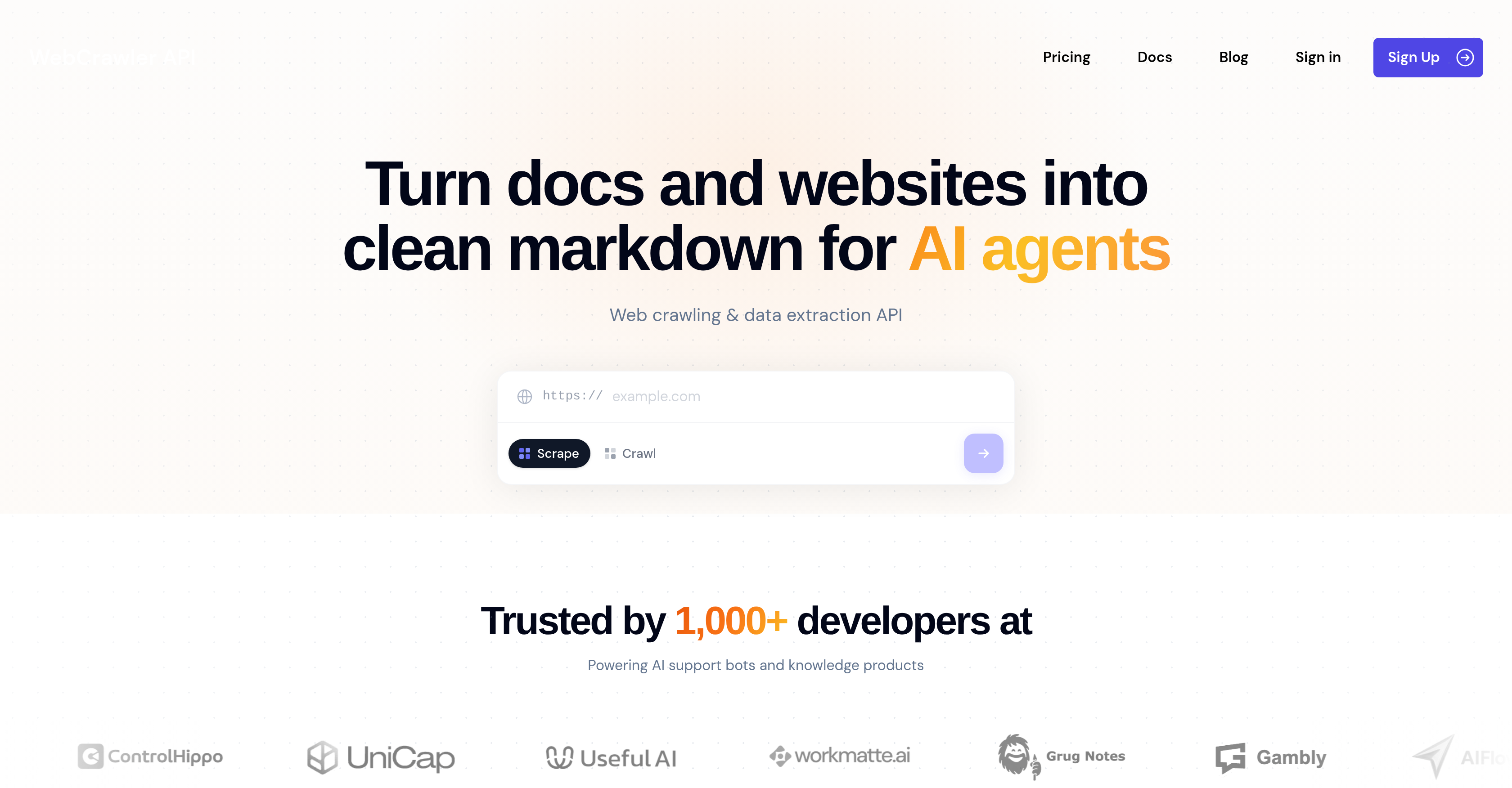
- Feed your AI agents clean, structured markdown from any website or help center by automatically stripping menus, cookie banners, footers, and ads during data extraction
- Integrate with your existing stack in under a minute using any major programming language, with full API support for seamless web scraping
- Eliminate infrastructure headaches as CAPTCHAs, anti-bot protection, JavaScript rendering, and proxy rotation are handled automatically for reliable data extraction
- Get faster responses on frequently accessed pages through smart caching that reduces load times and resource consumption
- Stay current with any site's content using change detection that delivers only modified pages, including full diffs, new additions, and structural changes
- Scale your extraction costs to match your usage with flexible pricing—pay only for requests made or choose a monthly subscription for high-volume web crawling
- Work without code by connecting WebCrawler API to no-code platforms your team already uses, enabling quick setup for AI bot support and knowledge products
Pros & Cons
Pros
- Turns documents into markdown
- Turns websites into markdown
- Markdown extraction feature
- Removes irrelevant elements
- Cleans structured markdown
- Smart caching system
- Change detection feature
- Handles scraping infrastructure
- Handles retries
- Handles CAPTCHAs
- Anti-bot protection
- Javascript rendering
- Easy integration
- Compatible with major languages
- Pay-per-request usage option
- Monthly subscription option
- Works with no-code tools
- Automated data extraction
- Menu removal
- Banner removal
- Irrelevant content removal
- Fast page return
- Detailed diffs
- API key availability
- JavaScript handling
- CAPTCHA handling
- Proxy handling
- Scrapes help centers
- Can bypass cache
- No redundant API calls
- Automatic retries
- No manual tracking required
- Provides crawler usage statistics
- Separate pricing options
- Up-to-date information
- Trust from multiple developers
- Handles headless browsers
- No boilerplate
- No friction
- Unrelated content removal
- Residential proxies
- Rate limit handling
- Automatic bot bypass
- Fast path selection
- No-code integrations
- User-friendly for developers
Cons
- No free tier
- Limit on parallel requests
- Extra charge for prompts
- Not suitable for larger volumes
- No enterprise pricing details
- No credit card free trial
- Potential slow response times
- Limited no-code platform compatibility
Reviews
Rate this tool
Loading reviews...
❓ Frequently Asked Questions
WebCrawlerAPI is a developer-friendly web crawler and data extraction API popular for transforming documents, help centers, and various websites into clean, structured markdown files. These files can serve as an instrumental resource for AI support agents. It can also support AI bots and knowledge products efficiently, as it provides data in a robust, clean and usable form.
The Markdown extraction feature in WebCrawlerAPI serves a crucial function in providing clean, usable content for AI agents. It performs the task of loading a web page, extracting the markdown, and cleaning it of any unnecessary elements. Post cleaning, it yields only the practical and useful content thus enhancing the efficiency and relevance of the information extracted.
WebCrawlerAPI ensures clean extraction of markdown from web pages by implementing a process that eliminates irrelevant elements from the content extracted. This includes non-essential components such as menus, cookie banners, footers, as well as ads. The result is the extraction of pure and structured markdown, devoid of any clutter, which significantly increases its usability.
Yes, WebCrawlerAPI is developed to be compatible and easy to integrate with every major language. Its flexibility and adaptability make it a popular choice among developers.
While extracting markdown from web pages, WebCrawlerAPI removes non-essential and irrelevant elements to ensure the output is clean, structured, and useful. These elements include menus, cookie banners, footers, and various types of advertisements.
WebCrawlerAPI offers an advanced caching mechanism where frequently requested pages are returned at a significantly quicker pace due to smart caching. It ensures that the extraction process for these pages requires fewer resources and less time, providing a smooth and efficient web crawling experience.
Yes, WebCrawlerAPI features a change detection function. This feature is designed to send updates about pages that have undergone modifications, new additions, removed entries, and structural changes. It is an efficient tool for tracking changes on web pages.
WebCrawlerAPI handles web scraping infrastructure by offering functionalities that encompass proxies, retries, headless browsers, CAPTCHAs, anti-bot protection, and JavaScript rendering. By managing this layer of operations, WebCrawlerAPI simplifies the scraping process and ensures efficient retrieval of data.
WebCrawlerAPI offers transparent pricing with both pay-per-request usage and monthly subscription options. This lets users choose the most cost-effective plan based on their use case and it ensures affordability as well as provides pricing flexibility. Standard and Scale plans are also available, offering savings of up to 50% for high-volume crawling.
Yes, WebCrawlerAPI provides a pay-per-request option. This flexible pricing plan ensures users only pay for the requests they make, making it a cost-effective and user-friendly service.
WebCrawlerAPI provides simple and flexible payment options. Users can choose between a pay-per-request plan and a monthly subscription model. This allows individuals and businesses to select the plan that best meets their usage and budget requirements.
Yes, WebCrawlerAPI offers a monthly subscription option. This serves as a cost-effective solution for users who require high-volume web crawling and data extraction services. The monthly subscription provides an economical, scalable solution for businesses and individuals alike.
WebCrawlerAPI is designed to be easily integrated into existing systems. It works with every major language, reducing friction and making the integration process as seamless as possible.
Yes, aside from its primary function of web crawling, WebCrawlerAPI also provides data extraction services that serve as critical support for AI bots. By converting various web content into clean, structured markdown files, it provides easily utilizable data that can aid in enhancing the performance of AI bots.
Yes, WebCrawlerAPI handles CAPTCHAs and implements anti-bot protection as part of its comprehensive suite of functionalities that manage scraping infrastructure. This alleviates the complexity of web scraping and offers a more simplified and efficient data extraction process.
WebCrawlerAPI successfully manages JavaScript rendering in its process of web crawling and data extraction. By handling JavaScript rendering, it ensures the complete and thorough extraction of data from websites, including those that heavily rely on JavaScript for content delivery.
WebCrawlerAPI adheres to a meticulous policy on cleaning web content. During markdown extraction, it removes superfluous elements such as menus, cookie banners, footers, and ads. The result of this detailed cleaning process is a clean, structured markdown that enhances the utility and relevance of the extracted content.
WebCrawlerAPI supports every major programming language, thereby catering to a wide range of developers and projects. This accommodation of various languages augments its adaptability and user-friendly nature.
Yes, WebCrawlerAPI provides a robust mechanism to handle proxies and retries while scraping web data. This ensures reliable and efficient data extraction. By managing proxies and retries, WebCrawlerAPI enhances the consistency of web scraping operations, minimizing failures and maximizing data retrieval.
WebCrawlerAPI serves a variety of customers majorly comprising developers who utilise its efficient data extraction for supporting AI bots and knowledge products. Additionally, AI teams needing reliable web crawling and data extraction also significantly benefit from WebCrawlerAPI. Its wide array of features and simple integration make it a preferred choice for a diverse set of users.
Yes, WebCrawlerAPI supports all major languages. It's designed for easy integration into any developer's platform.
WebCrawlerAPI's markdown extraction feature works by loading a page, extracting its markdown content, cleaning it, and removing the unnecessary elements. It then yields only useful content that is ready for an AI agent.
WebCrawlerAPI removes irrelevant elements such as menus, cookie banners, footers, and ads during the markdown extraction process.
Yes, WebCrawlerAPI can efficiently handle frequent page requests. It employs smart caching to offer speedier returns for frequently requested pages.
The change detection feature of WebCrawlerAPI provides updates on changed pages, new additions, removed entries, and structural alterations.
WebCrawlerAPI smoothly manages scraping infrastructure by handling elements like proxies, retries, headless browsers, CAPTCHAs, and anti-bot protection.
Absolutely, WebCrawlerAPI is proficient in CAPTCHA handling. This capability is part of its robust scraping infrastructure.
WebCrawlerAPI efficiently handles proxies through its well-maintained scraping infrastructure that routes every request via the fastest path that can fetch the page.
Yes, WebCrawlerAPI is capable of handling JavaScript rendering. It manages the entire stack and ensures that the page can be fetched successfully.
WebCrawlerAPI has simple and transparent pricing options. It provides the flexibility of pay-per-request usage as well as monthly subscription options.
Yes, WebCrawlerAPI does offer a monthly subscription pricing option for users who require more extensive services.
Certainly, WebCrawlerAPI is suitable for AI teams. It is designed to serve AI teams that need reliable and efficient data extraction.
WebCrawlerAPI offers robust anti-bot protection as part of its extensive scraping infrastructure. This feature guarantees successful retrieval of page data.
Yes, WebCrawlerAPI does offer no-code integration. It allows users to work with no-code tools they are already familiar with, offering an easy integration process.
Yes, WebCrawlerAPI does handle headless browsers as a part of its efficient management of the scraping infrastructure.
In WebCrawlerAPI, caching works by storing frequently requested pages, providing much faster return times. For bypassing cache, you can pass max_age=0.
The 'Detailed Diffs' feature of WebCrawlerAPI provides users with detailed comparison information about what has changed, including full content, new additions, structural changes, and removed entries.
WebCrawlerAPI can convert a vast number of online sources into clean markdown files - from documents and help centers to websites of any size.
Indeed, WebCrawlerAPI offers automated data extraction. It is especially designed to reliably manage a variety of data extraction and web crawling needs.
Pricing
Pricing model
Free Trial
Paid options from
$0.00/unit
Billing frequency
Pay-as-you-go