
Overview
- Feed AI models directly with fresh, structured web data without manual cleaning using clean JSON and Markdown output that requires zero post-processing.
- Build dynamic pricing models and monitor competitor prices in real-time by extracting live pricing data from e-commerce sites and marketplaces.
- Generate qualified B2B leads automatically by scraping targeted company data, contact details, and business intelligence from directories into your CRM.
- Conduct comprehensive SEO and market research by collecting clean, structured SERP data from search engines via the dedicated SERP API.
- Scale data extraction across entire website domains or specific sections without writing custom crawlers using the intelligent Crawl API for multi-page sites.
- Maintain high success rates scraping protected sites using advanced browser fingerprinting and rotating residential proxies.
- Power review mining and sentiment analysis by extracting structured reviews from platforms like Amazon, Trustpilot, and Google Reviews.
- Connect real-time web data to AI agents and automation workflows seamlessly through native Model Context Protocol (MCP) compatibility.
Pros & Cons
Pros
- Intelligent automation workflows
- Structured data extraction
- Multi-format outputs (JSON, Markdown)
- Screenshot capture ability
- Scrape, Crawl, SERP APIs
- Rich multi-page navigation
- SERP data collection
- Model Context Protocol compatibility
- No post-processing required
- Wide use-case applicability
- LLM training integration
- Lead generation functionality
- Competitive intelligence collection
- Real-time market monitoring
- Markdown output for training
- Price monitoring
- Dynamic pricing data
- SEO monitoring
- SERP analysis
- Review mining capacity
- Sentiment analysis data
- Single API request return
- API for multi-domain scraping
- Real-time website connections
- Integrates with 500+ apps
- Advanced browser fingerprinting
- Rotating residential proxies
- Consistent data extraction
- Structured extraction with schema
- B2B prospecting data
- Built-in retries for reliability
- Automated network rotation
- Anti-bot evasion
- Machine learning integration
- Social media scraping
- Consistent social data extraction
- Reduced maintenance needs
- Multiple platform scraping
- Real-time scraping
- Predictive model performance improvement
- Stable and fast API
- Productive API on day one
- Supports JavaScript-heavy sites
- Universal scraping endpoint
- Real-time data feeding
Cons
- No native app
- No browser extension
- No free tier
- No information on security
- No support for local databases
- No live support
- No data anonymization
- No multilingual support
- Lacks multi-threading
- Limited third-party integrations
Reviews
Rate this tool
Loading reviews...
❓ Frequently Asked Questions
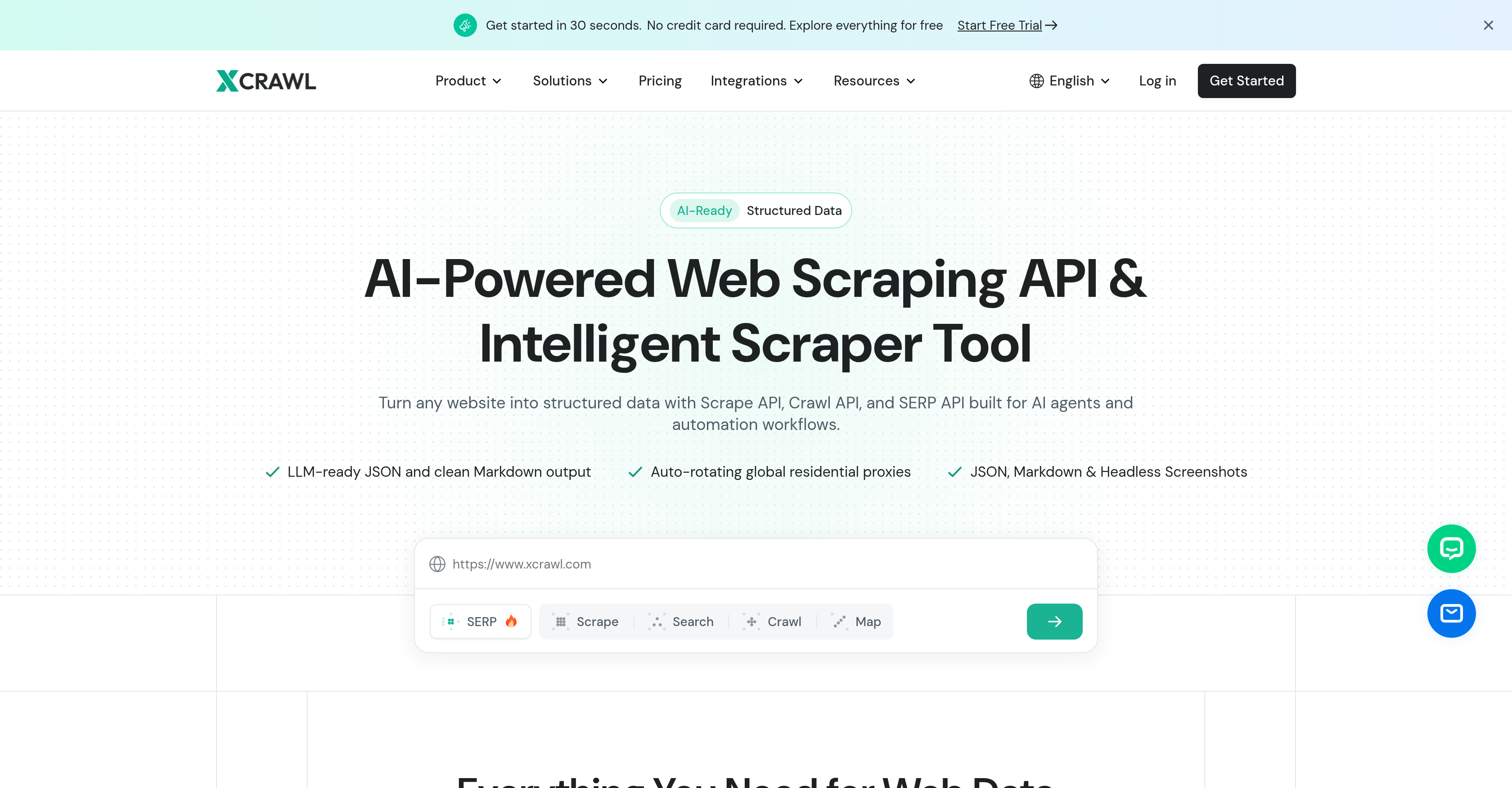
XCrawl is an AI-ready web scraping API renowned for its intelligence and automation workflows. It is designed to extract structured data from any webpage and return results in a single API request. XCrawl's key offering includes APIs such as Scrape API, Crawl API, and SERP API. One of XCrawl's distinctive features is its thorough integration for AI agents and automation, alongside its compatibility with Model Context Protocol.
XCrawl extracts data from a webpage by using its Scrape API. The API is designed to extract structured data from any page and return results in JSON, Markdown formats. The API can even take screenshots.
XCrawl can extract data in JSON and Markdown formats. It can also generate screenshots of the webpage being scraped.
The Scrape API offered by XCrawl extracts structured data from a page and returns clean JSON, Markdown, or screenshots in a single API request. It is designed to function intelligently, quickly, and effectively, making data available for immediate use without requiring post-processing.
The Crawl API provided by XCrawl serves the function of intelligently navigating through multi-page websites to extract data from full domains or targeted sections. This feature allows data extraction from comprehensive website domains or specific areas as necessary.
Yes, XCrawl is capable of extracting data from multi-page websites. This is made possible by its Crawl API, which is designed to intelligently navigate through full domains or targeted sections of multi-page websites.
The SERP API in XCrawl collects clean, structured SERP (Search Engine Results Pages) data from search engines. This capability allows XCrawl to gather data crucial for SEO and market research.
XCrawl supports AI agents and automation workflows by providing a built-in integration feature. This allows these agents swift access to real-time web data. Moreover, XCrawl's compatibility with the Model Context Protocol enables AI models to have direct access to CXrawl, facilitating more effective automation workflows.
The Model Context Protocol in XCrawl plays a pivotal role in seamlessly connecting AI models directly to XCrawl. This feature significantly augments XCrawl's capability in supporting AI agents, as it ensures swift and comprehensive access to real-time web data.
XCrawl is optimized for AI workflows by providing structured JSON and clean Markdown output that requires no post-processing. This allows AI applications to ingest the extracted data directly without the need for additional formatting or cleaning.
XCrawl can be used in a wide range of use-cases including generative AI and LLM training, lead generation and B2B prospecting, competitive intelligence and market monitoring, price monitoring and dynamic pricing, SEO monitoring and SERP analysis, review mining and sentiment analysis, and AI agent automation.
With XCrawl, dynamic pricing and price monitoring are handled through real-time extraction of pricing data from e-commerce sites, marketplaces, and distributors. This allows businesses to create dynamic pricing models and also monitor compliance.
Yes, XCrawl can efficiently be used for SEO monitoring and SERP analysis. Its SERP API is designed to collect structured SERP data from search engines, a vital aspect of SEO and market research.
XCrawl aids review mining and sentiment analysis by enabling structured extraction of reviews from various prominent platforms like Amazon, Trustpilot, Google Reviews, and app stores. The gleaned data can be used for comprehensive sentiment analysis and customer intelligence.
Yes, XCrawl can be effectively used for lead generation and B2B prospecting. XCrawl allows extraction of targeted company data, contact details, and business intelligence from directories and industry databases, enriching your CRM with live web data.
XCrawl supports web scraping and data extraction through its intelligent APIs, including Scrape API and Crawl API. These APIs are designed to retrieve structured data from any webpage and intelligently navigate through multi-page websites to extract data from full domains or targeted sections respectively.
Yes, XCrawl supports automation workflows. Specifically, its built-in integration for AI agents and automation allows for swift connection of real-time web data to applications. Its compatibility with Model Context Protocol also facilitates streamlined access for AI models.
XCrawl can be directly integrated into your application via its robust APIs, including Scrape API, Crawl API, and SERP API. Using these APIs, you can extract structured data from any website and API endpoints can be requested to return clean JSON or Markdown formats.
XCrawl is capable of extracting data from protected sites consistently using advanced browser fingerprinting and rotating residential proxies. These technological solutions ensure that XCrawl's data extraction maintains a high success rate, even from sites with stringent protection measures.
XCrawl supports generative AI and LLM training by allowing extraction of fresh documentation, articles, and knowledge bases. The data generated in this process is presented as clean Markdown for RAG pipelines, fine-tuning datasets, and AI assistants, thus contributing towards effective AI training.
Pricing
Pricing model
Free Trial
Paid options from
$8/month
Billing frequency
Monthly