
Overview
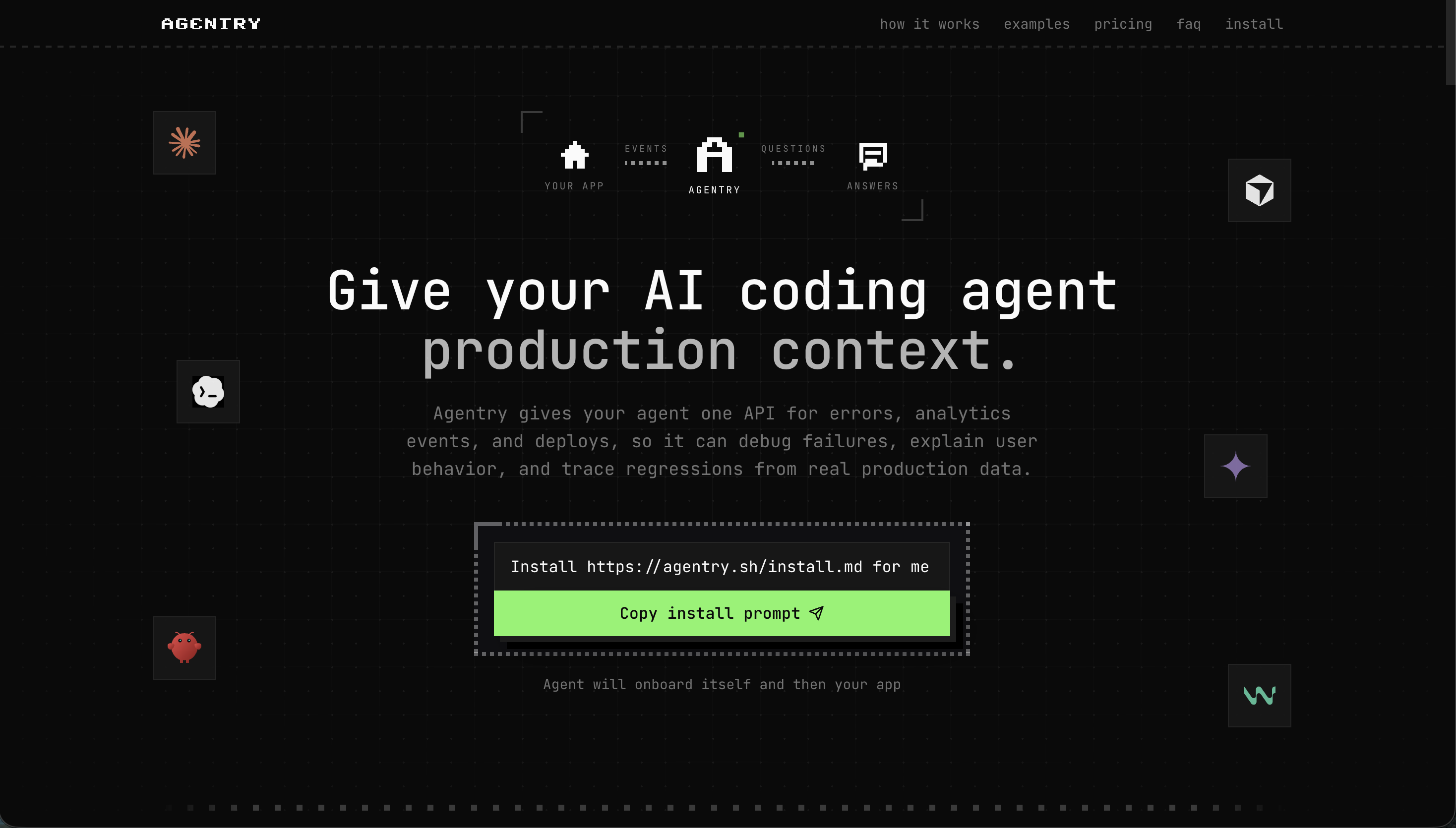
- Diagnose production failures instantly by giving your AI agent access to real error logs, user events, and deploy history through a single HTTP API.
- Identify user drop-offs and churn signals so your coding agent can pinpoint activation issues and feature adoption gaps from actual production data.
- Resolve bugs faster when your agent groups similar errors by fingerprints, showing status, frequency, affected users, and examples for targeted fixes.
- Trace regressions and behavior changes back to the specific deploy that caused them, connecting cause and effect without manual investigation.
- Understand user behavior by querying real event data—your agent explains what users did, where paying customers come from, and which marketing sources drive activation.
- Automate root cause analysis as your agent inspects the codebase, plans the right telemetry, installs it, verifies it, and proposes code changes or pull requests.
- Eliminate dashboard overhead with an agent-first API—your coding agent queries analytics, errors, and deploy data directly without needing a separate SDK or dashboard.
Pros & Cons
Pros
- Single API for errors, analytics, deploys
- Real-time data access
- Deep production environment understanding
- Identifies codebase elements
- Case management features
- Deploy attribution function
- Webhook support
- Able to suggest improvements
- Incident investigation capabilities
- Bugs fixing function
- Groups similar errors
- Status, frequency, affected users tracking
- Examples providing feature
- Researching user churn
- Scouting potential marketing opportunities
- Product-related queries posing
- Query solving capacity
- Error tracing features
- Test running capabilities
- Code revision proposals
- Data evidence based decisions
- Operationalizes repository analysis
- Provides production data evidence
- No additional SDK required
- Signed webhooks
- Real event data querying
- Analyzes user behavior
- System failures diagnosing
- New cases solving
- Anomaly detection
- Operational analytics
- Marketing opportunity discovery
- Includes deploy information
- Errors encapsulation
- Analytics events encapsulation
- API, Error Diagnosis capabilities
- User Behaviour Analytics
- Optimized for Agentic development
- Provides agent-readable APIs
- Plain HTTP API
- Debugging of failures
- Offers Code Repository Analysis
- Provides case examples
Cons
- No built-in dashboard
- Requires repo access
- Uses only HTTP API
- Suitable mainly for technical workflow
- Limited to HTTP requests
- Requires continuous interaction for updates
- Only supports plain HTTP API
Reviews
Rate this tool
Loading reviews...
❓ Frequently Asked Questions
Agentry is a tool developed for AI developers, primarily providing a single API that caters to errors, analytics events, and deploys. It is designed with the goal of aiding in debugging of failures and tracking user behavior and data regressions using actual production data. Agentry also facilitates the process of inspecting repositories, wiring signals, and providing answers which arm the coding agent with a better understanding of the production environment.
Key features that Agentry offer include case management, deploy attribution, querying of events, and webhook support. It allows the agent to generate integrations, analyze trends and offer suggestions for improvements, investigate incidents, and fix bugs. A standout feature of Agentry is its ability to group similar errors via fingerprints, showing status, frequency, affected users, and examples. It also has a provision for querying real event data for insightful information regarding activation, churn, campaigns, or regressions.
The uniqueness of Agentry's API lies in its ability to provide a single interface for errors, analytics events, and deploys. This feature aids the agent in debugging failures, tracking user behavior, and tracing data regressions based on actual production data. It supports event store, has a plain HTTP API, and allows deploy attribution.
Agentry supports AI coding agent onboarding by facilitating the entire process from inspecting the code repositories to wiring signals and providing answers based on real data. The coding agent is thus endowed with a comprehensive understanding of the production environment.
Agentry assists in bug fixing by collecting similar errors upon fingerprints, detailing their status, frequency, affected users, and examples. This information provides a clear context and understanding for the agent to resolve the bugs. Agentry also supports creating queries from real event data.
Yes, Agentry can integrate with any AI coding agent. It is designed with an inherent flexibility to support various coding agents.
In Agentry, case management involves the grouping of similar errors by fingerprints. This process provides comprehensive details like the status of the case, how often it occurs, which users are affected, and examples of the error. This helps in efficient management and resolution of cases.
Deploy attribution in Agentry refers to the ability of the software to correlate failures and changes in user behavior with specific software releases. It enables understanding of the cause-and-effect relationship between releases and system behavior.
Event querying in Agentry supports a systematic examination of records regarding errors, analytics events and deploys. It allows for deep insight extraction regarding activation, churn, campaigns or regressions from real production data.
Agentry aids user behavior tracking by correlating changes in user behavior with specific software releases. This feature proves essential in measuring the impact of a newly released feature on user retention.
Webhook support in Agentry refers to signed hooks for cases, deploys, and events that become useful when your app needs to react. It's part of the API which can be used by the coding agent to facilitate automation and integration.
Agentry plays an essential role in data regression analysis by tracking user behavior and data regressions from actual production data. This feature assists in debugging failures by tracing back to the root cause from real data.
Indeed, Agentry does facilitate software automation. By shifting focus from human hands-on management to smart AI agents, it automates workflows, generates integrations and provides actionable analysis.
Error analytics in Agentry involves systematic grouping of similar errors by fingerprints. Agentry presents status, frequency, affected users, and examples of errors to facilitate swift and effective resolution.
In Agentry, production monitoring is facilitated by providing AI coding agents with production context derived from real data. In addition, Agentry identifies routes, jobs, webhooks, funnels, failure surfaces, and deploy hooks in the codebase, enabling a deeper exploration of the production environment.
Agentry supports codebase inspection by providing a systematic process of inspecting repositories and wiring signals. This equips the coding agent with a deeper understanding of the production environment and aids in debugging and failure resolution.
Agentry assists in improving user retention by tracing changes in user behavior to specific releases. This helps in determining the impact of a newly released feature on user retention.
Agentry has a key feature that enables the agent to generate integrations, analyze trends, and suggest improvements. This feature can be deployed for use-cases like ranking sources of users and measuring the impact of a new feature on user retention.
Incident investigation in Agentry involves a comprehensive examination of errors to pinpoint their frequency, affected users, status, and samples. Furthermore, deploy attribution helps in the correlation of failures to specific releases for better understanding of incidents.
Agentry provides support for software releases management through its deploy attribution feature. This allows the tracking of failures and changes in user behavior to match with specific releases. This feature makes the management of software releases organized and effective.
Agentry assists in debugging failures by providing an analysis of errors, analytics events, and deploys. It supports the tracing of regressions using real-time data from the production environment. Furthermore, it offers deploy attribution that allows for the correlation of failures and changes in user behavior to specific releases, enabling efficient debugging.
Agentry can identify an extensive range of errors in a codebase. One of its key features is the ability to group similar errors by fingerprints, providing essential details such as status, frequency, affected users, and examples. Its comprehensive inspection and tracking system helps identify routes, jobs, webhooks, funnels, failure surfaces, and deploy hooks in the codebase.
Yes, Agentry is designed to integrate with any AI coding agent. Moreover, it provides support for agent onboarding.
The 'deploy attribution' feature of Agentry facilitates the correlation of failures and changes in user behavior to specific releases. This ability provides key insights into the impact of each deployment and assists in identifying issues.
Agentry provides an interface that allows AI agents to query events for investigation. Queries can be based on actual production data, and can cover areas such as bugs, churn, marketing, or product questions.
Insights from Agentry's real event data can include user activation, churn, campaigns, and recurrent issues. Additionally, these insights can reflect changes in behavior correlated to specific releases, thus helping in associating observed effects with specific events or deployments.
Agentry can be deployed in various scenarios including debugging and resolving new cases, ranking sources of users by downstream activation and paid conversion, and measuring the impact of newly released features on user retention.
Yes, Agentry can suggest improvements. Its ability to analyze trends, investigate incidents, and identify bugs, allows it to generate insights that can be translated into action items for improving AI agents' performance.
Agentry assists in resolving new cases through systematic analysis of real production data. AI agents can utilize this tool to trace sources of errors, run tests, propose code revisions, and solve new cases based on the evidence provided.
Agentry facilitates 'agentic' software development, a philosophy shifting focus from human hands-on management to smart agents that automate workflows, generate integrations, and provide actionable insights by utilizing real production data.
Agentry aids in bug identification through comprehensive code repository analysis. Cases of similar errors are grouped by fingerprints, indicating potential bug patterns. Moreover, deploy attribution allows the tracing of bugs or system failures to specific releases.
Agentry helps in tracking user churn by allowing the querying and analysis of real event data. It equips AI agents with the ability to investigate incidents relating to user engagement and churn, thus providing vital insights into user behavior.
Yes, Agentry can discover marketing opportunities. It allows for the querying of real event data, offering insights into campaigns, and user activation. Additionally, it supports decision making and the formulation of strategic marketing opportunities based on evidence from the production environment.
Agentry supports decision making for AI agents by providing production context and real data related to errors, events, deploys, and repository context. This enables AI agents to make informed decisions, propose actionable improvements, and take appropriate actions for bug identification, resolution and other operational tasks.
Yes, Agentry can trace sources of errors. It ties errors to deploys through deploy attribution, making it possible to associate system failures with specific releases. The ability to inspect code, analyze real-time data, and group similar errors, assists AI agents in identifying and tracing the sources of errors.
Agentry can support test running by allowing AI agents to propose and run tests based on the production data evidence provided. This functionality aids in the identification and resolution of issues and helps improve overall software quality and reliability.
Yes, Agentry assists in code revision. Based on the analysis of real data from the production environment, AI coding agents can propose code revisions via pull requests, making it an effective tool for improving the codebase incrementally and continuously.
To install Agentry, navigate to 'agentry.sh/install.md'. Follow the installation prompts and paste to your coding agent. Your AI coding agent will onboard itself and then your application.
Agentry works with any language and framework. It's built to be compatible with multiple languages including TypeScript, JavaScript, Python, Go, Rust, Ruby, Java, PHP, Elixir, Kotlin, Swift, .NET and frameworks like Next.js, React, Vue, Svelte, Astro, Nuxt, Remix, Express, Hono, FastAPI, Django, Rails, Laravel.
Pricing
Pricing model
Freemium
Paid options from
$39/month
Billing frequency
Monthly
Refund policy
No Refunds