
Overview
- Spot complex data patterns and correlations instantly by translating datasets into an interactive 3D visual space.
- Explore data relationships intuitively through immersive 3D images that make multidimensional connections visible at a glance.
- Navigate analytical findings faster with a browser-based 3D environment that requires no software download.
- Achieve deeper understanding of scientific or analytical datasets by interacting with data elements in a holistic 3D space.
- Maintain workflow speed with instant access via any JavaScript-enabled browser, eliminating installation delays.
Pros & Cons
Pros
- 3D Data Visualization
- Immersive Data Interaction
- Useful in Scientific Research
- Discerns Complex Data Patterns
- Web-Based Tool
- No Additional Software Download
- Interact with Data Intuitively
- Browser Compatibility
- Update Requirement Ensures Efficiency
- Advanced Data Analysis
- Navigation Varied by Data
- Data Interaction Capacities Varied
- Interactive Interface
- Suitable for Analytical Fields
- Hardware Dependent
- Translates Data Sets to 3D
- JavaScript-enabled
- Enables Advanced 3D Experiences
Cons
- Requires JavaScript
- Browser compatibility issues
- Hardware dependent
- Variability in data interaction
- Web-based only
- No offline capabilities
- Possible update requirements
- Reliant on user's hardware
- Limited functionality scope
- May require latest browsers
Reviews
Rate this tool
Loading reviews...
❓ Frequently Asked Questions
The main function of Hyper3D is to help users visualize data in three dimensions. It translates data sets into three-dimensional images, making it easier for users to explore and understand their data.
Hyper3D translates your data into immersive 3-dimensional images, providing an intuitive way to interact with and understand complex patterns and correlations within your data.
Hyper3D requires JavaScript to facilitate 3D experiences in a web-based environment. JavaScript allows for dynamic content changes, interactivity and other advanced features which Hyper3D leverages to provide optimal user experiences.
Yes, you can use Hyper3D without downloading any additional software. Being a web-based tool, accessing it would require a JavaScript-enabled browser.
Yes, you need an up-to-date browser to ensure that JavaScript, which is essential for Hyper3D function, is supported.
To ensure that JavaScript is enabled for running Hyper3D, navigate to your browser settings. Most browsers have a dedicated section for JavaScript where you can check if it's activated. If it's not, you will likely have an option to enable it.
Yes, the performance of Hyper3D may vary depending on the characteristics of your data set. Its functionality and output may adjust based on the data set being used.
Hyper3D translates different data sets into three-dimensional images. The interaction and navigation capabilities with these images could vary depending on the data set’s characteristics.
Yes, the navigation capabilities in Hyper3D can vary with different data sets. Some data sets might present a more interactive and easy-to-navigate interface than others dues to their different makeup.
Yes, your hardware capabilities can impact Hyper3D's performance. The tool's ability to interact with data and process 3D visualizations can be influenced by the specifications of your device.
Absolutely, Hyper3D is extremely valuable for scientific and analytical fields, where complex data patterns and correlations can be discerned more easily through a three-dimensional lens.
Hyper3D discerns complex data patterns by translating data sets into an interactive three-dimensional visual space, thus highlighting patterns that might not be as easily discernible in 2-dimensional formats.
Yes, Hyper3D can help you see data correlations more easily. It transforms the conventional datasets into 3-dimensional images, which can enhance the visibility and understandability of patterns and correlations within your data.
Hyper3D allows users to interact with the data by transforming it into a holistic 3D space. This immersive representation encourages users to interactively explore different data elements more intuitively than traditional 2D schemes.
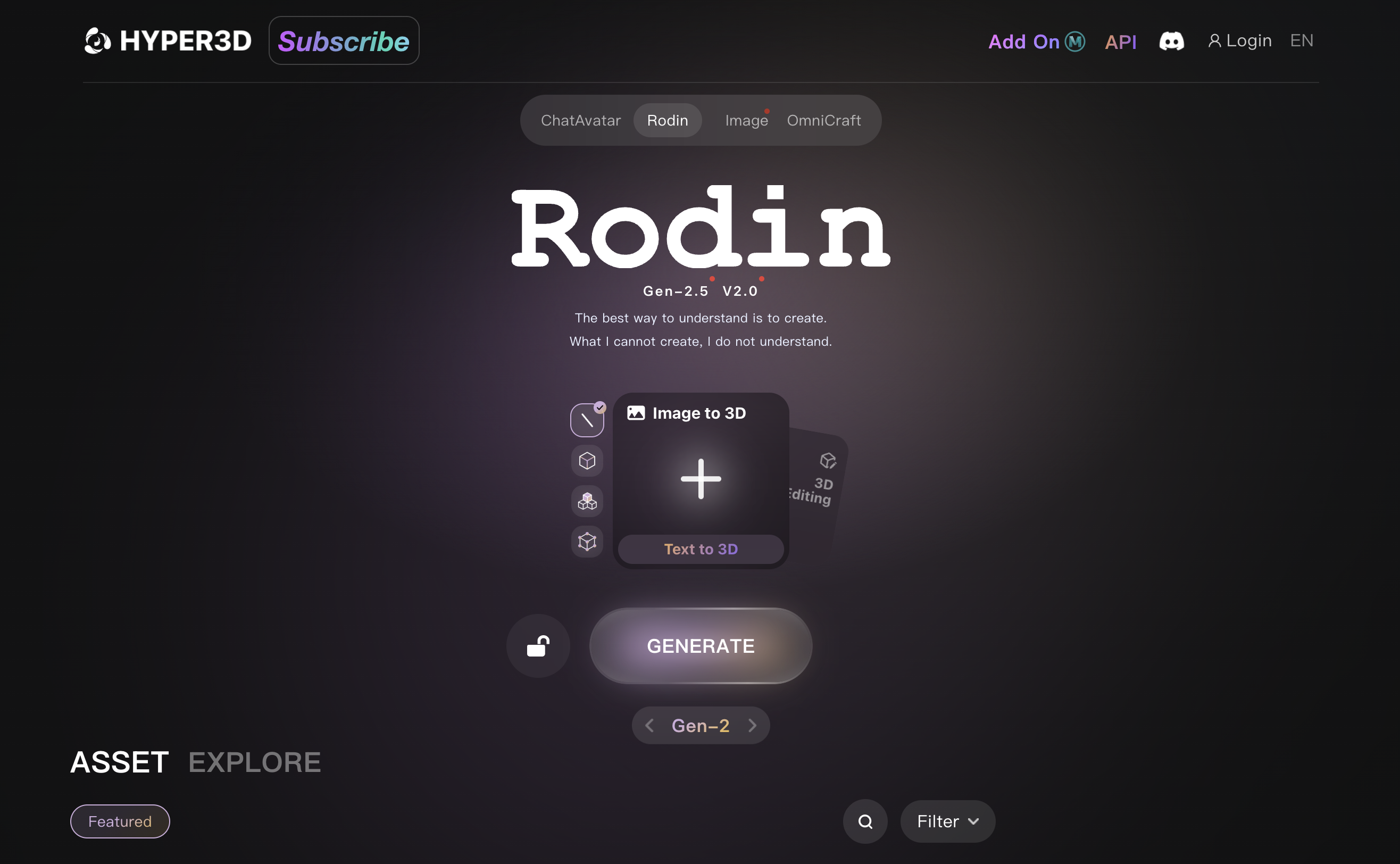
Hyper3D's user interface is an intuitive, immersive, and interactive platform where users can explore their data visually in 3D.
Absolutely, Hyper3D is an excellent tool for advanced data visualization. It transforms traditional datasets into three dimensional, interactable visual structures, providing a novel and thorough perspective on your data.
Pricing
Pricing model
No Pricing
Related Videos
Rodin AI Tips
Hyper3D Rodin•7.4K views•May 30, 2025