

Overview
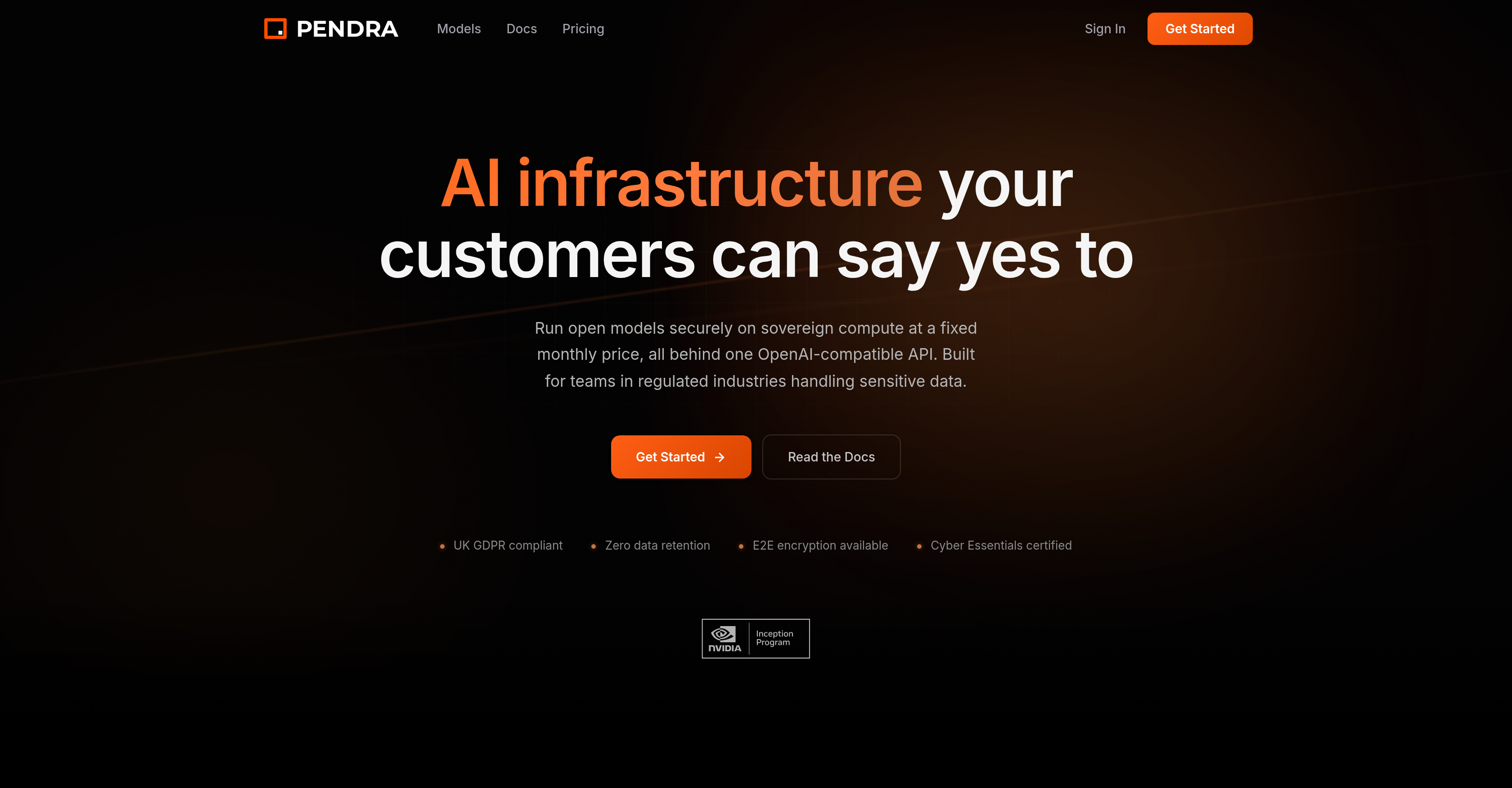
- Achieve full regulatory compliance for sensitive data with UK GDPR-aligned infrastructure, zero data retention, and end-to-end encryption across every inference.
- Deploy open models like Llama, Qwen, and DeepSeek directly on your own trusted hardware or managed UK GPUs, keeping data sovereign within your jurisdiction.
- Eliminate infrastructure overhead with a single OpenAI-compatible API that orchestrates both self-hosted and managed workers, enabling hybrid deployments without hardware changes.
- Accelerate development cycles using Python and Node.js SDKs that work seamlessly with existing OpenAI and Anthropic endpoints, so current code runs without modification.
- Control costs predictably with a fixed monthly price covering managed UK GPUs, serving, scaling, and failover—no surprise usage bills.
- Protect data in transit and at rest through end-to-end encryption, ensuring sensitive information remains secure from origin to endpoint.
- Maintain operational flexibility by mixing managed and self-hosted workers, all coordinated through one API, adapting infrastructure to changing needs.
Pros & Cons
Pros
- Regulated industry-focused
- Customized hardware deployment
- Compliant with UK GDPR
- Zero data retention guarantee
- End-to-end encryption
- Open API
- Compatible with Python
- Compatible with Node.js
- Fixed monthly pricing
- Deployment on user hardware
- Deployment on Pendra-managed hardware
- Hybrid infrastructure available
- Managed infrastructure availability
- Anthropic compatibility
- User jurisdiction data control
- Flexible model installation
- One-command Linux installation
- Works on macOS
- Works on Windows
- Inbuilt Docker support
- Managed UK GPUs
- Secure serving, scaling, failover
- Inference runs in user environment
- Python and Node.js SDKs
- Data sovereignty assurance
- UK hosted infrastructure
- Use-cases in Healthcare
- Use-cases in Legal
- Use-cases in Public Sector
- Use-cases in Financial Services
- RAM integrated processing
- Security control enhancements
- Automatic redaction capability
- Audit logging
- Regulatory surface management
- Established UK company
Cons
- Single API dependency
- Fixed monthly price
- Restricted to Python, Node.js
- No custom model training
- Strictly controlled data jurisdiction
- Lacks built-in visualization tools
- Dependent on user's hardware
Reviews
Rate this tool
Loading reviews...
❓ Frequently Asked Questions
Pendra is a managed inference platform that is specifically designed for regulated industries such as healthcare, legal, government, and finance. It provides a secure environment for users to run open models either on their hardware or on Pendra-managed hardware all within their jurisdiction. This aids in satisfactorily handling sensitive data.
The target audience for Pendra includes teams operating in regulated industries that handle sensitive data and have a need for secure, simple infrastructure for working with open models. These industries include but are not limited to healthcare, legal, government, and finance sectors.
Pendra is particularly useful in regulated industries such as healthcare, legal, government, and finance. These sectors often handle highly sensitive data requiring strong data protection measures and specific regulatory compliance.
Pendra handles sensitive data by running open models securely within the user's jurisdiction either on their hardware or Pendra-managed hardware. It also employs end-to-end encryption for increased data security and adheres to a strict policy of zero data retention as part of its comprehensive data security measures.
Key features of Pendra's data security measures include compliance with UK GDPR, ensuring zero data retention, and providing end-to-end encryption. These measures ensure that data is securely handled and privacy is maintained.
Pendra complies with UK GDPR by maintaining a strict zero data retention policy and ensuring end-to-end encryption which maximizes data security. Its infrastructure is designed to ensure that data remains sovereign, not accessible or legally reachable by foreign governments, including the US.
A managed inference platform is an application that allows for the running of models while handling the sensitive provisioning and management of resources. Pendra, for example, lets users seamlessly run open models on hardware they trust while it takes care of managing and orchestrating the resources.
Pendra's API operates through a single, OpenAI-compatible interface. This allows teams to install and call models on their trusted hardware. The API is designed to work without the need for changing the underlying hardware.
Pendra offers a variety of open models that can be installed and called from their trusted hardware via their API. These models include Qwen, Llama, DeepSeek, Gemma, gpt-oss and more, which can be pulled onto the user's hardware either from the console or CLI.
Yes, Pendra works compatibly with Python and Node.js SDKs. These provide a framework for building applications and interacting with the API, maintaining compatibility with both OpenAI and Anthropic endpoints.
Pendra's fixed monthly price includes access to the service, the ability to run open models securely on sovereign compute, end-to-end encryption of data, and features like zero data retention. Additionally, Pendra allows deployment of workers on user hardware or on their own managed UK GPUs with serving, scaling, and failover handled.
Pendra can be run on either the user's own hardware or on Pendra-managed hardware. This includes GPUs where workers can be installed to run the necessary models. Furthermore, users are not required to change their trusted hardware to call the models offered by Pendra.
A self-hosted solution in the context of Pendra services refers to the deployment of workers on the user's hardware. Here, the user's GPUs (Graphical Processing Units) host the workers, which run the necessary models. Pendra provides the necessary orchestration layer for this to happen.
Hybrid Infrastructure refers to the combination of both managed and self-hosted solutions. In context of Pendra, users can choose to run models on Pendra-managed hardware, their own hardware, or mix and match the two. Pendra coordinates all operations through a single API, creating a flexible and customizable infrastructure.
'Zero data retention' is a policy where no data is stored or kept after it has been processed. In terms of Pendra, this ensures user data privacy and security as once a model has processed the data, it is not stored either within the system or at an external location.
Pendra handles encryption of data through end-to-end encryption. This means that all data processed through Pendra's infrastructure is encrypted from the time it leaves the sender (the origin) until it reaches the intended recipient (the end point), ensuring the protection of data during transit.
Pendra supports deployment of workers on user hardware by simply allowing users to install a worker on their own device like GPUs with just one command. Regardless of the operating system they use, the worker then connects out to Pendra.
Pendra is compatible with OpenAI and Anthropic endpoints. It allows interaction through their APIs without changing the underlying node. This ensures that existing code just works, providing programming flexibility.
Sensitive data on Pendra-managed hardware is handled securely. It guarantees zero data retention, meaning no stored data after it is processed, and also features end-to-end encryption for enhanced data security. All these operations are run securely within the user’s jurisdiction.
The phrase 'AI Infrastructure your customers can say yes to' suggests that Pendra offers a secure, compliant, and reliable AI infrastructure that meets the stringent demands of regulated industries. This makes it easier for customers in these sectors to trust and adopt Pendra’s services without any fear of regulatory non-compliance or data security breaches.
Pricing
Pricing model
Freemium
Paid options from
$133/month
Billing frequency
Monthly