

Overview
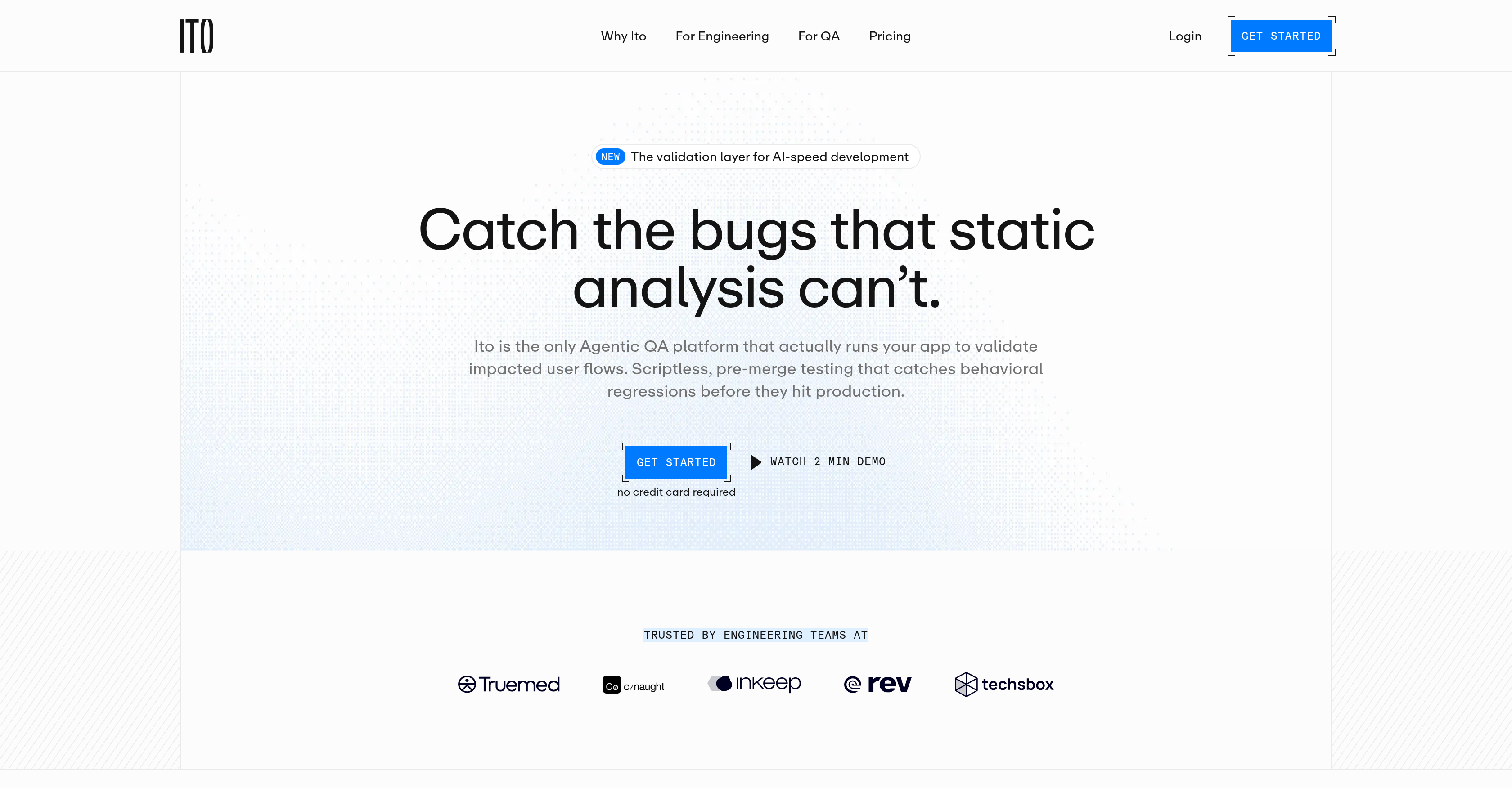
- Catch runtime bugs like broken UI logic and failed API integrations that static analysis tools miss by having ITO AI run your actual application in an isolated sandbox.
- Eliminate manual test scripts and brittle test suites with autonomous, code-aware agents that validate impacted user flows for every pull request, providing continuous pre-merge testing.
- Get visual proof of failures with video reports and pinpointed lines of code, enabling faster debugging without sifting through logs or writing replication steps.
- Test complex, authenticated user flows instantly by providing test environment credentials, allowing ITO AI to handle secure logins and multi-factor authentication automatically.
- Integrate with your GitHub workflow in 5 minutes for a zero-config setup that instantly maps your application logic and works with React, Vue, Next.js, Rails, and Django.
Pros & Cons
Pros
- Runs code and checks functionality
- Tests for edge-cases
- Automatically detects regressions
- Provides video, screenshots, logs
- Bugs feedback on PRs
- Agentic QA tool
- Uses code-aware reviewing agents
- Generates testing plans on PRs
- Tests without manual scripts
- Catches bugs static analysis cannot
- Validates user flow changes
- Zero-config platform
- 5-minutes setup
- Repository connectivity
- Tests user flows automatically
- Mocks unavailable credentials
- Compatible with various tech stacks
- Framework agnostic
- Provides visual proof through video
- Highlights code lines for failures
- Detects behavioral regressions
- Finds runtime bugs
- Works for complex user flows
- End-to-end validation
- Continous pre-merge testing
- Does not store your code
- High security level
- Confidential validation process
- Isolated sandbox testing environment
- Authenticates test environments
- GitHub integration
- Instant application logic mapping
- Scriptless setup
- Bug reports to GitHub timeline
- QA report for every PR
- Handles authenticated user flows
- Supports multi-factor authentication
- Maintains session management automatically
- 10 times more QA coverage
- Detects usability error
- Does development workflow efficiency
- Offers software development assistance
- Handles secure logins for testing
- Conducts audits on every PR
- Insightful for potential bugs
- Supports wide range of technology stacks
- Ensures end-to-end validation for every PR
- Auto-generates test cases
- Support for development velocity
- Visual reproduction steps posted on PR review
- Catches UI logic or API integration failures
- Adapts automatically as UI evolves
Cons
- Lacks static code analysis
- No support for manual scripts
- Exclusively PR oriented
- Potential incompatibility with non-web apps
- Dependency on repository connection
- Restricted customization in testing
- Focus on runtime bugs only
- No identified error documentation feature
- Lack of integrations beside GitHub
- No support for multi-repositories
Reviews
Rate this tool
Loading reviews...
❓ Frequently Asked Questions
Ito is an advanced Automated Quality Assurance (QA) tool. It is designed to meet the needs of high-velocity development teams by reviewing each pull request with code-aware agents. These agents identify regressions and usability errors without the need for manual test scripts. This provides a validation layer for AI-speed development and allows the migration from static analysis to total behavioral certainty when testing user flows.
The primary objective of Ito's QA Agent is to autonomously validate your pull requests. This involves providing visual proof via video reports and highlighting the precise lines of code responsible for any failures. This tool facilitates continuous pre-merge testing to sieve out any issues before they become a part of the main codebase.
Ito validates pull requests by using code-aware agents that review each request. They identify regressions and usability errors, and highlight the exact lines of code causing those issues. This process eliminates the need for manual test scripts. The agent runs the application to validate the affected user flows, switching from merely static analysis to total behavioral certainty.
The code-aware agents employed by Ito have the ability to understand the effects of each pull request on the performance of the software. These agents help in identifying not just syntax errors but major regressions and usability issues as well. Their competence allows teams to eschew manual test scripts, offering a streamlined experience and saving the developers' time.
Ito differentiates itself from static code review tools by prioritizing behavioral regression detection over syntax or code-level issues. While traditional static analysis tools can only catch problems at the code level, Ito runs the application to find 'runtime' bugs - those errors which may only be observable during the actual running of the app - which static tools may overlook.
Ito presents several unique benefits to fast-paced development teams. It uses code-aware agents to review pull requests identifying regressions and usability errors, which replaces the need for manual test scripts. It provides continuous pre-merge testing with visual proof in the form of video reports. Additionally, Ito supports various tech stacks and is framework agnostic, allowing for seamless integration with existing technologies.
Setting up Ito only takes 5 minutes. During this setup, you connect your repository and can instantly begin testing user flows using mocked authentication. Its efficient and swift setup makes it an excellent choice for teams working in a high-velocity environment.
When it comes to runtime bug detection, Ito surpasses static analysis tools by identifying bugs that are otherwise overlooked. By running your app, Ito validates the impacted user flows. It prioritizes behavioral regression detection above syntax or code-level issues, catching 'runtime' bugs that emerge when the application is in operation.
Ito's approach to QA automation deviates from conventional methods in that it emphasizes behavioral regression detection rather than syntax or code-level issues. This is achieved by running the application to find the 'runtime' bugs. In addition, rather than just using static analysis, Ito validates the affected user flows, ensuring total behavioral certainty.
Ito is compatible with a wide range of tech stacks, proving its adaptability. It supports popular frontend and backend frameworks such as React, Vue, Next.js, Rails, Django and more. Its framework-agnostic nature makes it versatile and accommodative of diverse technology landscapes.
Ito emphasizes on behavioral regression detection over syntax or code-level anomalies. It does this by running your application, enabling it to validate the affected user flows and catch bugs that static analysis tools might miss. This promising feature shifts the testing focus from static analysis to total behavioral certainty.
'Framework agnostic' in the context of Ito means that it is compatible with diverse technological stacks. This attribute allows Ito to interact seamlessly with any tech stack used in your project regardless of the programming language or development framework.
Ito ensures continuous pre-merge testing through its QA Agent. This agent autonomously validates your pull requests, supplying visual proof via video reports and marking out precise lines of code responsible for each failure. This procedure equips the team with necessary insights for timely corrections before the pull requests are merged.
Using mocked authentication with Ito lets you test user flows instantly after connecting your repository. This approach allows the simulation of authenticated sessions to validate user flows that require sign-in, thus imitating a real user's passage through the application without disclosing sensitive information.
'Total behavioral certainty' offered by Ito signifies the thoroughness in validating the affected user flows by running your application. This goes beyond just static analysis to catching bugs that static tools might overlook, thus ensuring the smooth functioning of the application in real time in line with the end user's behavior.
Ito offers visual proof in the form of video reports during pull request validation. These reports show the precise lines of code behind any failures helping the team visualize and understand the issues without having to read through extensive logs or replication steps.
Ito replaces manual QA and brittle test suites by providing automated pre-merged, end-to-end validation. The process is autonomous and requires no script writing or excessive configuration. Instead, it runs the app directly to validate user impacts. This mitigates the risk of human error and the time consumed in manual QA, offering a more robust, reliable, and time-efficient QA process.
Engineering and QA teams, particularly those working in fast-paced environments, can significantly benefit from Ito. Its ability to automate QA, present visual proof for detected issues, and achieve continuous pre-merge testing can help these teams catch regressions and usability errors early, enabling more efficient and consistent production cycles.
Ito can catch 'runtime' bugs, which static analysis tools often miss. These may include broken user interface logic or failed API integrations that only become noticeable when the application is running. By replicating real user behavior, Ito provides a comprehensive quality assurance solution that outperforms static analysis tools.
Ito replicates the actions of a real user by running your app to validate impacted user flows. For flows requiring authentication, Ito uses test environment credentials for multi-factor authentication or secure logins, essentially practicing session management just like a real user would.
Ito.ai is a behavioral validation layer designed as an Automated Quality Assurance (QA) tool aimed at facilitating faster development velocity for development teams. It uses code-aware agents to review each pull request, generate testing plans, run the code, and test without the need for manual test scripts.
The main function of Ito is to act as a Quality Assurance (QA) tool for development teams. It checks functionality, edge cases, and regressions by running the application code. It can detect bugs which static analysis cannot. After running your application, Ito validates the affected user flows, offering a switch from static analysis to total behavioral certainty.
Ito offers a zero-config platform that takes about 5 minutes to set up. During this setup process, you connect your repository and Ito automatically begins testing user flows and mocks any credentials it doesn't have.
Ito can detect runtime bugs, which are bugs that become apparent only when the application is running. These include bugs like broken UI logic or failed API integrations, something that static analysis may miss.
Ito's QA Agent is designed to autonomously validate your pull requests. It provides visual proof through video reports and highlights precise lines of code for every failure, thus marking a significant improvement in continuous pre-merge testing.
Ito contributes to continuous pre-merge testing by intercepting every pull request to validate impacted user flows before they merge. This is done by performing code-aware inference to find regressions, and then posting visual bug reports and reproduction steps directly to your GitHub timeline.
Ito handles complex behavioural user flows by validating your application's behavior in a manner closely resembling a real user. It supports test environment credentials for flows that require secure logins or multi-factor authentication. In doing so, it provides an advanced level of validation for applications.
Yes, Ito is compatible with various technology stacks. It works with several technologies such as React, Vue, Next.js, Rails, Django, and more, making it framework agnostic.
Ito differentiates itself from static code analysis tools by prioritizing behavioral regression detection above syntax or code-level issues. It accomplishes this by directly running your application, thereby finding 'runtime' bugs which static tools may miss.
In terms of security measures, Ito ensures security and confidentiality by executing your application in an isolated sandbox environment. It does not store your code and the QA Agent deploys your application in an isolated, single-use sandbox environment to perform secure code execution.
Ito's easy compatibility with GitHub allows for seamlessness in the setup process. Once you connect your GitHub repository, Ito’s Agentic QA platform instantly maps your application logic, allowing for effective and efficient testing.
For fast-paced development teams, Ito offers various benefits such as the detection of regressions and usability errors without manual test scripts, and a high level of compatibility owing to its ability to work with a wide range of technology stacks. It also provides continuous, scriptless, end-to-end validation for every PR.
Yes, Ito works with sandbox environments. It employs an isolated sandbox environment while executing the application during testing, thereby ensuring that the process remains secure and doesn't interfere with other systems.
Ito provides visual proof for validation through video reports. In case of any failure, it also highlights the precise lines of code, providing an exact reference for the issue within the code.
Ito detects runtime bugs by running your application. This process allows it to pinpoint behavioral regressions and usability errors, going beyond the capabilities of static analysis tools and capturing bugs only visible when the application is running.
Yes, Ito can understand impacted flows by running code in an isolated environment. This deep browser inference abilities allows it to comprehend the impacts of potential changes and helps in catching bugs that could introduce flaws in the application.
Yes, Ito helps in the detection of usability errors and regressions in coding. It does this by auditing every pull request using code-aware agents, ensuring bugs and regressions are identified and dealt with before they affect the production phase.
Ito improves development workflow efficiency by testing all edge cases right on their pull requests which eliminates the need for manual testing, resulting in faster development. By integrating with GitHub and directly mapping application logic, it speeds up the setup process and facilitates faster action on bugs and regressions.
Ito is compatible with application logic mapping by integrating with GitHub to instantly map the application’s logic during the setup process. This mapping gives it the understanding to perform validations and suggested corrections.
Ito supports flow authentication by handling session management automatically once you provide the credentials. It supports test environment credentials for flows that require secure logins or multi-factor authentication. This ensures the user flow testing sequence remains intact, even when secure logins are required.
Pricing
Pricing model
Free Trial
Paid options from
$150/month
Billing frequency
Monthly