
Ultravox.aiv0.7
Overview
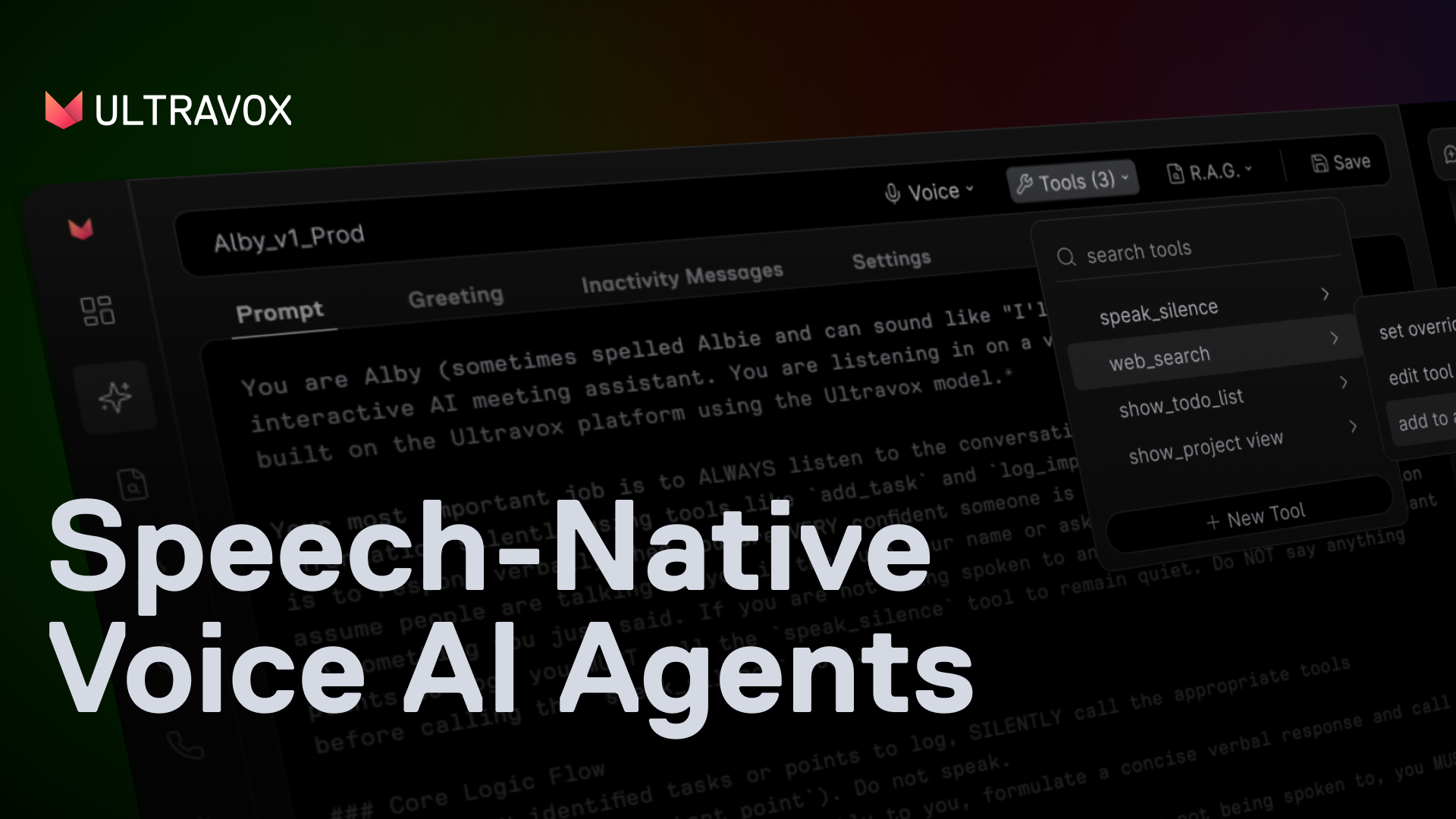
- Launch voice agents that feel human with direct speech processing, bypassing slow text conversion for natural, fluid conversations
- Guarantee consistent, low-latency performance at any scale with dedicated GPU resources for every call, eliminating unpredictable pipeline delays
- Deploy and retain full control in your own cloud environment, ensuring data sovereignty and flexible infrastructure management
- Customize interactions for a global audience by adding languages, fine-tuning on your datasets, and creating unique custom voices
- Integrate seamlessly into any product using developer-friendly APIs and SDKs for all major programming languages and platforms
- Maintain conversational flow naturally by handling interruptions and overlapping speech just like a human would
Pros & Cons
Pros
- Open-source
- Bypasses text conversion
- Web, native apps, telephone integrations
- SDKs for major languages
- Built-in Twilio support
- Multi-language proficiency
- Adapts new languages/accents
- Allows any open-source model
- Allows personal models
- Direct speech recognition
- Reliable and faster interactions
- Fully customisable
- Support for additional languages
- Unique custom voices
- High quality speech
- Function calling feature
- Voice cloning
- RAG Support
- Works with text-based prompts
- Captures non-textual speech elements
Cons
- Might struggle with dialects
- Integration complexity in non-open source
- Customization requires technical know-how
- Adaption to new languages might be limited
- Accuracy varies with accent
Reviews
Rate this tool
Loading reviews...
❓ Frequently Asked Questions
Ultravox.ai is an open-source Speech Language Model (SLM) designed to understand and process speech in a similar manner to human interaction. This software excels in analyzing spoken language directly, bypassing the conventional text conversion process to enable more natural and fluid conversations. Ultravox can be integrated into web, native apps, or telephone-based products and supports multiple languages, allowing for smooth communication across diverse audiences. It can be customised extensively, enabling the addition of additional languages, fine-tuning on personal datasets, and creation of unique custom voices.
Ultravox.ai understands and processes speech by analyzing spoken language directly. It bypasses the conventional process of converting speech into text, allowing it to achieve more natural and fluent interactions. Its unique approach distinguishes it from typical voice systems that rely heavily on text conversion.
Ultravox can be integrated into various platforms including web-based, native apps, or telephone-based products. Its versatility and simplicity make it a perfect fit for diverse product types.
Yes, Ultravox supports Software Development Kits (SDKs) for all major languages. The platform is built with broad compatibility and ease of integration in mind, enabling it to connect with a variety of programming languages.
Ultravox boasts multi-language proficiency to ensure smooth communication across diverse audiences. Its sophisticated language processing capabilities enable it to fluently understand and respond in all major languages, making it suited for global applications.
Yes, Ultravox has the capability to adapt to new languages or accents. Thanks to its adaptive learning feature, Ultravox ensures smooth and effective communication, even when dealing with new language inputs and varying accents.
Ultravox.ai provides the flexibility to work with any open-source model. This includes personal models that have been finely tuned. It’s designed to accommodate a wide range of third-party models, promoting flexibility and diverse use cases.
Unlike other voice systems that rely on transforming speech into text, Ultravox integrates speech recognition directly. This approach makes it faster, more reliable, and enables more natural interactions. It reduces the project’s overall complexity and can capture the nuances of speech more accurately.
Ultravox can be fully customised to align with specific needs. It’s open to adding support for additional languages, fine-tuning based on personal datasets, or creating unique custom voices. This customization capability ensures a more personalized and effective user experience.
The process of adding additional languages to Ultravox involves customization of the base model to include the new language. However, the website does not provide explicit detailed instructions or the exact process for this.
Fine-tuning Ultravox on personal datasets would likely involve appending or training the model with the additional data. The explicit method or instructions to achieve this are however not outlined on their website.
Yes, Ultravox can be used to create unique custom voices. This customization capability is inherent in its design, allowing for a more individualized and tailored user experience.
Indeed, Ultravox supports deployment directly in your own cloud environment, providing greater flexibility and control over the deployment and operation of the model.
The costing information for Ultravox use is listed as 5¢ per minute. However, they also mention being free to get started, suggesting there might be different tiers of usage or pricing.
Yes, Ultravox can handle interruptions in spoken language. This feature is designed to accommodate the natural flow of conversation, where interruptions and overlapping speech may occur.
The information offered about Ultravox mentions the capacity to create custom voices, which might infer the ability to clone voices. However, it doesn't explicitly say that voice cloning is a feature of Ultravox.
Yes, Ultravox can work with existing text-based prompts; however, its superior value comes from its direct speech processing capabilities, bypassing the need to convert speech to text.
Yes, Ultravox is designed to produce high-quality speech, facilitating effective and clear communication in different interaction contexts.
To get started with Ultravox, you can utilize their get started link provided on their website. Further instructions or processes are however not explicitly stated on their website.
Concrete system requirements to run Ultravox are not specified on their website. Considering it's described as being deployable in a cloud environment, there's a likelihood of it operating within fairly standard tech infrastructure. More specific requirements could be listed in more technical documentation or obtained directly from the Ultravox team.
Pricing
Pricing model
Free Trial
Paid options from
$0.07/unit
Billing frequency
Pay-as-you-go
Related Videos
Ultravox MASTERCLASS (Beginner → Pro) 2025: Build AI Voice Agents + AI Mass Caller [FREE Workflow]
Shreyas Raj•3.2K views•Dec 1, 2025