

Overview
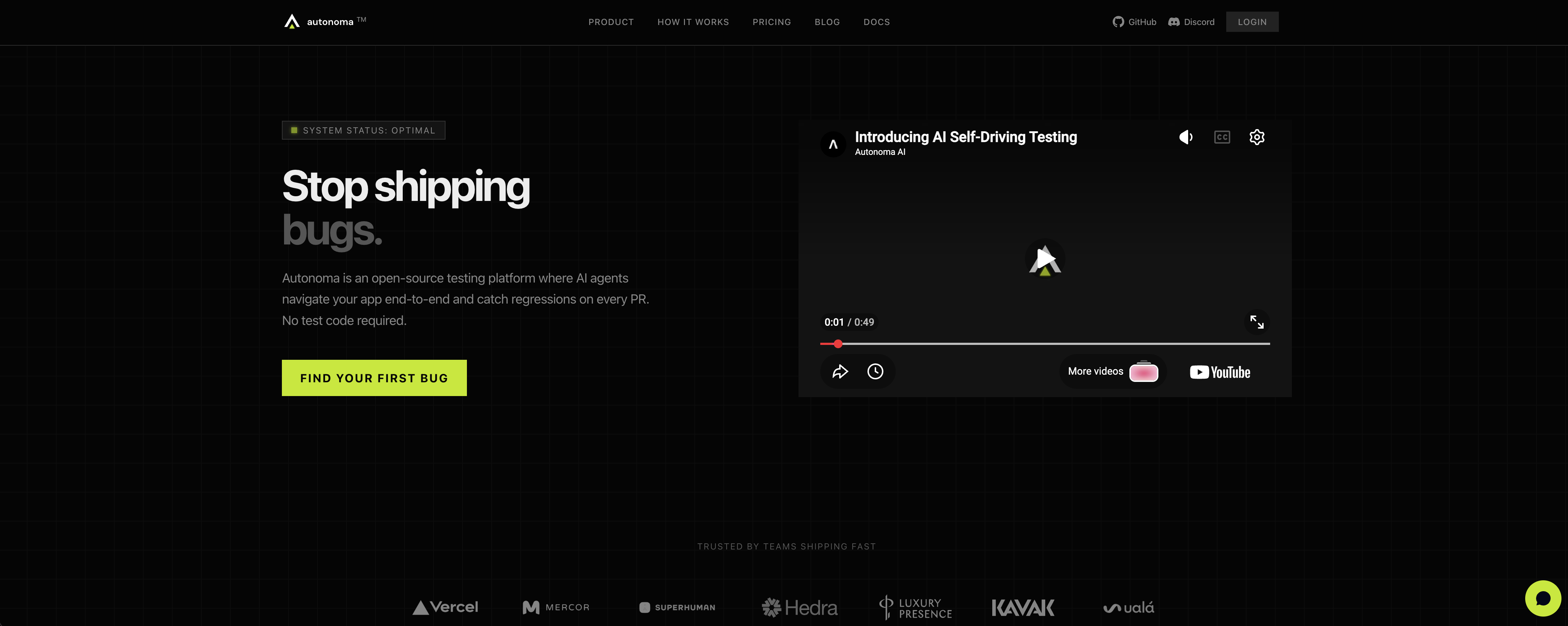
- Catch regressions on every code push with AI agents that test your preview deploy and report results directly in the pull request, providing instant feedback before merging.
- Generate comprehensive test plans automatically by analyzing your GitHub repository to map every page, user flow, and edge case without writing a single line of test code.
- Test applications like a real user on real browsers and devices, with AI agents that navigate, click, and fill forms for accurate end-to-end and user interface validation.
- Integrate seamlessly into your existing development stack and workflow, supporting a wide range of frameworks and languages without disruption.
- Enhance your QA team's efficiency by automating repetitive testing tasks, freeing them to focus on higher-value analysis and complex scenarios.
Pros & Cons
Pros
- Open-source testing platform
- End-to-End Testing
- Code Analysis
- GitHub Integration
- User Flow Testing
- Edge Case Testing
- UI Testing
- Automatic Test Generation
- Deployment Testing
- Stack Integration
- Framework Support
- Language Support
- Enhances QA efficiency
- Provides instant feedback
- Tests in real browsers
- Tests on real devices
- No test code required
- Catches regressions on updates
- Enhances efficiency of QA teams
- Clicks through flows
- Fills forms in testing
- Test results in PR
- Test on preview deploy
- Wide framework compatibility
- Wide language compatibility
- Mapped coverage of codebase
- Zero trust architecture
- SOC 2 Type II Certified
- End-to-End Encryption
- SSO & RBAC integration
- VPC Peering (Enterprise)
- Data Encryption at Rest
- Browses app like a user
- Integrates with existing tools
- Supports various development stacks
- Automatically Analyzes GitHub repo
- Supports Web and Mobile testing
- Sandboxed test environment
- Parallel test execution
- Dashboard and team collaboration
- Scalable parallel execution
- Supports Autonoma cloud and self-hosted
- Enforces role-based access controls
- Tests accessibility of URLs and devices
- Web, iOS & Android testing
- Slack channel integration
Cons
- Requires GitHub integration
- Relies on real devices
- Not a stand-alone tool
- Repository access necessary
- May miss human insensitivity
- Payment for additional credits
- Unclear handling of framework-specific issues
- Not bound to specific frameworks/languages
- Limited to web, mobile testing
- No feature limits for self-hosted version
Reviews
Rate this tool
Loading reviews...
❓ Frequently Asked Questions
Autonoma is an open-source platform powered by artificial intelligence, specialized in automated end-to-end testing of web and mobile applications. Autonoma uses AI agents to test applications in real browsers and devices. One of its key features is detecting regressions with each update and it integrates directly with GitHub for analysis and mapping of the codebase. Despite its extensive features, Autonoma is designed not to replace but to work closely with QA teams, enhancing their efficiency.
Autonoma's AI agents navigate through a user's application end-to-end, in the same manner a real user would. They perform actions like clicking through flows, filling forms, and testing the user interface. The AI agents conduct these tests without the need for any test code, thereby providing thorough and real-time testing.
Autonoma has a direct integration with users' GitHub repository. It utilizes this connection to analyze and map the codebase. Each code push triggers Autonoma to run tests on the preview deploy, with the results showing up directly in the pull request, making sure regressions are detected with every update.
Yes, Autonoma does support mobile applications testing. It is designed to check applications in real devices, providing comprehensive testing that mimics a real user's interaction with the application.
Whenever developers push updates to their repository, Autoonoma starts a testing cycle. It analyses the codebase, navigates and tests the application end-to-end. Autonoma mimics a real-user interaction with the application, enabling it to detect any regressions caused by the new update. The results of these tests are delivered directly in the pull request.
Autonoma generates a comprehensive test plan by connecting directly to the user's GitHub repository and analyzing the application's codebase. This analysis allows Autonoma to map every page, user flow, and edge case which it uses to create a thorough test plan covering all aspects of the application.
Yes, Autonoma does conduct tests on real devices and browsers. This is an essential feature of its agentic testing method, which helps capture accurate, real-world testing scenarios.
Autonoma handles user interface testing by effectively mimicking the actions of a real user. Its AI agents perform tasks like clicking through flows and filling forms which help in achieving a comprehensive review of the user interface. The objective is to ensure a smooth and intuitive user experience with the application.
With Autonoma, every code push triggers a series of tests on the preview deploy. These include navigating through the application, filling forms, and clicking buttons, among other actions that mimic the actions of a real user. The results of these tests show up directly in the pull request.
Not at all. Autonoma is designed to integrate seamlessly into the existing stack of tools. It acts as an execution layer for the generation of code, verifying functionality without disrupting workflow.
Autonoma supports a wide range of frameworks and languages. This makes it a versatile option for any development stack, capable of testing applications built with various technologies including React, Next.js, Vue, Angular, Flutter, React Native, Swift, and any web or mobile application accessible via a URL or device.
While Autonoma provides comprehensive testing capabilities, it's not intended to replace your QA team. Its goal is to work in tandem with QA teams and enhance their efficiency by providing real-time detection of regressions and immediate feedback.
Autonoma enhances the efficiency of QA teams by providing real-time detection of regressions, relieving the QA teams from manual and repetitive tasks. The results of Autonoma’s tests provide immediate feedback, allowing the QA team to focus on higher-value tasks.
Once a developer pushes an update to their repository, Autonoma initiates tests on the preview deploy. This ensures that the new deployments are robust and functioning as expected before they are merged into the main codebase. The process helps identify and rectify any issues before the deployment reaches the end-users.
Autonoma provides immediate feedback on the tests it conducts for each code push. The results of the tests are presented directly in the relevant GitHub pull request. This rapid feedback enables quicker identification and rectification of issues, ensuring high-quality code and application stability.
Yes, Autonoma is designed to test edge cases in your application. When it connects and analyses your GitHub repository, it maps every page, user flow, and edge case to generate a comprehensive test plan.
Autonoma employs AI agents to navigate through your application, eliminating the need for hard-coded test scripts or manual testing. These AI agents test the application from end to end interacting with it like a real user would, thus taking care of the entire testing process without requiring any test code.
Autonoma analyzes and maps your codebase by connecting directly to your GitHub repository. It studies the entire structure of the code, understanding every page, user flow, and edge case. This deep understanding of the codebase allows Autonoma to create a comprehensive test plan that covers all facets of the application.
Autonoma's AI agents mimic the actions of a real user when interacting with an application. They perform tasks like navigating through the application, clicking through flows, filling forms, and more. This approach gives the advantage of experiencing and testing the application from the user's perspective.
Yes, Autonoma does handle automatic test generation. By connecting to the GitHub repository and analyzing the codebase, Autonoma's AI agents can cover every page, user flow, and edge case to generate a thorough test plan. This process happens automatically with each code push, ensuring up-to-date and relevant tests.
Pricing
Pricing model
Freemium
Paid options from
$499/month
Billing frequency
Monthly
Related Videos
First steps creating a test - Autonoma AI
Autonoma AI•876 views•Dec 9, 2025