
Overview
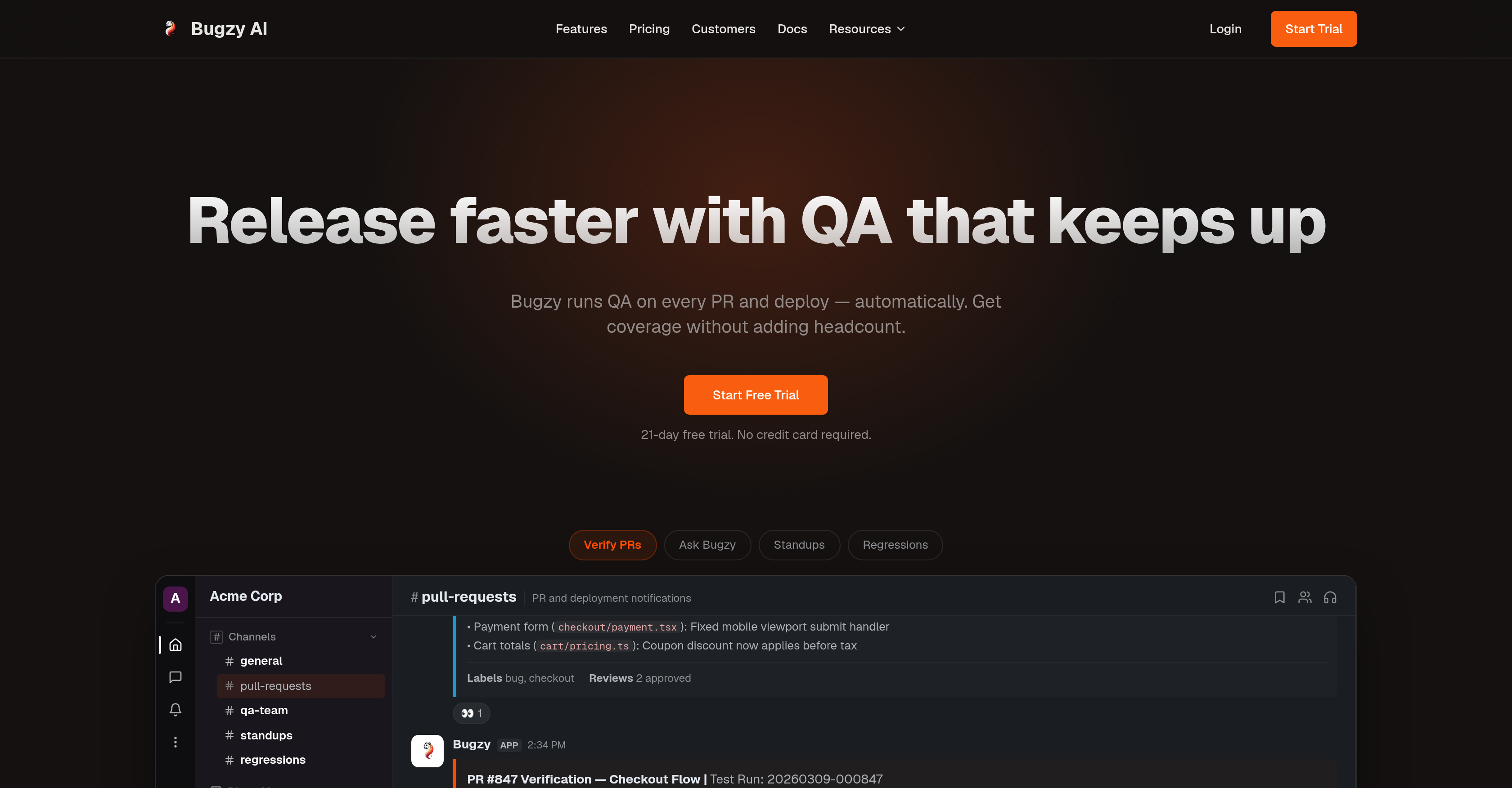
- Ship software faster without expanding your QA team by automating tests on every pull request and deployment
- Eliminate the maintenance backlog with tests that self-heal and automatically adapt when your UI changes
- Get actionable bug reports in under 30 minutes with plain English findings, screenshots, and root cause analysis
- Enhance your existing test suite by having failures triaged, debugged, and auto-fixed directly in your repository
- Build a smarter testing system that learns your product's context by reading PRs, tickets, and documentation
Pros & Cons
Pros
- Works on every PR
- Every change triggers testing
- Quick 30 minute results
- Tools integration (GitHub, Slack)
- Automated test generation
- Automated test maintenance
- Contextual learning from PRs
- Adapts to UI changes
- Compatible with existing tests
- Tests sent directly to Slack
- Includes screenshots and repro steps
- Root cause analysis included
- Defect triage handling
- Auto-fixes broken tests
- Multi-platform compatibility
- Integration with Jira, Notion
- Plain-English findings
- Eliminates maintenance backlog
- Setup only takes 5 minutes
- Up to 17 integrations
- Maximizes test efficiency
- Multi-platform integration
- 21-day free trial
Cons
- Limited integration options
- Extensive setup time
- Possibly incorrect auto-generated tests
- May miss contextual errors
- 30-minute delay for results
- Increased dependency on Slack/Teams
- Expensive for small-scale usage
- Limits on triages/test cases
- No real-time testing functionality
- Results may lack depth
Reviews
Rate this tool
Loading reviews...
❓ Frequently Asked Questions
Bugzy AI is a quality assurance automation tool designed to streamline and automate the QA process. It performs QA tests for every pull request and every deployment, integrating with a host of tools and gradually refining its understanding of the product based on user feedback.
The main features of Bugzy AI include its ability to automatically generate and maintain tests, adapt tests when the UI changes, eliminate the need for maintenance backlog, and 'self-heal' when the UI changes. It also updates its coverage along with code changes, offers speedy testing, provides plain English reports with screenshots, steps to reproduce and root cause analysis, and can assist with existing tests by debugging and auto-fixing failures. Bugzy AI's learning capabilities allow it continually hone its capabilities with use.
Bugzy AI streamlines the quality assurance process by automating QA tests for every pull request and every deploy, thereby eradicating the need to increase the team size. It generates and maintains tests, adapts these tests when UI changes, and eliminates the necessity of maintaining a backlog. By doing so, it speeds up the testing process and improves the speed of product releases.
Yes, Bugzy AI seamlessly integrates with tools such as GitHub, Slack, Linear, Jira, and Notion. This allows the tool to read pull requests, tickets, and documentations from these platforms.
Bugzy AI progressively refines and improves its understanding of the product based on the feedback provided by users. This user feedback is instrumental in continually honing Bugzy AI's capabilities and increasing its efficiency with every use.
Bugzy AI comes with a variety of features including automatic generation and maintenance of tests, capability to adapt tests when the UI changes, elimination of maintenance backlog, ability to self-heal when UI encounters changes, updating of test coverage with code changes, speedy testing, and production of detailed reports in plain English. Additionally, Bugzy AI can assist with existing tests by running them alongside its own, improving them by triaging failures and auto-fixing broken ones.
Bugzy AI updates its test coverage to match code changes, using its ability to read pull requests and other documentation. Specifically, when the user interface changes, Bugzy AI automatically adapts the tests corresponding to those changes to ensure thorough and updated testing.
Yes, Bugzy AI has the capability to 'self-heal' when the user interface encounters changes. This self-healing feature means the tool automatically adapts the tests that correspond to those UI changes, thereby reducing the chances of failing tests due to these alterations.
Yes, Bugzy AI does provide speedy testing. After the tool is kick-started, it delivers the test results typically within 30 minutes. This allows teams to quickly act on any issues and initiate any necessary corrective measures.
Bugzy AI's reports are delivered in plain English, making them easy to understand. The reports include screenshots to visually illustrate any issues, step-by-step instructions to reproduce the problem, and a root cause analysis to elucidate what triggered the problem.
Yes, Bugzy AI can run and improve existing tests. It works alongside existing tests by triaging failures, debugging issues, and auto-fixing broken tests. Your existing tests continue running on your infrastructure while being enhanced by the capabilities of Bugzy AI.
Yes, Bugzy AI learns from user feedback and interactions. This user input is key to the tool's continuous improvement over time, ensuring that it adapts and evolves to become more effective with each use.
The setup process for Bugzy AI is quick and easy, designed to provide teams with a convenient and efficient tool to expedite their QA processes and speed up the release of products.
No, Bugzy AI does not require an increase in team size. It is designed to perform QA tests for every pull request and deploy automatically, thereby mitigating the need to increase the workforce.
The 'code coverage' feature in Bugzy AI refers to the tool's ability to update its testing coverage in line with changes in the code base. This feature ensures that as the user interface changes and the code evolves, the testing processes are automatically adapted to match those changes.
Bugzy AI's test generation and maintenance process involves automatic creation of tests based on the product's context. When the UI changes, Bugzy AI automatically adapts these tests to match the changes, thereby eliminating the need for maintenance backlog.
Yes, Bugzy AI interacts with pull requests and documentations. The AI is integrated with several tools including GitHub, allowing it to read pull requests, tickets, and documentations to help refine its understanding of the product.
Bugzy AI assists in software development and product release by automating the quality assurance process. It performs automated testing on every deploy and pull request, and provides comprehensive reports that include regression detection, screenshots, steps to reproduce any identified issues, and root cause analysis. The result is an improved, expedited QA process, faster releases and improved software products.
Yes, Bugzy AI can triage and auto-fix broken tests. It runs in conjunction with existing tests, and when it detects a failure, it capacitates the debugging of issues and automatically rectifies the broken tests, without requiring any user intervention.
'Runs automatically on every deploy' means that Bugzy AI conducts automated Quality Assurance (QA) testing every time a code deployment happens. This ensures that QA happens consistently, without the need for a manual trigger, thus ensuring that every change in the software is tested for issues and bugs before it locks.
Bugzy AI collaborates with any pre-existing tests, handling the triage of failures, debugging issues, and auto-fixing broken tests present in your repo. The existing tests continue to run on your infrastructure while Bugzy enhances them.
When Bugzy AI detects a UI change, it generates tests that self-adapt, effectively eliminating the need for maintenance. This is part of Bugzy's adaptive testing feature which ensures consistent test maintenance even when your UI undergoes alterations.
Bugzy AI's automated testing produces findings in plain English that include screenshots, reproducible steps, and root cause analysis. These results are presented in a comprehensive and understandable manner, similar to a team member reporting findings.
Yes, in addition to Slack, Bugzy AI's reports can be sent to Linear and Jira platforms as well. This versatility allows for seamless integration with various team communication tools.
Bugzy AI learns your product by reading PRs, tickets, and product documentation. This information enables Bugzy to build a context around your product, understand its functionality, and enhance its testing effectiveness based on this knowledge.
Bugzy AI understands your product by connecting with your tools such as GitHub, Linear, Jira, Notion etc., and reading PRs, tickets, and docs which builds context. This connection and the information gained helps Bugzy learn your product and increases its efficiency over time.
It takes approximately 30 minutes for Bugzy AI to produce results from the automated testing. This quick turnaround time allows for swift action in the event of any identified issues.
Bugzy AI supports integrations with 17 platforms, including GitHub, Slack, Linear, Jira, and Notion among others. This wide array of integrations ensures a seamless experience for users by connecting to various tools in use by your team.
Bugzy AI pricing starts at €250 per month, which includes 50 triages and 10 test cases. Additional triage is offered at €5 and additional test case at €10.
Yes, Bugzy AI provides a 21-day free trial, allowing potential users to experience its features without any financial commitment. A credit card is not required to start the free trial.
The Bugzy AI pricing package includes managed test runs, all integrations, and support. The starting package at €250 per month includes 50 triages, 10 test cases, and up to 1,500 managed test runs with email support.
Bugzy AI has completed over 1,000 automated test runs at GoodShape, demonstrating its capacity to handle extensive testing needs.
Bugzy AI delivers testing findings directly to either Slack, Linear, or Jira teams. The findings include screenshots, reproducible steps, and root cause analysis that offers an in-depth understanding of any identified issues.
Bugzy AI assists in debugging by triaging failures in your existing tests, identifying whether the issue is a product bug, a test issue, or flakiness. By debugging and auto-fixing broken tests, Bugzy maintains the efficacy of your testing process.
Yes, Bugzy AI offers an auto-fix feature for broken tests in your repository. With this feature, Bugzy not only spots issues but also contributes actively to their resolution, reducing the burden on your team.
Bugzy AI maximizes test efficiency by working in tandem with any pre-existing tests, handling triage, debugging, and auto-fixing potential issues. These features ensure test runs go smoothly, providing a platform for maximum efficiency and minimal interruptions.
Bugzy AI adapts to UI changes by generating tests that adjust themselves automatically when there are alterations in the UI. This self-healing feature prevents tests from becoming obsolete due to UI changes.
Yes, Bugzy AI supports Jira integration. This integration is part of Bugzy's multi-platform compatibility, offering users the flexibility to choose a toolset that best suits their needs.
Yes, Bugzy AI offers a Quick Results feature. It is designed to provide the results of the automated testing process within approximately 30 minutes, ensuring your team can act swiftly on the findings.
Bugzy AI handles reproducible steps by providing a clear, step-by-step breakdown in its findings report. These steps help to accurately reproduce the issue, giving you a clear path to understanding and addressing the discovered defects.
Pricing
Pricing model
Free Trial
Paid options from
$250/month
Billing frequency
Monthly
Refund policy
No Refunds