
Document Transcribe
Overview
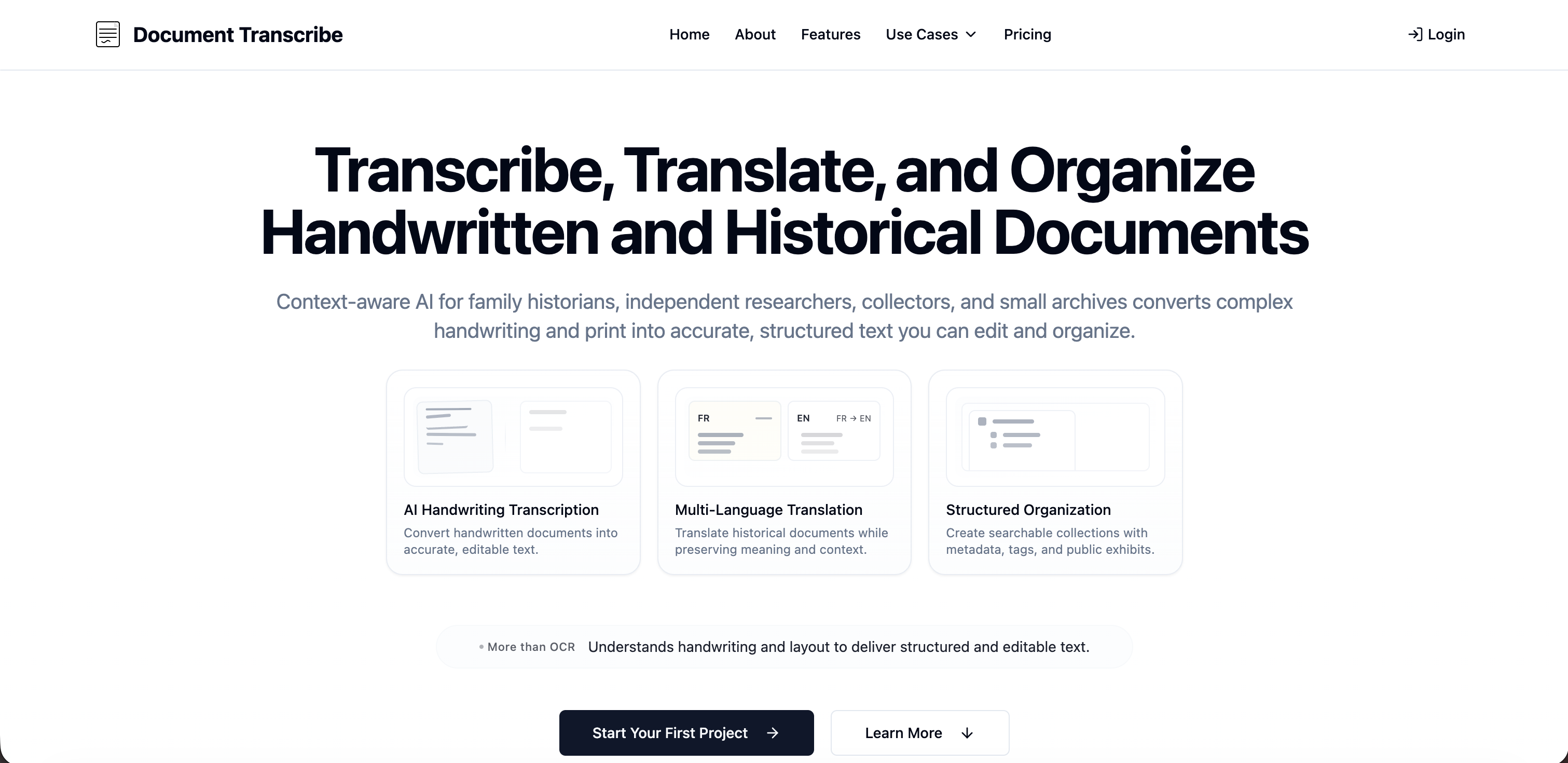
- Preserve family letters, diaries, and photos as fully searchable digital collections with automatic metadata and tags, using context-aware AI that understands handwriting and document layout.
- Unlock foreign language historical records by translating them into your language while preserving original meaning and context, thanks to multi-language translation capabilities.
- Process bulk handwritten documents into accurate, editable text at 92% confidence, turning stacks of manuscripts into structured research assets without manual data entry.
- Build public exhibits and shareable research archives from your digitized materials, enabling easy access for collaborators or the public through secure document sharing.
- Automatically organize digitized historical records with structured metadata and tags, creating a searchable archive that eliminates hours of manual cataloging for small archives and historical societies.
Pros & Cons
Pros
- Adapts to various historical work
- Preserves context of documents
- Understands document layout
- Generates metadata
- Handwriting to editable text
- Print to editable text
- Multi-language translation
- Organized, searchable collections
- Can add contextual information
- Secure sharing of transcriptions
- Turns foreign language documents into searchable data
- Batch processing for multi-page records
- Project organization features
- Facilitates local history preservation
- Facilitates collaborative work
- Handles manuscripts and historical records
- Does not require a large technical team
- Generates tags
- Public exhibit creation
- Confidence level of 92%
- Historical document preservation
- Suitable for various use cases
- Facilitates Metadata generation
- Allows for shareable research
- Automates addition of metadata, tags, and context
- Offers structured and searchable outputs
- Publishes documents for research or public access
- Offers pay-as-you-go or subscription pricing plans
- Includes trial for testing the service
- Offers a team plan for collaborative projects
- Suitable for small archives
- Adapts to family history, research projects, private collections
- Can turn scanned manuscripts into searchable, organized materials
- Converts scanned pages into searchable, organized materials
- Facilitates Historical collection organization
- Offers credits for service actions
- Exhibit tools adapt to different historical work
- Provides workflow options for different types of historical work
- Includes unlimited metadata, article generation, and exhibits for subscriptions
- Covers transcription, translation, metadata, article generation, and exhibits with credits
- Includes multi-user workspace for team subscription
- Offers priority support for team subscription
Cons
- Limited to historical documents
- Possible errors in transcription
- Translation may lose nuances
- Charges for transcription, translation
- Does not support video/audio
- Limited project organization options
- Might require manual data correction
- Lacks real-time collaboration features
- Doesn't support bulk metadata edits
- Limited exhibit creation tools
Reviews
Rate this tool
Loading reviews...
❓ Frequently Asked Questions
Document Transcribe is a tool that utilizes advanced AI techniques to translate, transcribe, and organize handwritten and historical documents. It is designed to serve family historians, independent researchers, collectors, and small archives by converting their documents into searchable, organized digital collections.
Document Transcribe leverages AI in a context-aware manner for understanding complex handwriting and print in documents, transforming them into accurate, structured text. It uses AI for achieving highly accurate transcription of handwritten documents and for translating historical documents while preserving their context and meaning. The AI also helps in structuring the digital collections through metadata, tags, and public exhibits.
Document Transcribe can handle a variety of documents, including handwritten manuscripts, historical records, letters, and foreign language documents. It is built to manage documents ranging from family records, diaries, and photos for genealogy purposes, to local history materials, donor collections, and public archive items for small archives or historical societies.
Yes, Document Transcribe does have the capability to translate foreign language documents. It offers multi-language translation features and transcribes them while preserving the original context and meaning.
Document Transcribe boasts confidence level of 92% in accurately transcribing handwritten text. This confidence level indicates a high level of precision in transcribing complex handwriting into structured, editable text.
Absolutely. Document Transcribe includes features that aid efficient organization of digitized documents. Users can create searchable collections with metadata, tags, and public exhibits. The AI's understanding of handwriting and document structure allows it to produce text that can be searched, edited, and organized effectively.
'More than OCR' feature refers to Document Transcribe's capability to understand and transform not just typed print but also handwriting into structured and editable text. Unlike simple OCR (Optical Character Recognition), it also understands the layout of the documents to deliver more structured text.
Document Transcribe can aid in historical document processing by digitizing handwritten historical documents. It can transcribe these documents into accurate, editable text and also translate them if required, while preserving the meaning and context. It can structure the digital collections with metadata, tags, and public exhibits for better organization and searchability.
Yes, Document Transcribe certainly handles archive digitization. Whether it's local history materials, donor collections, or public archive items, the tool can transcribe, translate, and organize all these into structured, searchable research assets.
Document Transcribe can assist with manuscript digitization by transforming handwritten manuscripts into accurate, editable text that can be efficiently organized and searched. It makes digital versions of these manuscripts that are easier to archive, access, and search.
Document Transcribe offers various pricing plans. There's a free trial option with 3 credits. A $5 one-time credit bundle applies for starter credits. The individual plan at $19 per month includes unlimited metadata, article generation, exhibits, and 300 credits for transcription and translation. The team plan, designed for multi-user collaborative projects, comes at $79 per month and includes 2,000 credits for transcription and translation along with unlimited metadata, article generation, and exhibits.
Yes, it is completely possible to generate a searchable digital collection using Document Transcribe. The system allows users to add metadata, tags, and contextual information automatically to the digitized documents, creating easily searchable collections that can be published for research or public access.
Document Transcribe can be extraordinarily useful for family historians and independent researchers. It can serve them in preserving family letters, records, diaries, and photos along with the stories behind them and in making these documents searchable and structured. Additionally, independent researchers can turn source pages into searchable transcripts, notes, and shareable research using Document Transcribe's functionalities.
Yes, Document Transcribe is capable of handling a bulk of handwritten historical documents. It's AI-powered transcription tools convert these documents into accurate, editable text, making it feasible to process a large quantity of documents.
The transcription output quality of Document Transcribe is highly accurate, with the company providing a declared confidence level of 92%. Its AI not only understands the handwriting but also the document structure, producing text that can be searched, edited, and organized.
Starting a project with Document Transcribe involves a few simple steps. Initially, the documents to be processed need to be uploaded. The uploaded scanned manuscripts, letters, or historical documents are then systematically transcribed or translated by the AI. Additional metadata, tags, and contextual information are then automatically added to organize the documents. Following these steps, the documents can then be shared or published for research or public access.
Yes, Document Transcribe does offer translation capabilities along with maintaining the context and meaning of the original document. With its multi-language translation feature, it is able to translate historical documents into other languages without losing their original context and significance.
Document Transcribe significantly contributes to heritage preservation by ensuring that historical materials and documents are digitized, transcribed, and translated in a way that their original concept and context are intact. It allows for the preservation of this heritage in an accessible, searchable, and digitally organized manner.
Yes. Document Transcribe is versatile enough to process documents for museum tech arrangements. It can transcribe, translate, and organize the digital collections, making it a functional tool for digitizing and categorizing museum archives and collections effectively.
Absolutely. Document Transcribe excels at converting complex handwriting into structured and editable text. Its context-aware AI precisely understands complex handwriting and the associated document layout, allowing it to produce highly accurate transcriptions that can be readily searched, edited, and organized.
Pricing
Pricing model
Free Trial
Paid options from
$5/unit
Billing frequency
Pay-as-you-go
Refund policy
View Policy