
Overview
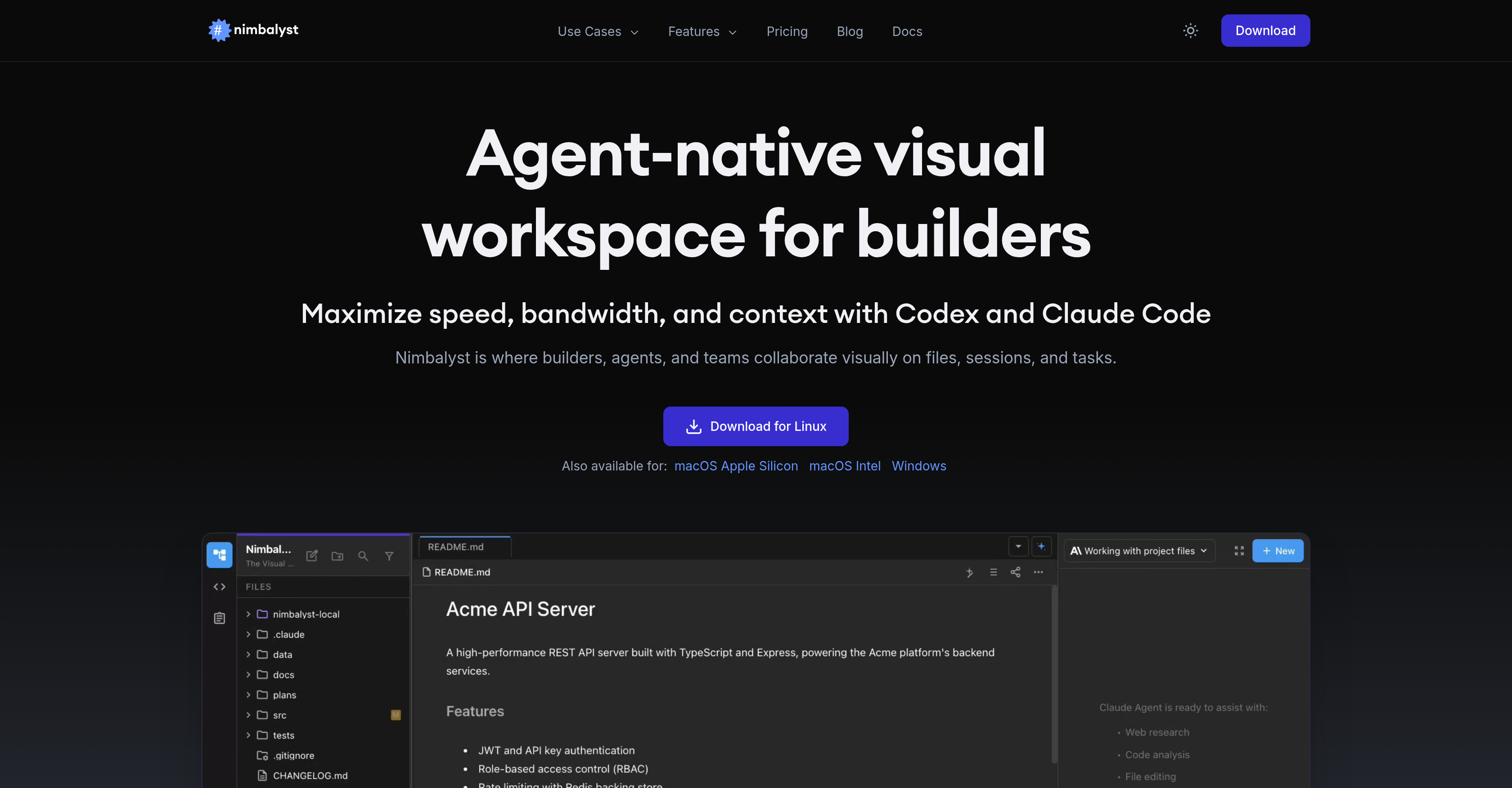
- Maintain full-project awareness while editing any file, as Claude Code and Codex understand your entire codebase, related files, and intent for context-aware AI assistance.
- Transform wireframes into production-ready code instantly, with AI that understands your project to generate matching frontend code from visual mockups and UI plans.
- Design complete database schemas and system architecture visually, using natural language to create diagrams and export normalized Prisma schema files.
- Review and approve every AI edit before it lands, with all changes surfaced as a diff for precise control over code generation and data transformations.
- Manage your entire workflow on a visual Kanban board, where AI agents can create, edit, and move tasks between backlog, planning, implementing, and complete phases.
- Edit CSV data and perform AI-powered transformations directly within the workspace, filtering, sorting, and reshaping without switching to external spreadsheet tools.
Pros & Cons
Pros
- Agent-native visual workspace
- Context-aware editing
- Files review before application
- Supports various file types
- Trusted by established companies
- Integrated session management
- Built-in task tracking system
- Compatible with macOS, Windows, Linux
- UI mockup editor
- Real frontend code generation
- Database schema visual design
- Interactive with other agents
- Visual schema design
- Session Kanban for organization
- Option to manage git state
- Real-time preview diagrams
- Full project awareness for code
- Flexible project management options
- Draft markdown files
- Allows CSV data editing
- Spreadsheets familiar-like view
- Productivity optimization
- Allows agent management
- Normalize schema generation
- Visual UI planning
- Natural language diagramming
- Prisma-ready output
- Embedded markdown diagrams
- Chat function built-in
- Real-time mermaid syntax creation
- Full context and visibility
- Visual file editing
- Workload organizing features
- Plan, write, analyze capabilities
- Coming soon to iOS
- Visual diagram creation
- Broad set of use-cases
- Agent-powered visual Editors
- Interactive question and visual startups
- Eliminates app switching
- Live rendered preview of diagrams
- Interact with your agents functionality
- Agent auto-updating tasks
- Project tracking features
- Full data model understanding
Cons
- No Android support
- Limited file type support
- No offline mode
- No full-screen mode
- Limited customization
- High learning curve
- No multi-language support
- No import/export capabilities
- Single platform dependent
Reviews
Rate this tool
Loading reviews...
❓ Frequently Asked Questions
Nimbalyst is an agent-native visual workspace specifically designed for builders like developers, product managers, and designers. It offers a platform where these professionals can visually collaborate on files, sessions, and tasks to streamline their workflow.
Nimbalyst's primary purpose is to facilitate collaboration between various project stakeholders on files, sessions, and tasks. It intends to enhance productivity by delivering AI-assisted, context-aware editing. The platform is designed to accommodate the varying needs of developers, product managers, and designers.
Nimbalyst works by offering a visual workspace where users can work collaboratively. Key components of its workflow include the use of a main editor with multiple tabs, AI-assisted editing, visual UI planning, and session and task management tools. Prominent AI functions like Claude Code and Codex are integrated into the platform, providing AI-powered edits and data transformations.
Some key features of Nimbalyst include agent-native visual workspace, AI-assisted and context-aware editing, multiple file type support including Markdown, CSV, Mockup Code, Excalidraw diagrams, session and task management tools, full-project awareness for code editing, spreadsheet editing, visual UI planning, system architecture diagramming with natural language, AI code generation, and AI-powered data transformations.
Nimbalyst supports a variety of file types, including Markdown, CSV, Mockup Code, and Excalidraw diagrams among others.
Nimbalyst fosters collaboration by providing a visual workspace where different stakeholders can work together on files, sessions, and tasks. It features session and task management tools for workload organization. Additionally, the integration of AI tools like Claude Code and Codex facilitates context-aware editing, allowing stakeholders to understand and assist each other better.
In Nimbalyst, the AI-assisted editing is powered by Claude Code and Codex integration. This feature offers context-aware editing, helping users to understand and work on their files while considering the full project structure, related files, and intent. The AI can also provide suggestions for efficient coding and data management.
Claude Code and Codex in Nimbalyst are AI tools integrated within the platform. These tools enhance productivity by offering AI-assisted, context-aware editing. They help understand the project structure, related files and intent, and aid in the generation of code and data transformations.
The AI code generation in Nimbalyst works in tandem with Claude Code and Codex. These tools can create, refactor, and debug code working directly in the file alongside the user. This accelerates the coding process and improves efficiency.
In Nimbalyst, you can review AI edits before applying them. Every AI edit is shown as a diff, which users can inspect and approve before integrating into their file. This full control promotes precision and eliminates unwanted changes.
Yes, Nimbalyst does offer sorting and task management features. It enables users to organize their tasks and sessions on a kanban board by phase: backlog, planning, implementing, complete. This lets users see their full workstream at a glance.
Yes, you can use Nimbalyst for spreadsheet editing. It has a feature that lets you edit CSV data in a familiar spreadsheet view. Claude Code and Codex will understand the structure and context of your data, while allowing CSV file edits within Nimbalyst instead of forcing a switch between editors and terminals.
The Visual UI planning feature in Nimbalyst allows users to design wireframes and mockups visually. Claude Code and Codex can understand your project and generate matching code, bridging the gap between design and implementation. This allows users to iterate and review agent changes real-time.
In terms of system architecture diagramming, Nimbalyst allows users to create and modify Excalidraw diagrams using natural language. Claude Code and Codex can place, connect, and style elements, making it easy to map system architectures, flows, and processes visually.
Nimbalyst's future plan for extension to the iOS framework involves launching a mobile application. This would allow users to start new sessions, monitor running sessions, review agent work, and chat with Claude Code and Codex from their iPhone, creating a seamless way to continue work from anywhere.
The context-aware editing feature of Nimbalyst aids in project management by understanding the full project structure, related files, and intent while editing Markdown files. Users can interact with Claude Code and Codex side-by-side while working on their Markdown, without needing to switch context. It allows them to review and approve AI edits, resulting in more efficient and controlled project management.
Nimbalyst provides AI-powered data transformations using Claude Code and Codex. Users can ask these tools to filter, sort, reshape, or enrich their data, which are then applied directly to the file. This feature aids in the efficient management of data.
Nimbalyst enhances productivity for developers, product managers, and designers by providing a visual platform for collaboration on files, sessions, and tasks. The integration of Claude Code and Codex facilitates AI-assisted, context-aware editing. The platform also supports different types of files, streamlined coding and data management via AI, session and task management, visual UI planning, and concise project awareness for code editing.
In the context of Nimbalyst, an agent-native visual workspace refers to a platform where users can collaborate on various tasks using visual aids. It's referred to as 'agent-native' because it incorporates intelligent AI agents like Claude Code and Codex natively into the workspace, enabling AI-assisted functions like context-aware editing, AI-powered data transformations, and AI code generation.
Nimbalyst facilitates collaboration through various tools such as Claude Code and Codex that enhance productivity by providing AI-assisted, context-aware editing. Users can work on their tasks while the AI tools understand and assist with the full project structure and intent. Real-time collaboration is also supported for iterative design.
Nimbalyst supports various types of files, including but not limited to Markdown, CSV, Mockup Code, and Excalidraw diagrams.
Nimbalyst uses AI technology, specifically the integration of Claude Code and Codex, to enhance productivity through features such as AI-assisted, context-aware editing. These tools understand the full project structure, related files and intent, enabling users to work efficiently. This technology also powers functions like AI code generation and AI-powered data transforms.
Yes, Nimbalyst offers spreadsheet editing. Users can edit CSV data in a familiar spreadsheet view while Claude Code and Codex understand the structure and context of the data.
Yes, users can review AI edits in Nimbalyst before applying them. Every AI edit is surfaced as a difference that can be inspected and approved before landing in the user's file. This promotes user control over the changes made.
Yes, Nimbalyst has task management features. It offers an integrated environment for session and agent management, allowing users to manage tasks efficiently with a full task tracking system built in.
Nimbalyst is currently working on extending its functions to the iOS framework. Users will be able to start new sessions, monitor running sessions, review agent work, and chat with Claude Code and Codex from their iPhone. They can also pair with desktop Nimbalyst in seconds and stay connected to their work from anywhere. However, specifics about the iOS integration are not available at the moment.
Yes, Nimbalyst can generate AI code. With the help of Claude Code and Codex, it can generate, refactor, and debug code directly in the file alongside the user.
Nimbalyst assists with visual UI planning by allowing developers to design wireframes and mockups visually, while Claude Code and Codex understands the project and can generate matching code.
Claude Code and Codex are integrated AI tools within Nimbalyst that provide AI-assisted editing. They work to understand the full project structure, related files and intent thereby helping users with AI code generation, data transformation, diagram creation, schema design, among other things, which enhances productivity while working on Nimbalyst.
Yes, users can use Nimbalyst to create and modify diagrams like Excalidraw and Mermaid diagrams. Claude Code and Codex assist in placing, connecting, and styling elements when diagrams are created and modified using natural language.
Nimbalyst aids in database schema design by allowing users to design database schemas and entity relationships visually. Claude Code and Codex understand the full data model and can even generate a complete, normalized schema as a visual diagram.
Nimbalyst handles session and task management by offering an integrated session management and agent management environment. It allows users to organize sessions on a Kanban board by phase and track the files modified in a session. The platform has a full task tracking system built in, enabling users to track plans, bugs, ideas and more. Agents can create tasks, edit them, move them between statuses, and mark them complete, as part of their normal workflow.
Yes, Nimbalyst can understand and assist with the full project structure. Its integrated AI tools, Claude Code and Codex, enable this feature allowing users to work directly in their markdown or other files while the AI simultaneously comprehends the full project structure, related files, and intent.
Yes, users can use Nimbalyst to edit CSV data. The platform's integrated AI tools, Claude Code and Codex, will understand the structure and context of the data, transforming it directly in the file.
Yes, Nimbalyst supports real-time collaboration. Users can edit the drawing directly and iterate on drawings conversationally with their agent. This also applies to the task management feature where tasks can be edited and organized in real time.
The groups that would benefit the most from using Nimbalyst are developers, product managers, designers, and builders in general, along with their respective teams. It aids in collaboration on files, sessions, and tasks and enhances efficiency and productivity.
Yes, Nimbalyst can generate a normalized schema as a visual diagram. When users describe their data needs, Claude Code and Codex can generate a complete, normalized schema as per the requirements. The output can be exported as Prisma schema files, ready for use in the users' application.
Pricing
Pricing model
Free
Paid options from
Free
Related Videos
Next Level AI powered Product Management workflows with Claude Code and Nimbalyst
nimbalyst•215 views•Jan 26, 2026