

Overview
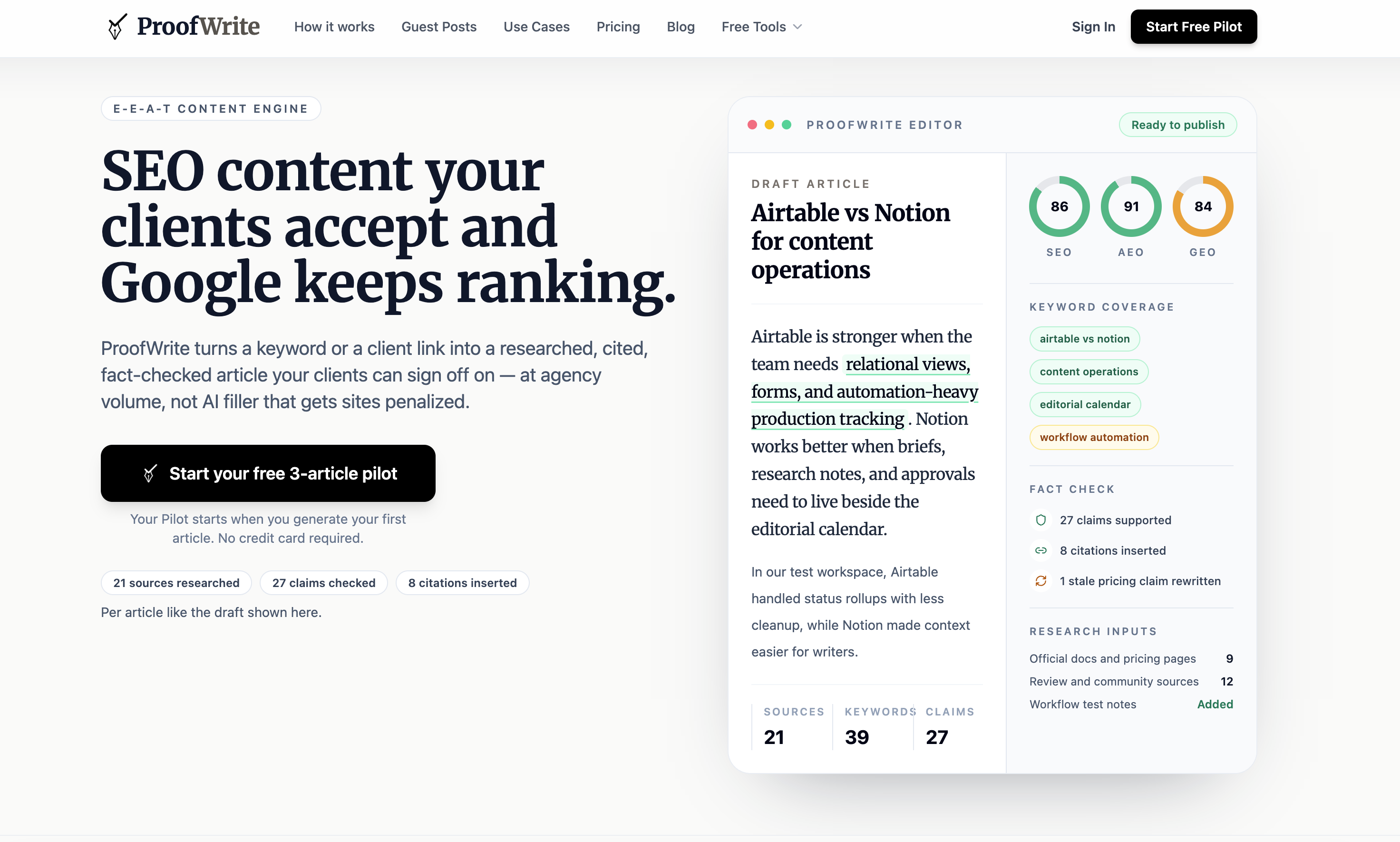
- Publish credible, research-backed SEO articles every time by starting with live keyword data and coverage targets that define exactly what to cover.
- Eliminate manual research by sourcing materials from official pages, reviews, discussions, and files to build comprehensive articles.
- Produce unique, personalized content by integrating your own notes and opinions directly into the draft during creation.
- Publish with confidence by running automated quality assurance checks that detect and correct weak claims before going live.
- Achieve natural SEO keyword integration without stuffing by having the AI weave required terms organically into the draft during generation.
- Build publisher-ready guest posts that place client links naturally and editorially justified, keeping engagements organic.
- Scale content across multiple websites simultaneously by using multisite analysis that adapts to each domain's unique context.
- Maintain consistent brand voice across all articles by letting the system learn your tone and style from existing website content.
- Uncover fresh article opportunities daily with topic suggestions based on your site's existing content and coverage gaps.
- Improve site structure and rankings through intelligent internal linking recommendations that integrate into new content pieces.
- Make data-driven keyword decisions without switching platforms by accessing live volume and competition data directly within the workflow.
- Create domain-backed drafts that align with your specific audience and SEO needs by analyzing your own site's context and brand voice.
Pros & Cons
Pros
- Research-first workflow
- Article structuring
- Citations included in text
- Supports various starting inputs
- Generates publisher-ready drafts
- Supports SEO content workflows
- Analyzes connected websites
- Suggests missing article opportunities
- Brand voice adaptation
- Live keyword research data
- Pre-publishing quality checks
- Avoids keyword stuffing
- Two workflow modes
- Supports various user types
- Daily content suggestions
- Claim verification
- Offers Standalone and Domain modes
- ProofWrite supports internal linking
- Generates unique content
- Conducts research from various sources
- Revision of weak claims
- Gathers draft materials
- Includes multiple audiences
- Features personal opinion integration
- Reviews, guides, listicles creation
- Multiple review and community sources
- Real-time SEO scoring
- Live keyword coverage data
- Multi-source synthesis
- Aggregated trust scores
- Brand voice matching
- Generic phrase checking
- Reddit sentiment analysis
- Provision of real search data
- Internal linking support
- Supports Gap Detection
- One-click to project
- Automatic structure alerts
- In-app Search volumes, difficulty scores, and CPC data
- Automatic keyword mapping
- QA agents check before publishing
- Analyzes site brand voice
- Supports Domain defaults, brand context
- Automatic support for internal linking
- Daily article gap detection
- Search intent mapping
- Supports E-E-A-T claims
Cons
- Lacks real-time collaboration features
- No direct integration with CMS
- Limited customization of content structure
- Lacks in-built translator for multiple languages
- No offline mode supported
- Lack of robust user access control
- No version history of articles
- No support for video and audio content
- No auto-synchronization with external data sources
- Doesn't support meta tag generation
Reviews
Rate this tool
Loading reviews...
❓ Frequently Asked Questions
ProofWrite is an AI-powered platform aimed at helping publishers, content agencies, and in-house content teams in the creation and management of research-driven, fact-checked SEO articles. The platform is built to turn keywords or client links into evidence-based articles and supports both standalone and domain-backed drafts depending on the workflow.
The quality of articles generated by ProofWrite is maintained through a Quality Assurance (QA) check which detects and corrects any weak points in the content. The AI system is designed to conduct this check before publishing, ensuring the article's integrity and suitability for the intended reader.
ProofWrite can integrate user notes and opinions into the articles by weaving the notes, opinions, and firsthand context provided by the users into the creation process. This not only makes the articles more personalized but also tailor-made to the specific needs of the client.
Yes, ProofWrite is capable of adapting to your brand's specific voice. By analyzing content from the connected website, it learns the brand voice and applies this knowledge to the creation of new articles, ensuring consistency across all published content.
ProofWrite gathers information from a wide variety of resources to create articles. These include official pages, reviews, discussions, files, live keyword data, coverage targets, and user-supplied notes and opinions.
ProofWrite uses real demand live keyword data in its content creation by defining what the articles need to cover. This process, which includes determining keyword volume and competition data, ensures that the content matches the real demand in terms of relevant search terms.
Yes, ProofWrite can analyze existing content on your website. The platform offers a comprehensive workflow that includes an analysis of existing content, identification of article opportunities, support for internal linking, and adaptation to the brand voice.
ProofWrite offers several content management features. Besides creating individual SEO articles, it can analyze existing content, suggest new article opportunities, support internal linking, and adapt to the brand voice. The platform also provides a comprehensive workflow for content creation, from input to publication.
Yes, ProofWrite does offer keyword research features. It provides live keyword data, giving you real-time volume and competition data without needing to switch platforms or use additional tools.
With ProofWrite, you can create either standalone articles or domain-backed drafts around a client's link. The platform is versatile, allowing it to adapt to different SEO workflows and making it suitable whatever your article creation requirements.
Weak points in content are identified and rectified in ProofWrite through a Quality Assurance (QA) check, which takes place before an article is published. This check looks for any issues in the content that might harm its quality or credibility and ensures necessary corrections are made before the article goes live.
ProofWrite helps with internal linking in content by analyzing existing content and supporting the integration of internal links into new content pieces. This feature is especially useful for SEO as it can help improve site structure, user navigation, and eventually, search engine rankings.
ProofWrite allows for the creation of domain-backed drafts. Users can make drafts that are backed by their own domain, ensuring that their content is tailored to their site, their audience, and their specific SEO needs.
ProofWrite can help explore new article opportunities by analyzing your site's existing content. It offers daily suggestions of topics that have not been covered yet, providing new and relevant content ideas every day.
Yes, ProofWrite does provide data on keyword volume and competition. The data is live and doesn't require users to switch platforms. This means that you can make data-driven decisions on your keyword strategy directly within the ProofWrite platform.
Yes, ProofWrite can suggest daily topics based on your site's existing content. By analyzing what content is already present on your site, it can suggest new topics every day that haven't been covered yet, providing you with a constant stream of fresh and relevant content ideas.
Yes, ProofWrite does allow for standalone article creation around a client's link. This feature makes it a versatile tool for different SEO workflows, as it creates the flexibility for users to build content around a specific focus, such as a client's product or service link.
Yes, ProofWrite can research and integrate data from various sources, such as official pages, reviews, discussions, files, and others, to generate comprehensive and fact-checked SEO articles. This exhaustive research process ensures a wide spectrum of perspectives and information are considered during article creation, enhancing the credibility and value of the output.
Yes, ProofWrite does offer forms of quality assurance before publishing. Prior to publication, a QA check is conducted to identify and address any weak points in the article. This prevents the publication of low-quality or inaccurate content, ensuring that only polished, fact-checked and valuable articles are released.
ProofWrite supports your SEO and content creation workflow by automating the creation of research-driven, fact-checked SEO articles from keywords or client links. The platform provides a comprehensive workflow, from input where live keyword data and coverage targets define what the articles will cover, to a QA check which ensures weak points are detected and rectified before publishing. In addition, ProofWrite can analyze existing content on your site, suggest article opportunities, support internal linking, and adapt to your brand voice.
ProofWrite's primary purpose is to assist SEO agencies, content creators, link builders, publishers and content teams in creating high-quality, long-form content. It centres on a research-first approach, transforming inputs like keywords, client URLs, anchor text, or website context into structured, evidence-backed articles that exhibit clear reasoning and a strong editorial foundation.
ProofWrite assists in generating content. Users input initial information such as a keyword or a website context, which the AI uses to develop structure and generate a data-backed article. This process includes researching, writing, citing sources, and quality assurance checks.
The Standalone and Domain Modes in ProofWrite accommodate different content workflow requirements. Standalone Mode is designed for link builders and agencies, helping them draft content around a client's URL and anchor text. Domain Mode is tailored for teams creating content for their own sites; it analyses the site, learns the brand voice and suggests article opportunities.
ProofWrite aids in creating guest posts by building publisher-ready drafts around the client's link while ensuring that the placement remains natural, relevant, and justified editorially. This makes the drafted content suitable for guest posts, keeping the engagement organic and the content of high quality.
The 'avoid keyword stuffing' feature in ProofWrite ensures that SEO keywords are integrated organically into the content during generation. Rather than forcing in keywords awkwardly, the AI ensures the terms fit naturally within the context of the content, maintaining readability while boosting SEO.
Yes, ProofWrite can assist in internal linking within websites. It analyses existing content on the website, providing recommendations for internal linking that will enhance SEO and improve the navigability and structure of the website.
ProofWrite adapts to a brand's voice through its Brand Voice Learning feature. As part of its Domain Mode, the system analyses the brand's existing content on the website and learns the brand voice, tone, and style. It then utilizes this knowledge to generate new content that aligns with the learned brand voice.
ProofWrite supports broad SEO content workflows by providing an array of SEO tools and features. Besides generating content, ProofWrite can analyse connected websites, suggest missing article opportunities, adapt to brand voices, and deliver keyword research backed by live volume and competition data. It also performs quality checks and optimizes content for SEO before publishing.
Yes, ProofWrite can analyze connected websites. It uses this analysis to understand the context better, extract relevant reference points, identify missing article opportunities, and generate more precise and targeted content. This leads to content that is more consistent with the rest of the website and maximizes SEO benefits.
In digital PR campaigns, ProofWrite is used to generate content that is research-backed, structured, and has a strong editorial substance. It uses inputs like a keyword, client URL, anchor text, or website context, and turns them into credible, publishable articles that can be used in PR campaigns to enhance the digital presence and brand value.
ProofWrite ensures the quality of content before publishing through its quality checks feature. The AI checks for weak claims, logical inconsistencies, and other issues. It ensures that every claim made in the content is checked and every source is attached. This allows users to maintain high quality, accuracy, and credibility in their content.
The research-first workflow in ProofWrite refers to its method of generating content based on in-depth research. Users start with a keyword, client URL, anchor text, or website context. ProofWrite uses this to research and gather relevant information and source material, creating a complete, well-rounded article with citations, and a strong narrative structure.
ProofWrite helps with daily content suggestions based on previous work. It analyses your content and offers suggestions for topics that you haven't covered yet, ensuring you always have new qualified article opportunities ready.
Yes, ProofWrite does provide live keyword research data. As part of its comprehensive support for broader SEO content workflows, ProofWrite not only generates keyword research but updates it with live volume and competition data. This data allows users to target terms that they can realistically win.
The citation generation in ProofWrite works by connecting claims to their sources. As part of its research-first approach, ProofWrite accumulates a list of references from reliable sources during its initial research. When drafting, it substantiates each claim with these references, inserting them as citations in the appropriate areas of the content.
The primary audience for ProofWrite includes SEO agencies, link builders, guest post providers, publishers, and content teams. This also extends to niche edit operators, multisite operators and in-house content creation teams. It aids these users in producing credible, research-based, long-form content at scale.
Yes, ProofWrite can adapt to different brand voices. Using its Domain Mode, ProofWrite analyses a brand's website to understand its tone, style, and voice. The AI then uses this learning to produce new, unique content that aligns consistently with the brand's voice.
The 'Niche Edit Operators' feature refers to ProofWrite's suitability for those who specialize in niche edits. This involves inserting links into existing content on websites, a strategy used in SEO. ProofWrite aids by crafting content that naturally and effectively integrates the client's links, ensuring that the content flows naturally and the link placement is justified editorially.
ProofWrite ensures natural and relevant placement of the client's link within the content by creating a draft that is built around the link. Instead of merely inserting the link into a generic article, the AI generates the content in such a way that it organically leads to and supports the client's link, thereby enhancing its relevance and effectiveness.
The 'multisite operators' feature in ProofWrite indicates the AI’s capability to work effectively across multiple websites simultaneously. This feature is highly beneficial for operators managing content for multiple domains, as it allows ProofWrite to analyse, learn from, and adapt to each site individually, tailoring the content creation process accordingly for each one.
Pricing
Pricing model
Freemium
Paid options from
$49/month
Billing frequency
Monthly
Refund policy
Refunds are reviewed case by case for billing issues, duplicate charges, or accidental purchases. Contact support if you believe there is a problem with your payment.