

Overview
- Deliver requirements that stakeholders approve without rework by linking every functional and non-functional requirement back to the business need it serves.
- Run efficient elicitation meetings that end with decisions by generating a complete package of agenda, elicitation questions, and potential issues.
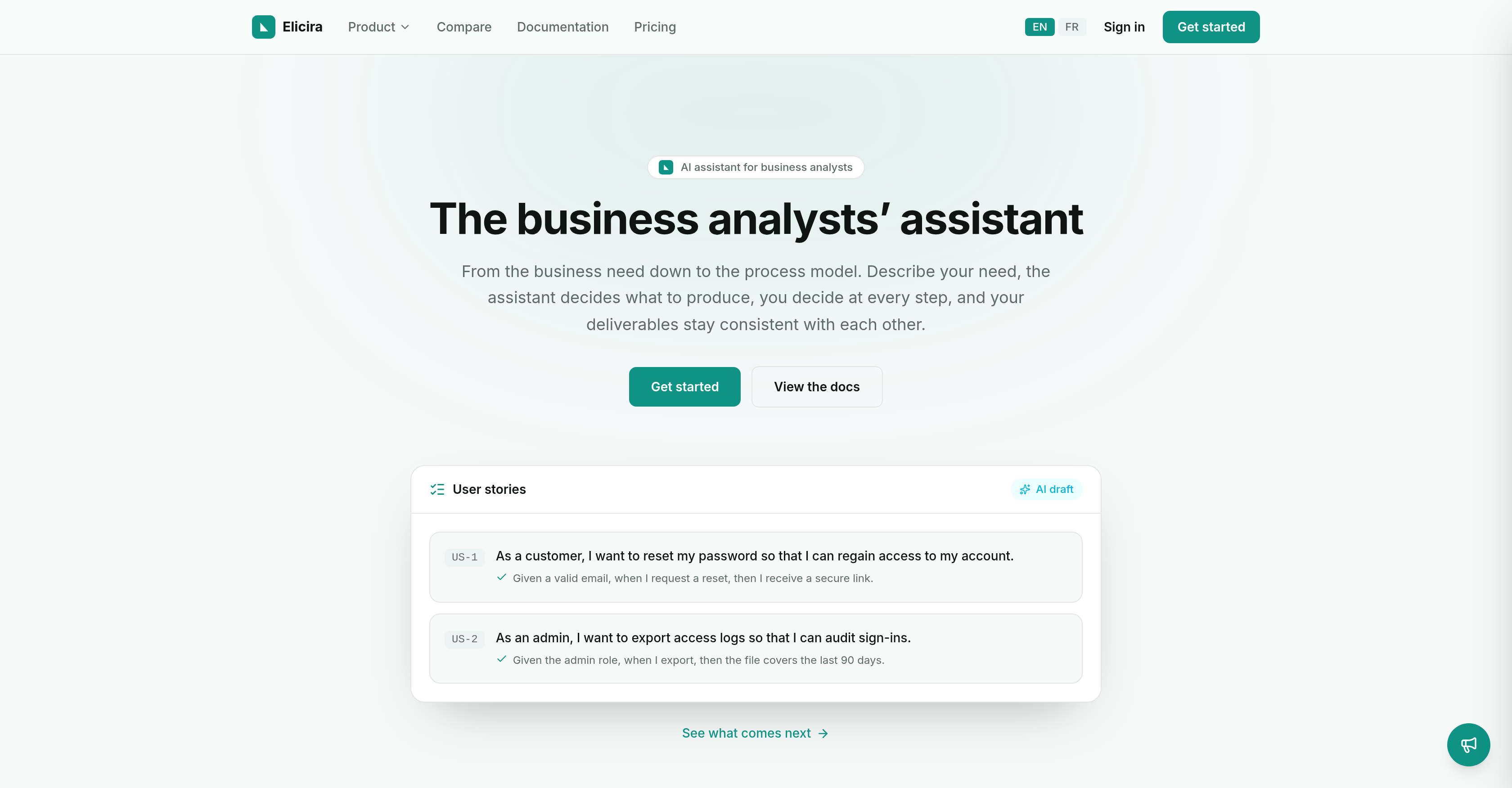
- Produce user stories development teams accept immediately using INVEST slicing and Gherkin acceptance criteria formatted for each role.
- Ship process models stakeholders actually read by building structured, readable processes with BPMN 2.0 export to your preferred tool.
- Catch contradictions before stakeholders do with consistency checks and critical reviews that critique finished deliverables before sharing.
- Eliminate orphan requirements and unmet needs with a traceability matrix that aligns every process step to its originating business need.
- Recover any previous deliverable instantly through version history that archives each iteration for easy comparison and reference.
- Plan and execute BA work according to BABOK v3 by cross-checking tasks against your current work for comprehensive completion.
- Move generated data into your existing workflow with exports to Jira, Azure DevOps, and Confluence.
Pros & Cons
Pros
- Task organization and management
- Dedicated modules for tasks
- Functional and non-functional requirements
- Drafts primary scenarios and alternatives
- Agenda formulation with questions
- Stories with acceptance criteria
- Creates structured process model
- Consistency check feature
- Deliverables critique and review
- Maintains task traceability
- Tracks version history
- BABOK v3 support
- Exports data to tools
- Jira integration
- Azure DevOps integration
- Confluence integration
- Orphan requirements highlight
- Uncovered needs identification
- Structured business needs identification
- 360 meeting preparation pack
- Formatted, INVEST slice stories
- Readable process structure
- Contradiction identification
- Critiques finished outputs
- BABOK validated task planning
- Regeneration archives previous version
- BPMN 2.0 export capability
- Import files, not API
- Document creation support
- Consistent deliverables generation
- Helps with unplanned work
- No installation required
- Arranges business needs to process model
- Elicitation questions provision
- Assistant decides what to produce
- Automatic module selection
- Steps chaining in single request
- Locates gaps in stories and requirements
- Devils advocate on finished deliverable
- Detects blind spots and assumptions
- Supports pre-ticket existence work
- Export document layout whith BPMN
- Annex document (.txt, .docx, .md) feature
- Structured draft proposal for deliverable
- Makes Exported BPMN readable
- Targeted for Business analysts
Cons
- Doesn't hold real-time conversations
- Only suggests not implements
- No integrated API integration
- Limited export formats
- Modular rather than integrated design
- Critical review not real-time
- Dependent on user decisions
- Version history comparison limited
- Not an end-to-end solution
- Doesn't integrate with all BA tools
Reviews
Rate this tool
Loading reviews...
❓ Frequently Asked Questions
Elicira is an artificial intelligence assistant designed to support business analysts. It assists in organizing and managing tasks from identifying business needs to process modelling.
Elicira supports business analysts by helping in task organization and management. Additionally, it aids in identifying business needs, outlining requirements, preparing use cases, scheduling meetings, drafting user stories and modelling processes.
Elicira assists in several tasks in the business analysis process such as identification of business needs, outlining of requirements, preparation of use cases, scheduling meetings, drafting user stories, process modelling, consistency check, deliverables critique, maintaining traceability, and tracking the version history.
Elicira's modules are designed to serve different functions in the business analysis process, such as establishing the problem to solve, creating functional and non-functional requirement, drafting primary scenarios, and alternatives, formulating the agenda alongside elicitation questions, creating formatted stories with acceptance criteria, and building a structured process model.
Elicira assists in creating functional and non-functional requirements by aligning them with the identified business needs. Each requirement is tied back to the need it serves, ensuring requirements fit the problem to be solved and add value.
For meeting preparation, Elicira helps by creating a comprehensive package consisting of an agenda, elicitation questions and potential issues to be discussed, encouraging thorough planning and efficient use of meeting time.
Elicira assists in drafting user stories by providing formatted stories, offering the INVEST slicing method and acceptance criteria in the Gherkin language. This helps in understanding the demands and expectations of different roles.
Yes, Elicira supports process modelling by offering readable process structures and allowing for a BPMN 2.0 export to the user's favored tool.
Apart from its core functions, Elicira offers features like consistency and critical review of deliverables to identify contradictions, maintenance of traceability from the business needs to process steps, version history tracking, and exportability of data to preferred tools.
Elicira ensures the consistency check and critical review of deliverables by identifying contradictions across different deliverables and critiquing the completed outputs before they are shared.
Elicira maintains traceability from the business needs right up to process steps. It highlights orphan requirements and unmet needs, effectively keeping track of the alignment of requirements with the identified business needs.
Elicira tracks version history by archiving the previous state whenever new iterations are generated, making it easy to compare against it and reference old versions.
Yes, Elicira supports the Business Analysis Body of Knowledge (BABOK v3). It assists in planning and executing BA tasks as prescribed by this methodology.
Yes, Elicira can export generated data to preferred tools. Currently, it supports exports to tools like Jira, Azure DevOps, and Confluence.
The advantage of using Elicira in organizing and managing business analysis tasks lies in its comprehensive set of features and capabilities. It aids from initial phases of identifying business needs, through requirement outlining and up to process modelling. It also helps users to maintain consistency, traceability, and version history, streamlining the business analysis process.
Elicira's Needs Identification and Requirements Outlining feature is highly efficient. It not only helps business analysts to establish the problem to solve but also assists in creating functional and non-functional requirements that are tied back to the identified need.
Elicira's Use Cases Preparation function works by identifying the actors, main scenarios and alternatives. This helps in providing clarity for those who do not write in stories, making the requirements more understandable.
Elicira is highly useful in critiquing deliverables before they are shared. It reviews finished outputs and identifies contradictions, ensuring the deliverables are in line with the requirements and are error-free before sharing.
Elicira highlights orphan requirements and uncovers needs through its traceability matrix feature. This feature aligns the process steps with the business needs, thereby uncovering any orphan requirements and unmet needs.
Elicira aids with planning and executing BA tasks by aligning the BA tasks with the Business Analysis Body of Knowledge (BABOK v3). It additionally cross-checks these tasks against the user's current work to ensure comprehensive and fruitful task completion.
Pricing
Pricing model
Freemium
Paid options from
$15/month
Billing frequency
Monthly
Refund policy
No refund guarantee: try the free plan first. Cancel anytime, access continues until the end of the paid period. Billing errors and statutory withdrawal rights (EU/EEA/UK consumers) are always honoured.