
Overview
- Slash AI agent token costs by delivering pre-optimized, structured data through Airbyte's context layer that eliminates redundant raw API response consumption and data cleaning overhead.
- Eliminate multi-API call latency by giving agents a single unified context from Airbyte's integrated data layer instead of forcing them to query multiple sources separately.
- Achieve reliable, timely AI agent responses with Airbyte's replicate-unify-index pipeline that prepares and structures data before any agent executes.
- Maintain complete data sovereignty by choosing exactly where your data resides through Airbyte's flexible deployment options for maximum security and compliance control.
- Streamline AI agent operations at scale with Airbyte's built-in connector management, OAuth authentication, tool schema configuration, and action execution capabilities.
- Accelerate developer integration using Airbyte's CLI, SDKs, APIs, and MCPs that provide robust infrastructure for connecting systems to AI agents.
- Gain full transparency and customization through Airbyte's open-source architecture that lets you inspect, modify, and distribute the platform to fit your exact data integration needs.
Pros & Cons
Pros
- Open-source platform
- Efficient token consumption
- Reduces redundant data cleaning
- Mitigates latency issues
- Single layer of interaction
- Replicates, unifies, indexes data
- Choose where data resides
- Includes CLI, SDK, APIs
- Features OAuth management
- Connector management
- Mitigates token waste
- Real-time read/write access
- 600+ connectors
- Reduces API calls
- Increased data access efficiency
- Comprehensive management features
- Seamless access to data
- Pre-indexed context
- Portable data
- Builds context
- Reduce live API crawling
- Interactive Demo
- Easily integrated with CRMs
- Support multiple data sources
- Unified context quicker agent start
- Reduced data cleaning tasks
- Accessible tool schemas
- Efficient action execution
- Unifies system and agents
- No data lock-in
- Works with any agent framework
- Quick setup
- Advantageous architectural design
- Ensures timely information access
- Reduced latency with single API call
- Improved operational smoothness
- Comprehensive developer tools
- Optimized raw API response consumption
- Detailed documentation
- Supports various databases
- Good community support
- Customizable data residing options
- Flexible API usage
- Improved context visibility
- Reduces system and agent gap
- Optimized for data integration
Cons
- Dependent on tokens
- Potential latency issues
- Complex connector management
- Requires data cleaning
- Manual data residing choice
- Might overwhelm non-technical users
- Limited to pre-indexed context
- API consumption optimization needed
- Selective OAuth management
- Tool schema management
Reviews
Rate this tool
Loading reviews...
❓ Frequently Asked Questions
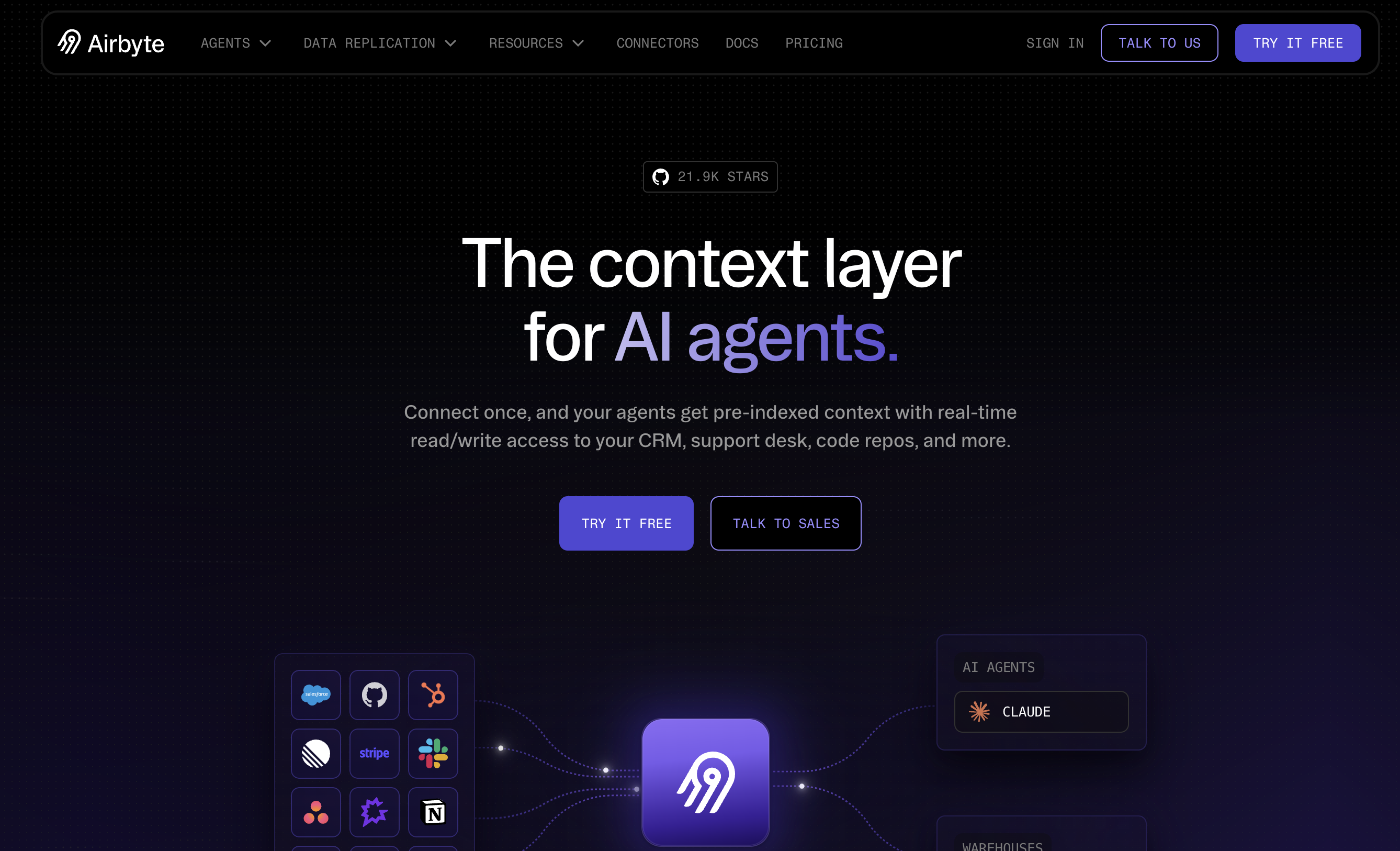
Airbyte is an open-source data integration platform that serves as a context layer for AI agents. It provides a connection between various systems and AI agents, addressing key issues like token waste, latency, and lack of context visibility.
Airbyte works by acting as an intermediary that connects to various data sources, constructs a context, and delivers it to any AI agent in use. It optimizes the consumption of raw API responses and thus reduces redundant data cleaning tasks. Also, it syncs, unifies, and indexes data before any AI agent runs.
The purpose of Airbyte in AI applications is to provide agents with efficient, comprehensive, and seamless access to data from multiple platforms. It provides a unified context to agents rather than making them call multiple APIs, hence improving data access efficiency.
Airbyte solves token waste issues by optimizing the consumption of raw API responses. It minimizes the use of tokens for data cleaning tasks, focusing more on delivering clean and structured data to AI agents.
Yes, Airbyte addresses latency issues by providing a unified data context to AI agents. Instead of implementing numerous API calls, AI agents can source data from one integrated layer, thereby reducing call latency.
Airbyte acting as a single layer of interaction means it provides a unified architecture between various systems and AI agents. Essentially, it consolidates data from multiple sources and delivers it in a structured and accessible format, streamlining the flow of information and interactions.
Yes, Airbyte can replicate and index data. It prepares the data before any AI agent runs by replicating, unifying, and indexing it, ensuring the information is reliable and timely.
Yes, Airbyte allows you to choose where your data resides, offering increased control over data management and security.
Airbyte provides multiple developer tools such as the command line interface (CLI), software development kits (SDKs), application programming interfaces (APIs), and managed control planes (MCPs). These tools form a robust infrastructure for smoother operations and system integration.
Airbyte's management features contain various functionalities, including managing connectors, OAuth, tool schemas, and action execution. This helps ensure smooth overall operations and streamlined data management.
Airbyte improves data access efficiency by establishing a single, unified context for AI agents. Instead of making multiple API calls, agents can leverage this comprehensive data layer, which optimizes raw API responses, reduces redundant data cleaning tasks, and ultimately enhances the efficiency of data access.
Yes, Airbyte comes with built-in OAuth, further easing the integration process by managing user authentication and access control measures.
Yes, Airbyte can manage tool schemas, providing more control and flexibility over data structure and implementation.
Yes, Airbyte facilitates action execution, ensuring smooth operations and contributing to the overall efficiency of the data integration process.
Airbyte ensures reliable and timely information access by replicating, unifying, and indexing data before any AI agent runs. It consolidates and structures data in preparation for AI agents, enhancing the accuracy and speed of data access.
Having a 'context layer' in AI agents means providing a unified, organized layer of data for AI agents. This context layer provides cohesive, structured data from multiple sources, eliminating the need for agents to make multiple API calls, thus increasing efficiency and reducing latency.
Yes, Airbyte is open-source. As an open-source platform, it allows developers to inspect, modify, and distribute the source code, fostering transparency and flexibility.
Airbyte can connect to a multitude of data sources, providing AI agents with comprehensive and indexed data sets. The exact data sources it can connect to might not be explicit, but they encompass a wide variety of systems based on the information on their website.
Airbyte is designed to mitigate latency issues in data replication and delivery. It does so by serving a unified data context from various sources to AI agents, reducing the need for multiple API calls and thus minimizing latency.
Yes, Airbyte can connect different systems and AI agents. It's designed to serve as an intermediary, establishing a connection between various systems and AI agents to streamline the flow of data, improve efficiency, and reduce latency.
Pricing
Pricing model
Freemium
Paid options from
$29/month
Billing frequency
Monthly