
Overview
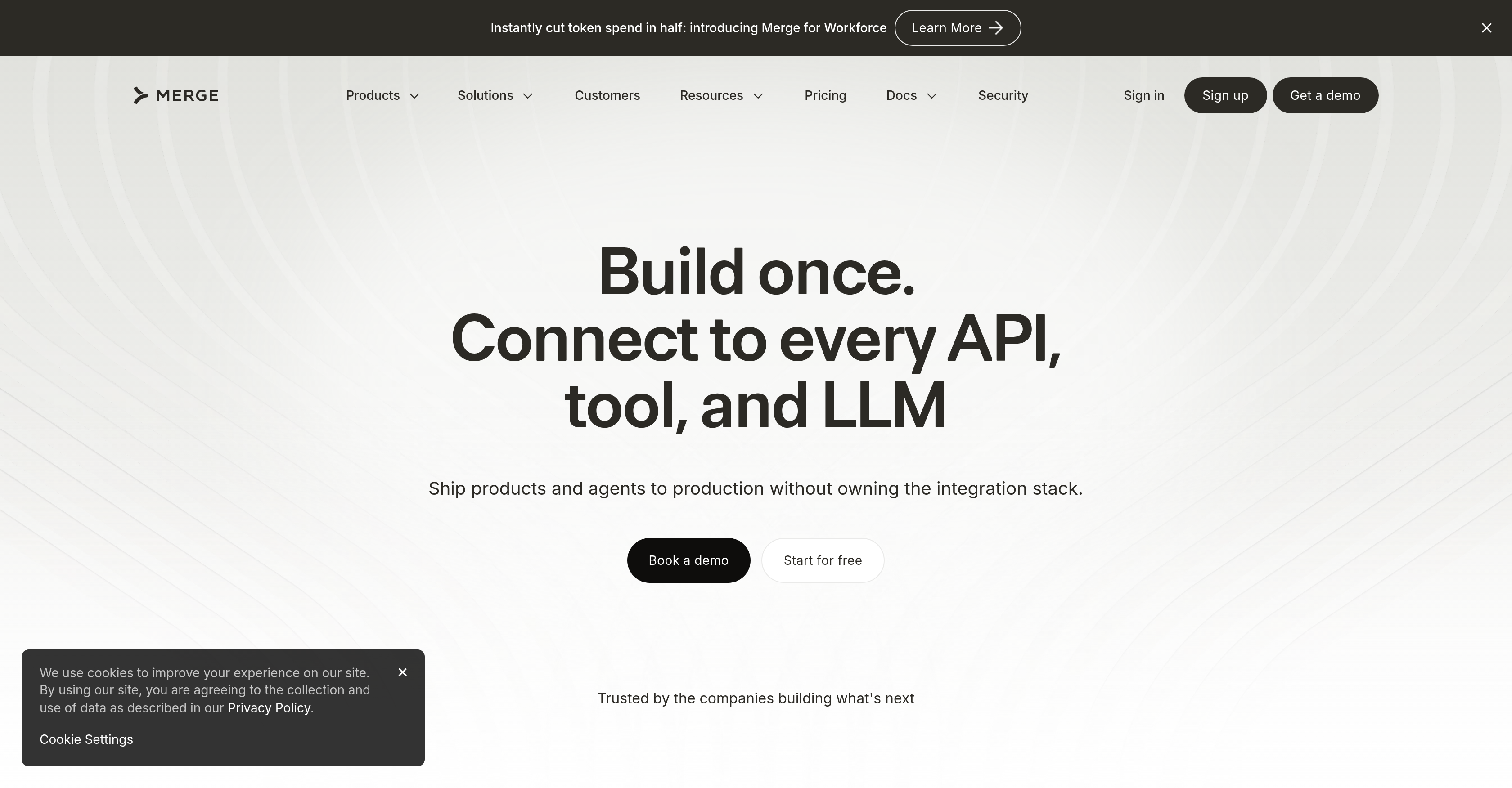
- Ship customer-facing integrations across hundreds of apps without building each connector yourself using a single unified API for data integration.
- Connect AI agents to the tools they already need with the Agent Handler, eliminating custom tool wiring for every new agent deployment.
- Route every LLM request through one API with the Gateway, gaining spend and performance control while keeping products running when providers go down.
- Catch issues before they reach users with AI Observability, which surfaces logs and health monitoring across every synchronization, call, and action in real time.
- Govern employee AI by pushing approved models, setting cost controls, and maintaining audit logs that create a traceable record for compliance and issue resolution.
- Meet enterprise security requirements with SOC 2, HIPAA, and RBAC compliance, scoped permissions, and complete audit logging.
- Keep integrations current without maintenance work through constantly maintained connectors that stay live across your entire app stack.
- Automate onboarding and permission assignment with auto-provisioning, reducing manual steps in HR technology and product workflows.
- Analyze projects and financials with integrated data, tracking, and audit capabilities that surface insights across connected systems.
Pros & Cons
Pros
- Large-scale operations support
- Data integration capabilities
- Customer-facing integrations across apps
- Single API usage
- Agent Handler for numerous tools
- LLM Gateway functionality
- Performance control features
- Observability tool included
- Logs and health monitoring
- Offers push models
- Cost controls available
- Audit logging provision
- Enterprise-grade security compliance
- Real-time monitoring feature
- Constantly maintained connectors
- Sourcing candidates feature
- Project and financial analysis
- Auto-provisioning functions
- Diverse industry usage
- Real-time sync capabilities
- Scoped permissions for agents
- Model routing optimization
- Up-to-date, maintained connectors
- Best-in-class support provision
- Fuel enterprise search
- Enable agents action
- Cut model costs
- Implement auto-provisioning
- Vendor payments reconciliation
- Project status analysis
- Financial analysis features
- Security compliant infrastructure
- ISO 27001, SOC 2, HIPAA compliance
- Scalable integration stack
- Token spend reduction
- Trusted by developers
- Agent Handler functionalities
- LLM performance control
- Data integration Catalog
- React component integration
- knowledge base integration
- Agent authenticated actions
- LLM spend controls
- Automated model request routing
- HR technology optimization
- API management and governance
- Integration Observability tooling
Cons
- No multi-language support
- Doesn't support custom connectors
- Lack of detailed documentation
- Dependence on single API
- Limited tool interoperability
- No free trial offered
- No local/offline mode
- Lack of user customization
- No version control features
- No roll-back option
Reviews
Rate this tool
Loading reviews...
❓ Frequently Asked Questions
Merge.dev features include AI Infrastructure, API Handler, Data Integration, AI Observability, Security Compliance, Real-Time Monitoring, Performance Control, Agent Handler, Audit Logging, Auto-Provisioning, Cost Controls, LLM Gateway, AI Optimization, and AI Governance.
Merge.dev ensures security compliance through enterprise-grade secure measures which include SOC 2, HIPAA, and RBAC compliance standards. It emphasizes scoped permissions and maintains complete audit logs for transparency and security.
Merge's Agent Handler is designed to connect agents to an array of pre-existing tools, facilitating seamless interaction and enhancing operational efficiency.
Yes, with Merge.dev's AI Observability tool, you can monitor logs and the health of your application, ensuring optimal performance and catch potential issues early.
Merge.dev is commonly used in various industries including HR Technology, Financial Services, and Product Development.
Merge.dev's Gateway feature allows for routing every Language Learning Model (LLM) through one API. It provides a single point of integration for all LLMs, ensuring spend and performance control.
Audit Logging in Merge.dev provides transparency for governance and security. It keeps track of all actions and changes, creating a traceable record which can aid in issue resolution and compliance.
Merge.dev aids in AI optimization through model routing. It automatically routes each request to the best model defined by the user, maintaining product functionality even when providers experience downtime.
Merge.dev handles data integration by offering capabilities to unify customer-facing integrations across hundreds of applications using a single API, drastically simplifying the integration process.
Merge.dev can connect to a variety of tools, APIs, and Language Learning Models needed for large-scale operations, making it a versatile platform for different production needs.
While specifics are not outlined, Merge.dev mentions that one of the significant uses of its comprehensive infrastructure includes candidate sourcing, suggesting it provides tools or functionalities that aid in this process.
Yes, Merge.dev offers Real-Time Monitoring. This enables businesses to monitor each synchronization, call, and action as it happens, improving visibility and control.
The specifics of the auto-provisioning process on Merge.dev are not explicitly mentioned. However, auto-provisioning is listed as a use-case, suggesting that Merge.dev provides functionalities to automate the onboarding or permission assignment processes.
Merge.dev can be used for analyzing projects and financials. While specific details are not specified, the ability to track, audit, and integrate data suggests it could provide valuable insights for project and financial analysis.
Yes, Merge.dev offers functionalities for AI Governance. It allows organizations to push approved models, create cost controls, and maintain audit logs to govern internal AI effectively.
Merge.dev offers performance control through its Gateway feature. This feature routes every Language Learning Model through one API, granting organizations control over the AI's performance and expenditure.
Merge.dev can be employed in the HR Technology Industry. The exact use-cases are not spelled out, but with features like data integrations, API Handler, auto-provisioning and more, it can assist in optimizing HR processes.
Yes, Merge.dev has several features beneficial for product developers, including the ability to integrate with a variety of APIs and Language Learning Models, handling data integrations, real-time monitoring, and more.
Merge.dev offers cost controls as part of its internal AI Governance suite. These controls help manage the expenses related to AI tools and models, ensuring cost-effective operation.
Yes, Merge.dev can support integration across hundreds of applications using a single API. It enables customer-facing integrations, simplifying the process and reducing the need for multiple integrations.
Pricing
Pricing model
No Pricing