
Overview
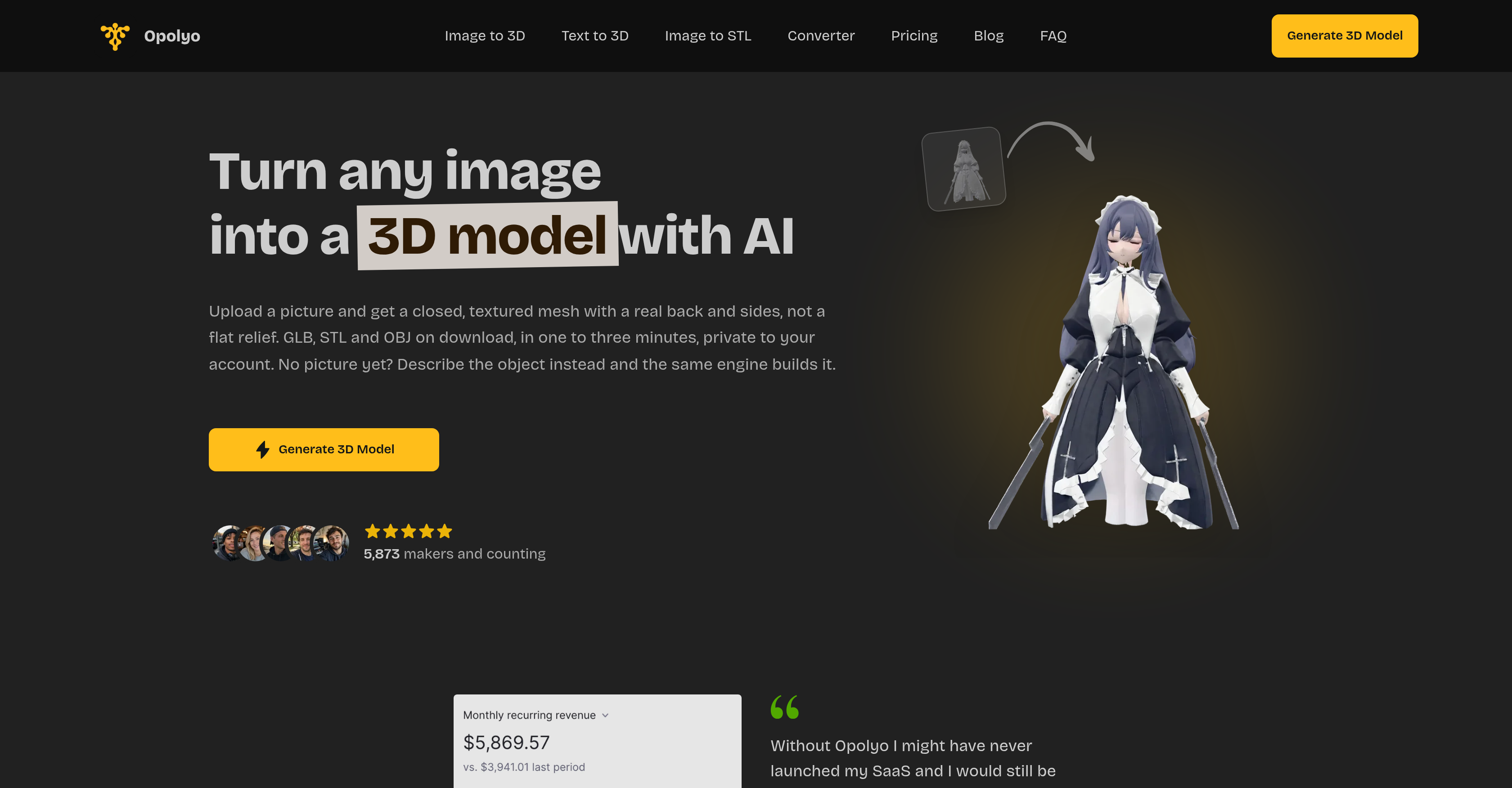
- Turn any image into a fully-formed 3D model with a closed, textured mesh featuring a real back and sides, not a flat relief, using AI processing that converts uploaded photos directly into rotatable 3D objects.
- Describe your idea in text and receive a complete 3D structure in response, using text prompt to 3D model generation that interprets written descriptions and produces the corresponding 3D geometry.
- Print your models immediately on any 3D printer by exporting in STL format, the industry-standard file type widely used for 3D printing purposes.
- Drop your generated models straight into game engines and filmmaking pipelines with FBX conversion and polygon count control, making them game-compatible for real-time use.
- Match any professional workflow by downloading in GLB, STL, or OBJ and converting to FBX or USDZ, covering applications from product design to AR/VR and 3D printing.
- Dial in the exact polygon count you need, from 500 to 2,000,000 faces, before generation begins, so your 3D model fits your target platform without post-processing cleanup.
- Choose between standard and ultra texture quality per generation to control the visual fidelity and file size of every textured 3D model you create.
- Keep every generated model private to your account with no public gallery and no platform ownership claims over your images or 3D models, giving you full control and ownership.
- Customize textures, topology, and faces after generation to fine-tune each 3D model for product design, art and hobby projects, filmmaking, or gaming.
- Upload a picture or write a description, set your model parameters, and download the finished 3D model in your chosen format through a user-friendly interface built for speed.
Pros & Cons
Pros
- Transforms images to 3D models
- Transforms text prompts to 3D
- Creates closed, textured meshes
- Real back and sides
- Multiple model formats
- Conversion to FBX and USDZ
- User-specific private models
- Quality, topology, polygon control
- Extensive customization options
- Used across industries
- Efficient conversion process
- High-quality 3D output
- User-friendly tool
- Customizable output
- Supports GLB, STL, OBJ formats
- Privacy Protection
- Realistic 3D models
- Creates 3D for 3D printing
- Generates models for game designing
- Accepts image or text input
- Supports variety of output formats
- Provides quality control
- Supports control of polygon count
- Broad industry applicability
- Enables control of topology setting
- Highly realistic models generated
- Mesh Generation provided
- Textures offer additional customization
- FBX and USDZ conversion
- Quality of output easily adjustable
- User retains full privacy
- Allows per generation quality adjustment
- Enables triangle or quad topology
- Allows face control from 500 to 2,000,000
- Converts images into textured 3D models
- Sets quality, topology, polygon before running
- Works for product design, art
- Useful for filmmaking, gaming
- Efficient model building
- Generator is private to user's account
- Follows the silhouette in pictures
- Works with any uploaded photograph
- Offers commercial license with paid plans
- Refunds failed credits automatically
- Mesh generation comes with back, sides and depth
- Supports both image to 3D and text to 3D conversion
Cons
- No free or trial version
- Requires GPU time
- Credits expiration system
- No public gallery
- Potential interpretation errors for text
- Picture quality impacts result
- Conversion process might be costly
- Constraints on topology and polygons
- Subscription-based pricing model
- Limitations on file uploading capacity
Reviews
Rate this tool
Loading reviews...
❓ Frequently Asked Questions
Opolyo supports various formats for 3D model generation including GLB, STL, and OBJ. Additionally, it offers the capability of conversion to FBX and USDZ formats.
Yes, Opolyo ensures user privacy. Every generated model is private to the user's account and the platform claims no ownership of user's images or models.
Yes, Opolyo allows users to customize the quality and topology of the resulting 3D model. Users have control to set these parameters before model generation.
Various industries like product design, art and hobby, filmmaking, and gaming where 3D representation is required can benefit greatly from using Opolyo.
Yes, with Opolyo, users can turn any image into a 3D model. Opolyo uses AI processing to convert uploaded images into textured, closed mesh 3D models.
Opolyo processes text prompts into 3D models by interpreting the given description and generating a 3D structure in response.
Yes, Opolyo can be very useful for 3D printing. It supports the STL format which is widely used for 3D printing purposes.
Yes, Opolyo allows a range of customization options, including modifying the textures, topology, and faces of the generated 3D models.
Opolyo ensures realistic model generation with its AI processing capabilities that take into account textures and topology when creating models. This means the resulting models are not just simple reliefs but full-bodied objects with back and sides.
Yes, Opolyo supports multiple formats. The AI tool generates models in GLB, STL, and OBJ, and offers conversions to FBX and USDZ formats.
Opolyo handles mesh generation by creating a closed, textured mesh with a real back and sides, creating a robust and realistic 3D model and not just a flat relief.
Yes, Opolyo allows users to control the polygon count of the generated 3D models. The polygon count can be anywhere from 500 to 2,000,000 faces.
Opolyo supports both standard and ultra texture quality, allowing users to choose the texture quality per generation.
Opolyo offers a user-friendly interface and process. It allows easy uploading of pictures or writing of descriptions, setting model parameters and downloading the resulting 3D models in various supported formats.
Yes, beyond generating models in GLB, STL, and OBJ formats, Opolyo also includes the capability of converting these models into FBX and USDZ formats.
Yes, Opolyo provides robust privacy protection. Every generated model belongs to the user's account and there is no public gallery hence users have full control and ownership of their models.
Yes, Opolyo supports game design. The created 3D models can be easily used in game engines and Opolyo also allows polygon count control and conversion to game-compatible formats like FBX.
Yes, Opolyo does support the transformation of textual prompts into 3D models. Users can write a description which is then processed by the AI to generate a 3D model.
Yes, Opolyo transforms photos into 3D models using AI processing. Users upload a photo and Opolyo's AI generates a 3D model from it.
Opolyo ensures quality 3D representation by using an AI-backed process that carefully considers the shape, texture, and topology of the model. This leads to the creation of high-quality, closed, textured 3D models that are fully-rotatable and not simple reliefs.
Pricing
Pricing model
Paid
Paid options from
$16/month
Billing frequency
Monthly