
Overview
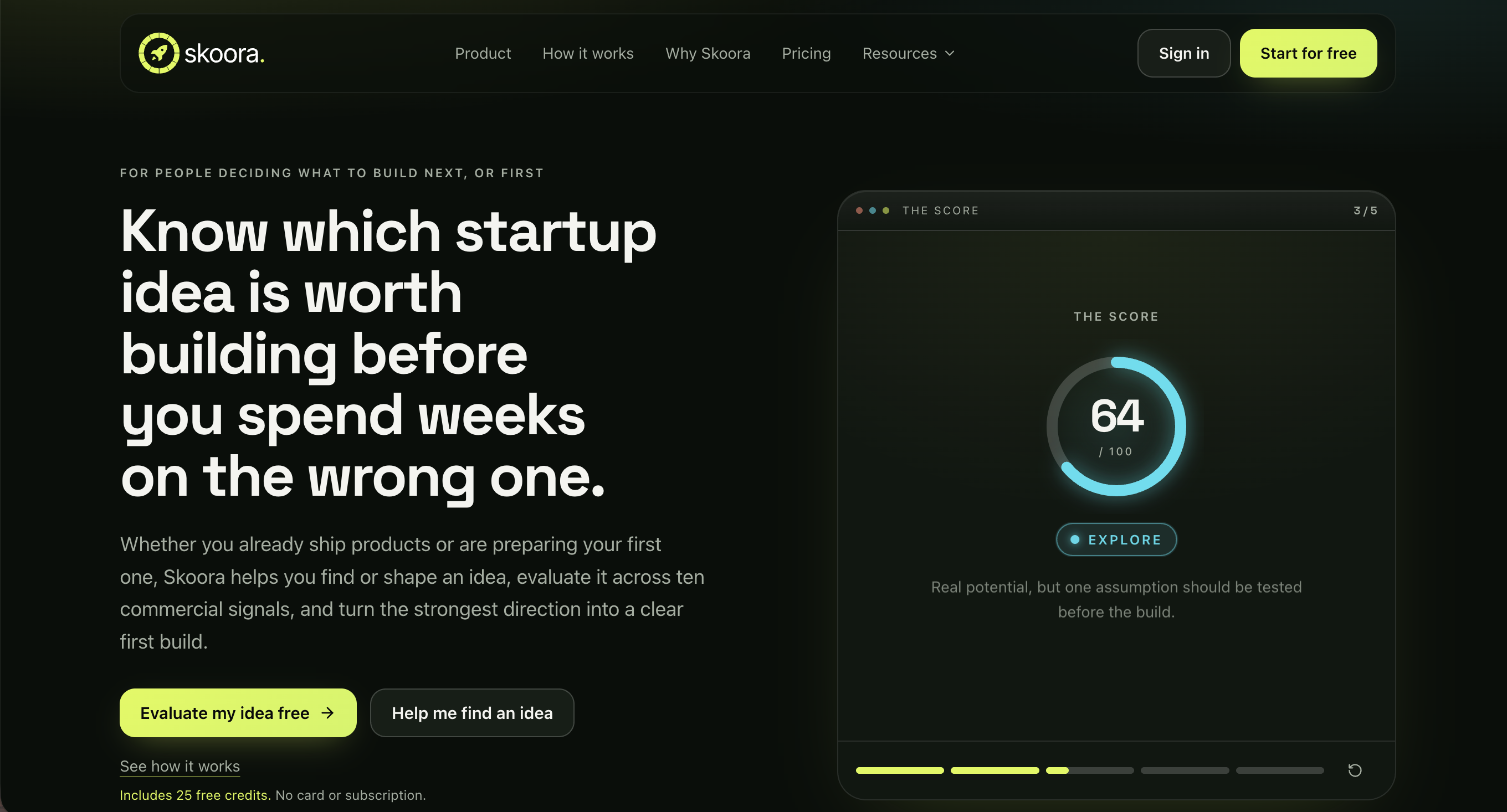
- Avoid sinking weeks into an idea that was never commercially viable by running it through a structured evaluation across ten commercial signals before you write a single line of code
- Know exactly whether to commit, test, or walk away with a Build, Explore, or Skip score that pairs every verdict with a clear, specific next step
- See precisely where your idea breaks before the market tells you, with each of the ten commercial signals explained alongside its confidence level, weak assumptions, risks, and failure modes
- Get a complete picture of your idea's commercial shape without writing a business plan, covering strengths, weak points, ideal customer, value mechanism, competition, pricing, MVP scope, and validation
- Move straight from verdict to execution with a marketing plan, sales strategy, finance model, and recommended tool stack generated from the same context as your evaluation
- Skip the blank page and generate startup ideas tailored to your own background and interests when you have nothing to evaluate yet
- Turn your validated idea into a working product faster with a build-ready prompt you can drop directly into Lovable, Cursor, Bolt, or Replit
- Start evaluating startup ideas immediately with 25 free credits on signup, no card required, and pay only for the ideas you actually assess through usage-based credits with no subscription
Pros & Cons
Pros
- Evaluates startup ideas
- Provides venture analysis
- Assists with idea screening
- Offers startup valuation
- Supports entrepreneurship
- Helps with business intelligence
- Assesses business ideas
- Aids in risk management
- Performs feasibility analysis
- Assists in business planning
- Provides predictive analytics
- Supports investment decisions
- Helps manage innovation
- Generates ideas based on user's interests
- Scoring system for idea evaluation
- Supports informed decision-making
- Identifies weak assumptions
- Free idea evaluation
- Explains score and next step
- Detects assumption-based risks
- Measures demand and market potential
- Evaluates competition risk
- Assesses Go-to-Market strategy
- Delivers clear execution path
- Offers three strategic outcomes- Build, Explore, Skip
- Provides concrete customer profiles
- Describes ideas value mechanism
- Offers marketing plan
- Supplies sales strategy
- Proposes finance plan
- Recommends relevant tools
- Generates build-ready prompts
- Shares improvement steps for weak signals
- User-based credit system
- Details reason behind 'Skip' status
- Privacy for user's ideas
- Start free without subscription
- No pitch deck required
- No business plan required
- No technical vocabulary required
- Operates with plain language
- 10 consistent commercial signals
- Framework comparability across ideas
- Exposes weak points and risks
- Specific idea strengths identification
- Identifies potential growth path
- Evaluates ease of use
- Checks for continuous value potential
- Provides validation steps for each decision
- Offers full report for each idea
- Compares new ideas to previous ones
- Generates answers to users questions
Cons
- No API
- No mobile app
- Requires credit purchase
- No multi-user support
- Not open-source
- Limited language support
- No offline availability
- No third-party integration
- No real-time collaboration
Reviews
Rate this tool
Loading reviews...
❓ Frequently Asked Questions
Skoora is an AI-powered tool designed specifically for startups to evaluate, score, and select their startup ideas. It helps entrepreneurs understand which ideas are worth pursuing before they begin building any product. Skoora does this by evaluating startup ideas across ten commercial signals and provides a Build, Explore, or Skip score with clear next steps.
Skoora operates in three principal steps. In the Intake phase, users describe their idea. Skoora checks the context and asks for additional clarification if needed. The idea then undergoes Evaluation where it is scored across ten commercial performance indicators with each being explained and assigned a confidence level. The outcome of this process is then decided; the user gets one of three outcomes - Build, Explore, or Skip along with specific validation steps and a full report.
Skoora's purpose is to assist startup entrepreneurs to decide what products or services they should build next or first. It evaluates startup ideas based on ten commercial signals and provides clear steps on what to build before the actual development begins. This helps entrepreneurs avoid wasting time and resources on ideas that may not be commercially viable.
Skoora is specifically designed to evaluate startup ideas, especially in the context of entrepreneurship and business. While it's not explicitly mentioned that it can evaluate 'any' type of idea, it is fair to infer that Skoora's capabilities are best used for startup, entrepreneurship, and business-related ideas. It uses certain factors such as demand, business potential, and go-to-market to evaluate these ideas.
Skoora evaluates startup ideas using ten commercial signals. These signals assess the market demand, which considers if anyone is actively searching for the solution being proposed, willingness to pay, and continuous value. It also considers the business potential, exploring various characteristics such as subscription potential, gross margin potential, competition risk, and scalability. Finally, it checks strategy on how best to reach the market and deliver the product or service - going-to-market strategy, ease of use, and setup required.
After evaluating startup ideas, Skoora gives a 'Build, Explore, or Skip' score. A 'Build' score (70-100) suggests that the commercial shape is strong enough to justify moving forward. An 'Explore' score (50-69) demonstrates real potential but also identifies that an important assumption needs to be tested first. A 'Skip' score (0-49) implies that the present version doesn't justify the time or the execution risk and suggests to move to the next idea.
Skoora aids risk management in startups by evaluating startup ideas across various commercial signals before committing significant resources to it. Detailed evaluation helps identify weak assumptions, points of failure, and risks. It provides a score and recommendation - Build, Explore, or Skip - thus aiding in managing the risks associated with pursuing a particular startup idea.
Skoora does not provide business valuation in monetary terms. However, it evaluates the commercial viability and potential of a business idea through its in-depth analysis which aids in understanding the hypothetical worth of a business idea.
Through its evaluation process, Skoora aids in venture analysis. It assesses startup ideas across ten commercial signals covering aspects such as demand, business potential, and go-to-market strategies, highlighting weak assumptions and the weakest signal that needs validation. This comprehensive evaluation helps entrepreneurs better understand the viability and the associated risks in their venture.
Yes, Skoora can help someone without a startup idea. Skoora's 'Discover' feature generates ideas customized to the user's background and interests.
Skoora predicts the feasibility of a startup idea through its evaluation process that scores the idea against ten commercial signals. These signals cover aspects like demand, business potential, and go-to-market strategies. The assessment exposes weak points, risks, failure modes and provides an outcome of Build, Explore, or Skip, thus offering insights into the feasibility of the idea.
Skoora does not provide a complete business plan. However, it does provide important elements that could go into a business plan. It provides a full report detailing strengths, weak points, ideal customer profile, competition, go-to-market strategy, MVP scope, pricing, and more, which equips entrepreneurs to build a comprehensive business plan better.
Skoora aids in investment decisions by providing robust evaluations of startup ideas. The scoring system and the resulting recommendation of Build, Explore, or Skip, can guide investment actions. Also, the comprehensive evaluation report and the subsequent execution plans it provides, contribute valuable insights that can be crucial to investment decisions.
Skoora operates on a usage-based credits system. Instead of a subscription model, users purchase a pack of credits and spend them when evaluating an idea. The specific cost of credits is not available in the provided content.
The credit system in Skoora works as a pay-per-use model. Users buy a pack of credits, which are then consumed when evaluating an idea. These credits stay in the user's account until they use them, indicating that they do not have an expiration date.
The privacy of user data on Skoora is not specified in the provided content. It's recommended to check Skoora's privacy policy for specific details concerning data privacy and protection.
Yes, Skoora can help users find a startup idea. Its 'Discover' feature generates ideas tailored to the background and interests of the user.
While 'predictive analytics' isn't explicitly mentioned in Skoora's description, it could be inferred that its evaluation process involves some form of predictive analysis. By examining ten commercial signals and providing outcomes (Build, Explore, Skip), Skoora essentially predicts the likelihood of success for a startup idea.
Yes, Skoora offers resources and guides aimed at startups. It provides practical guides for evaluating, scoring, and choosing startup ideas. It also hosts shorter articles on deciding what deserves to be built.
Skoora, ChatGPT, and Claude are AI tools but cater to different needs. While Skoora is designed to evaluate startup ideas and provide guidance on what to build before actual development begins, ChatGPT is generally used for generating human-like text. Claude appears to be a coding tool but without specific information, it's difficult to compare its functions with Skoora. Details of how Skoora compares specifically to ChatGPT and Claude are not provided in the given content.
Pricing
Pricing model
Free Trial
Paid options from
$15/unit
Billing frequency
Pay-as-you-go