Overview
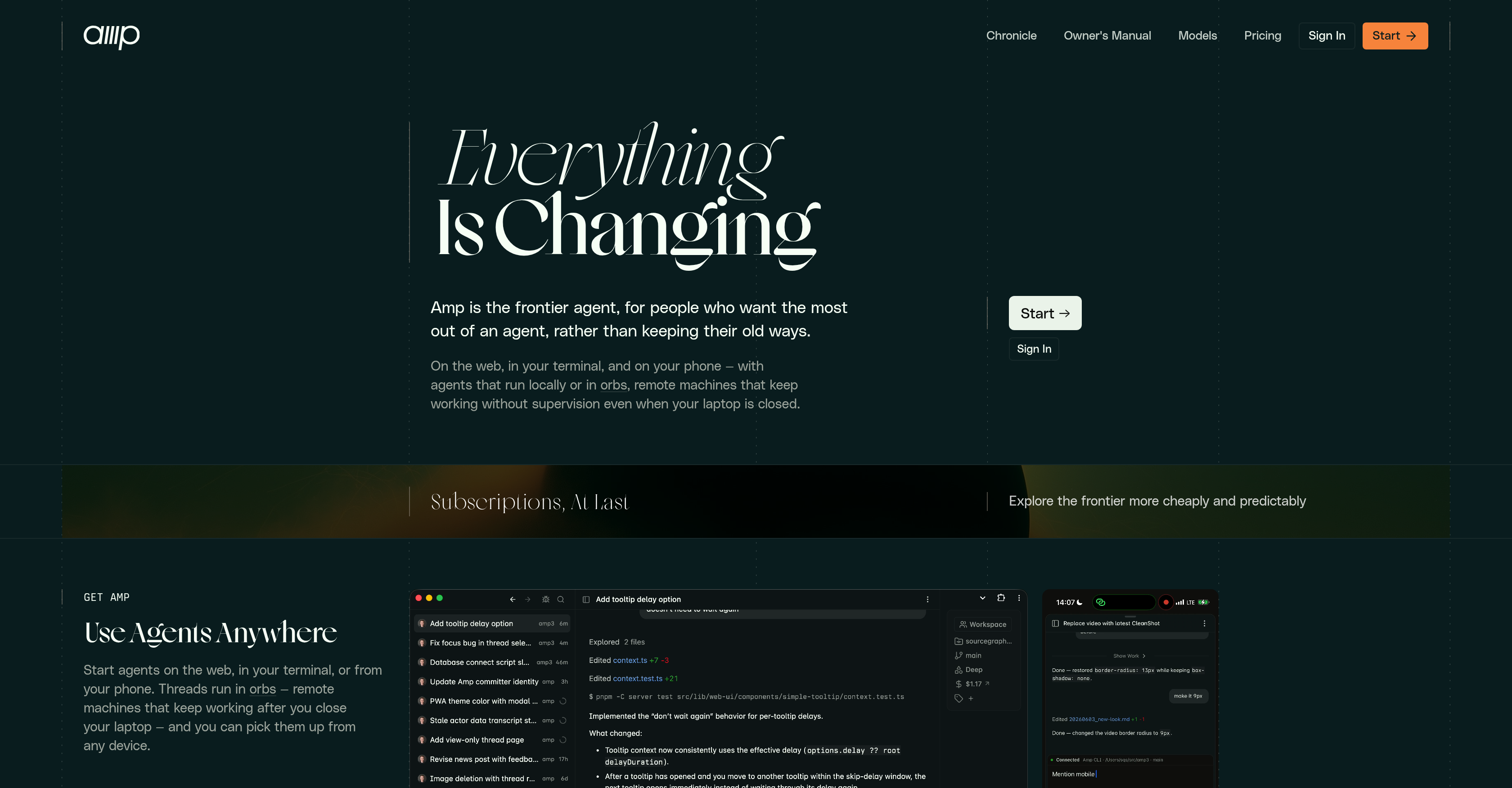
- Keep complex coding tasks running unattended even after you close your laptop by dispatching agents to remote orbs that operate without supervision.
- Pick up exactly where you left off from any device—web, terminal, or mobile—so your workflow never stalls when you switch contexts.
- Process videos, logs, PDFs, and datasets in the same platform where your agents run, eliminating the need to switch between separate file-handling tools.
- Maintain full responsiveness during long agent runs with large threads, so team-wide operations stay smooth even under heavy load.
- Standardize team policies and add custom tools through a plugin system that adapts the platform to your workspace requirements without custom development.
- Avoid tool obsolescence as models evolve, because the platform continuously drops outdated features and adopts new model capabilities automatically.
Pros & Cons
Pros
- Advanced coding platform
- Versatile usage
- Web, terminal, mobile compatible
- Autonomous operation on 'orbs'
- Unmonitored task continuation
- Easily switch between devices
- Continuous evolution and adaptation
- Responsive during extensive runs
- Excellent with large threads
- Plugin support and customization
- Supports policy standardization
- Handles a wide range of files
- Effective video processing
- Effective log processing
- Effective data processing
- Effective PDF processing
- Consistently eliminates unproductive features
- Focus on beneficial features
- Improves old workflows
- Innovation and versatility focus
- Uninterrupted agent runs
- Effective remote operation
- Agents can run locally
- Allows use of latest models
- Highly extensible
- Standardized policy support
- Can effectively process datasets
- Supports workflow optimization
- Supports customization
- Adoptive learning and development
- Performance oriented
- Can handle extensive threads
- Policy standardization support
- Works with diverse file formats
- Supports video, log, PDF and data processing
- Feature elimination for effective performance
- Able to maintain responsiveness
- Supports plugin for extended features
- Event hooking through plugins
- Works with remote machines
- Ability to pick up work anywhere
- ARCH: cross device compatibility
- Remote operating capability
- Standardizes policies among teams
- Supports effective file handling
- Offers plugin adaptability for workspace
- Eliminates stale assumptions
- Processes and handles large files
- Supports banking technology needs
- Scheduled agent operations
- Interactive multi-agent control
Cons
- Eliminates old workflows quickly
- Possible over-reliance on agents
- Can eliminate useful features
- Continuous development might disrupt work
- Requires multiple device setup
- No control over remote 'orbs'
- Potential data security concerns
- Plugin compatibility issues
- Limited to certain file types
- Unclear customer support options
Reviews
Rate this tool
Loading reviews...
❓ Frequently Asked Questions
Amp's main purpose is to function as an advanced coding agent platform. It is designed to enable users to fully utilize leading models, effortlessly handle tasks across various devices; be it web, terminal or mobile devices, and perform these tasks either locally or on remote machines called 'orbs'.
Amp utilizes agents that can run tasks either locally or on 'orbs', which are remote machines. These machines can operate with little to no supervision, even if the controlling device is powered off. This allows tasks to be executed without constant monitoring.
Amp offers cross-device compatibility. Users can operate Amp from the web, in their terminal, or on their mobile devices, allowing them to access and manage tasks from multiple devices.
Amp is designed to adapt and evolve with changing models. It is committed to continuous innovation and development, reshaping itself as models develop and change, thereby eliminating old workflows and stale assumptions.
Amp offers plugin support, allowing users to customize its features. The plugins plugin into events, add tools, standardize policies, and more, effectively enhancing Amp's extensibility and adaptability to meet unique workspace requirements.
Yes, Amp can process different file types like videos, logs, PDFs, datasets, and more. Its functionality has been designed to work with a wide range of files, adding to efficient processing and handling of data.
Amp optimizes workflows by staying adaptive and constantly evolving with the development of new models. It eliminates old workflows and stale assumptions to stay up-to-date with evolving dynamics. Furthermore, its feature of running agents locally or on orbs allows for uninterrupted task execution even when the controlling device is powered off.
Amp effectively handles large scale data processing. It is designed to remain responsive during extensive agent runs, making it suitable for managing large threads. It can also handle a wide variety of file types including datasets.
Amp improves performance optimization by staying responsive even during long and extensive agent runs. It is capable of handling large threads that teams are currently grappling with, making it efficient and resilient in its performance.
Policy standardization in Amp works via plugins. These plugins allow the integration of standardized policies, enhancing the adaptability of Amp to specific workspace requirements.
Cross-device compatibility in Amp enables users to pick up their work from any device they want. It functions on the web, in terminals and on mobile devices, giving users the flexibility to manage their tasks from multiple devices with ease.
Amp is capable of running tasks on orbs, which are remote machines that continue operating even after the controlling device is powered off. This means the tasks carried out by Amp won't be hindered by the power status of the controlling device.
Amp ensures that it stays responsive during extensive agent runs by tuning its system for high performance. It is particularly developed to remain efficient and responsive even during the largest threads teams are working with today.
Continuous development and innovation are central to Amp's operation. It constantly adapts and evolves based on the development of models, getting rid of old workflows and assumptions that no longer serve a purpose, and continuously introduces beneficial features.
Orbs in Amp are remote machines that continue working even after the controlling device is powered off. They enable tasks to be executed without the need for constant monitoring, enhancing efficiency and helping to save user time and effort.
Amp can be extended or adapted to workspace needs through its plugin system. These plugins can be used to add tools, standardize policies, hook into events and more, thereby enhancing the system's adaptability and extensibility.
Amp abides by a principle of feature utility. If a feature is not pulling its weight or contributing productively to the system, it will be eliminated. This ensures that only beneficial and functional features are retained and resources are not wasted.
Yes, Amp is designed to work without constant monitoring. Tasks are run locally or on orbs, remote machines that continue to operate even after the controlling device is powered off, thereby allowing tasks to proceed without the need for constant supervision.
Amp is capable of handling large threads that teams are dealing with. It is engineered to stay responsive and efficient during long and extensive agent runs, making it well-suited for tasks that involve large volume of data or threads.
Amp enhances extensibility and versatility through its plugin system. Through plugins, users can customize Amp by adding tools, standardizing policies, and integrating into events, among others. Moreover, it's adaptable to evolving models, capable of working on various devices, and able to handle a wide range of file types.
Pricing
Pricing model
Paid
Paid options from
$20/month
Billing frequency
Monthly